
TRANSCENDENTAL
CALVINISM
Note 2, page 96, The Hermetic Tradition, Julius Evola
What, if anything, remains of the meaning of Calvinism and Reformation theology, in the modern arena and world, after all these years? Gutted, as it were, by its own practitioners, whether hard-shell Baptists or so called emergent theologians, it has submitted basely to the wisdom, practice, and interpretation of the very world into which it had entered as a sharp and stunning rebuke. I have come across a few faithful Reformed men over the years, who sprang from the old stock, and can honestly say that had they ruled in the dark days of decision, things may have gone differently with the post-Puritanical West. Alas, modern Calvinism appears drawn to the secular world as a moth to the flame, and everywhere it has dominated, it has left behind a spiritual vacuum rapidly filled with atheism or liberalism, if not revolution.I wrote an older article about this, but it's been awhile.
Let us explore what may be done with the Reformation, even at this last gasp, the flickering flame of the dying West, before it succumbs to delusions of perfect earthlyutopia embodied in the Progressive Movement (Revolution). The Reformation began, not out of issues (which provided a mere pretext, and were ongoing) but a movement of the northern Germanic peoples. It was Luther's trip to Rome in 1511 which guaranteed that the Teutonic races would vomit up Catholicism and the Baroque.
The
city, which he had greeted as holy, was a sink of iniquity; its very
priests were openly infidel, and scoffed at the services they
performed; the papal courtiers were men of the most shameless lives;
he was accustomed to repeat the Italian proverb, “If there is a
hell, Rome is built over it.”
(T. M. Lindsay, Luther
and
the
German
Reformation
(Edinburgh: T. and T. Clark, 1900), p. 44, cited on
http://martinluther.ccws.org/footnotes/index.html#11
6-16-2017
Convinced (as we are) that
Luther had some fundamental misunderstandings about Catholic
doctrine, it is still true to say that the Roman Catholic Latin
Church had doubled down on its particular and exclusive heritage,
neglecting to preserve a strong stream of spiritual influence capable
of drawing in the lately converted Northern spheres of influence (the
Prussians were heathens as late as the 13th
century), not to mention becoming increasingly juridical and
“exoteric” in its doctrines and practices, as witnessed by
indulgences and the cult of relics. If someone in 1500 had been told
that in thirty years, all of Europe would be in flames in a religious
civil war, even the most sanguine might have had pause or the most
melancholic laughed out loud.The story of Europe's nightmare descent is incredibly complex, and we refer the reader to such works as Charles Williams' The Descent of the Dove, for example, in defending the “sins” of the Catholic Church: “Some sins do bear their privilege on earth” (Philip the bastard, in Shakespeare's King John). Or perhaps The Stripping of the Altars, by Eamon Duffy, or anything written concerning the iconoclasm in the Low Countries, or Peter Brown's work on the cult of the saints, in order to gain a rational perspective on indulgences, popular Catholicism, and relics. Whether or not the popes killed the medieval world order, it was certainly in a lot of trouble when Luther came along, and there are no shortage of villains to blame: Francis Bacon, Duns Scotus or William of Ockham, Jean Buridan and Rene Descartes, Rousseau...the list could go on and on. Owen Barfield (and by extension Rudolf Steiner) in fact argue that the Reformation and the modern scientific revolution is a necessary step in the necessary de-sacralizing of the world, which (surprisingly), is destined for re-sacralization at the hands of a conscious spiritual elite (see the works of Boris Mouravieff, in Gnosis).
This movement to despiritualize the universe and collapse it into a fideistic “Reformation” with an “Islamic” character of civilization was occuring as part of a broad upswelling of humanity's soul in Europe, even outside the Northern European perimeter, and involved general laws of a deep complexity and scope which can be observed (see Oswald Spenger or Toynbee) in other world-civilizations, such as the Magian civilization in Arabia or the ancient Chinese civilization also. To seek to blame one particular man or sect is futile and counter-productive. What we want to do is understand what was at work behind the field of force in history, and discern what to do next.
Although this will be quick and skimming, it is hoped the reader can follow up any rabbit trails deemed important to him or herself. To sum up, Jean Calvin placed all the responsibility and glory upon God alone (thus denying the theomorphic nature and mediatorial aspect of primordial man), while Luther's emphasis on faith tended to obscure the necessity for individual struggle and effort (also on the human side). It was not so much what they taught, as what they did not, and where the tendencies of what they did get right, would lead, at that historical moment. Together, however legitimate in spiritual truth, these two tendencies added up to placing man in a highly negative and disadvantageous position versus the new secular tendencies emerging, which tended to isolate and physicalize man to such a degree that the only kind of God conceivable was a rationalistic watch-maker operating as a first cause, a kind of absentee Deist Omnipotence who left Creation without Love, magic, or any active Providence. If God is restlessly ordering in some kind of abstract and almost dementia-like manner, every fact in the universe, then if everything is important, nothing is, because hierarchy is absent. If hierarchy and mediation (human, divine, or otherwise) is absent, then rationalism quickly fills the vacuum: a world of magic and dark gods is far more likely to be converted than a clockwork world which operates like a machine – men who sacrificed to Odin could believe in Baldur re-born, but men who conceive of the world as empty space and dead matter find no meaning in the Cross. A world with no magic and no centers of conscious in higher tutelary powers (see the epistle of Galatians) is not a world in which the Incarnate Logos can make any sense, except in some kind of diminishing private sense with no public relevance or spiritual power. Look around you to see how that went.
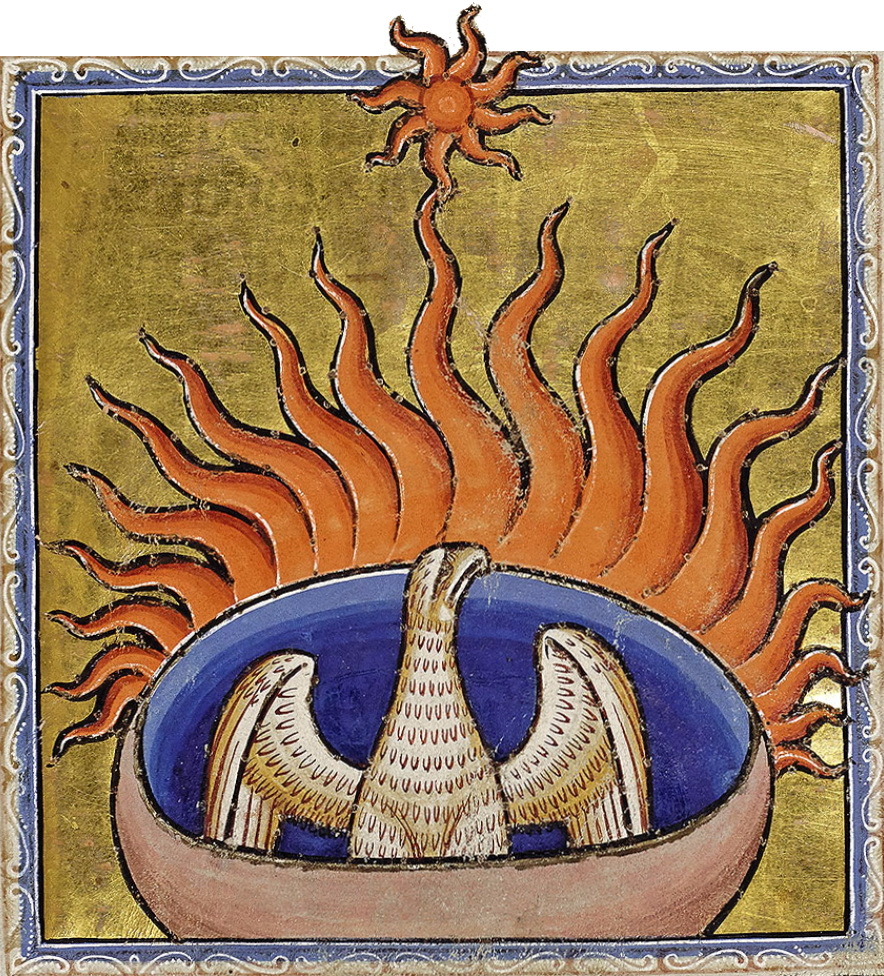
The medieval world struggled (for instance) with witchcraft, and how to make sense out of it, because it believed in the subtle, non-physical universe. When you look at a flat medieval picture, you are (in a real sense) not looking at a child's drawing, but a spiritual portrait of how they actually experienced (and could not help but experience) the world around them. Those Books of Hours, the Book of Kells, the ancient manuscripts – all testify that medieval man felt at least, and sometimes actually saw, numinous power peering through the world at them. They felt it because they were more perceptive than we are, and had more of their higher emotional centers and even intellectual centers intact, no matter how undeveloped their lower intellectual centers may have been.
Luther himself used to pick up the crumbs of the Eucharist off the floor, because it was Christ's body. Even Jean Calvin touches upon theomorphism in his opening to the Institutes (would that he had remembered it!):
Our
wisdom, in so far as it ought to be deemed true and solid Wisdom,
consists almost entirely of two parts: the knowledge of God and of
ourselves. But as these are connected together by many ties, it is
not easy to determine which of the two precedes and gives birth to
the other.
Calvin went on to
all-too-easily solve this dilemma in favor of a very voluntaristic
image of God Almighty, who did not move the stars and hearts through
Omnipotent Love, but through sheer restless and arbitrary power.
However, his instinct was correct: man is the microcosm of the
universe. The universe itself, is man writ large. And if Christianity
is even remotely true, the destiny of both are tied together through
the first born of them all: Christ Jesus the Pantocrator.
He
who is the image of the invisible God,
Firstborn
before all creation,
because
in Him all things were created —
things
in heaven and things on earth,
things
visible and invisible,
whether
thrones or dominions,
whether
principalities or powers —
they
have all been created through Him and
for Him
We are living through
the re-creation of the Cosmos, in Christ, and it matters how we
think, what we think, and why we think. As Owen Barfield noted in his
many writings, it makes a difference what images the poet and the
artist or thinker conjures before his mind, and what thoughts we
allow to root inside our head, since man is not merely the measure of
all things in Christ, but has the power to share in re-making a new
world after the image of the Logos, discerned in Love, through the
power of the Holy Spirit, in this final Age.
The Reformation, then, is what we make of it (provided we keep an eye on “the iron clad laws of history”). Will we allow a too-strict concern with rules and traditions of men to determine how we interpret Luther and Calvin, damning us to go down the road of secularization and finally nihilism, or will we (like bees) take the pollen from what they have to offer and make a honey to cure the wounds which idolators have caused in the world? John Milton once said “the Reformation must be Reformed”. How might one go about doing this?
In the first place, there are a great many wonderful Reformational legacies, too numerous to name in detail: the practicing Protestant who is devout can no doubt name many of these. Just as important are the spiritual-theological threads we find among the Reformational faithful, for example in Hermann Dooyeweerd. He is by no means the only one (we could cite several “mystical” Protestant authors by specific passage, including William Law and Jacob Boehme), but interests us as a specifically theological interpreter of the “possibilities”.
Dooyeweerd touches upon the very topic which interests us: that our imagination is a gateway to the stirrings of the Holy Spirit, and provide clues about our future spiritual destiny, which is rooted in a primordial Being and will return with what we harvested in the prime material plane of our own histories.
Dooyeweerd’s
understanding
of perception is one of his most astounding ways of overcoming
dualism. He rejects the empirical and phenomenological assumptions of
a dualism between an independent observing subject and an independent
object. Our
experience is not of independent things, but of “individuality
structures”
that depend on man for their full realization and individuality. And
the process of perception is a subject-object relation that occurs
within the modal aspects of temporal reality, in a nondual act of
perception....Dooyeweerd’s
ideas on imagination emphasize the importance of seeing and
intuitively imaging God, self and cosmos in a different way. In
Dooyeweerd’s words, when our heart is opened to the transcendent
reality, we see things as they really are.
The transcendent light of eternity then shines through, illuminating
even the trivial in our lives. Our theory itself becomes an act of
worship, where we ascend from sphere to sphere, until we are left in
apophatic wonder. But along the way, we help to redeem the sparks of
God within his creation. For if temporal reality fell because of
humanity, it is only through redeemed humanity that the world will be
redeemed. Our imagination is an act that proceeds from out of our
supratemporal selfhood. It is expressed within time, both within the
temporal functions of our body or mantle of functions, and in the
world outside of our body. We are simultaneously supratemporal and
temporal beings. There is therefore a need to relate our
supratemporal selfhood to our temporal functions. This relation
between inner and outer is given by our intuition, both
(pre-theoretical and theoretical). Imagination is an inner,
intentional act, in which we form images. Our imagination is more
than just fantasy, disconnected to reality. Rather , in imagination,
we seek the “figure” within temporal reality. This is an
anticipation of what reality may become, but which is presently only
a potential reality. In finding the figure within reality, and in
realizing it, we form history and fulfill the reality of temporal
structures.”
https://jgfriesen.files.wordpress.com/2016/12/imagination.pdf
Accessed 6-15-2017
If
I am reading Van Friesen on Dooyeweerd correctly, our intuition,
specifically our imagination, is a potential higher link to higher
emotional centers, which whisper to us of what the world-to-come is,
and invite our participation. To use Charles William's language, it
speaks to us of how we may be privileged to begin to “co-inhere”
in the Co-Inherence web that already exists, established through the
Love of the Absolute, expressed in the Incarnation of the Second
Person of the Trinity.
So that this is the very project which the Inklings
(Lewis, Barfield, Williams, Tolkien) had engaged in: making a
sub-creation out of the material world, which would be “baptized”
and help to lead modern man back to the unutterable and quiet and
homely mysteries of “the deeper Law”. It is the “pearl” of
great price, spun inside the oyster shell of our short time here.
Instead of seeing ourselves at odds with Rome and Constantinople, faithful Protestants should joyfully insist on hanging on to what they have gathered in their “fall” from grace, and re-uniting it with the fullness of the glory of God. This, after all, is exactly the boat we are all in since the fall from grace in Adam & Eve anyway.
I propose a new term for an old movement in the Faith: Transcendental Calvinism.
To return to the quote that introduced the essay, we will note that Calvinism, rightly understood, clears the ground for a re-valuation of man's being in light of God's free choice and high calling, which is to summon knights and their ladies from the dead bones and stones of the world, in free grace, surely, but also in all possible help and aid, prevenient or ex opere operato or otherwise, to create and restore a Free Will in man that was once there, in the Beginning. Calvinism, if embraced existentially, rather than aesthetically or ontologically, will burn down the weeds in the garden of the heart, and make things ready for the rain. Calvinism is a kind of short hand, which is true as a short hand, and therefore, quite readily, as an existential stance and response to its own temporary nihilism, which holds the believer in a kind of terrible but blessed tension and readiness, awaiting the legitimate return of the Lord, whether in the physical death and post-mortem state of the believer, or in this life, if spiritual sight should return in time. We believe that this is faithful to the intent, if not the letter, of the best of what Jean Calvin wrote. Thus we can define useful and true Calvinism as a kind of deliberately temporary Christian existentialism, designed to let the user function in a desacralized world for a period of time, provided that they are consciously seeking to phase out a fully literal Calvinism by (this is important) fleshing out what is inherently true in Calvinism at a literal level.
Dooyeweerd also advocates (in his theological writings, in which he developed Kuyper's idea of sphere sovereignty) a kind of spiritual “multiplicity in unity”. This is consistent with a perichoretic understanding of what the inner meaning of the Trinity's Love is. Although Dooyeweerd applied this to different “spheres” of law (eg., family, church, local community), we can put our point in his language and terms: God's grace and free sovereignty does not destroy man's sphere, but rather perfects it (Dooyeweerd would not, in fairness, acquiesce entirely to this, as he would regard the analogy as misplaced and medieval, but whether he recognizes it or not, it is the same analogy). Even the Westminster Confession confesses that God as first cause establishes, rather than destroying, the secondary cause of man's free will (this, of course, is the same medieval “Grace perfects Nature” analogy which Dooyeweerd rejects or thinks he rejects in a different context, but Dooyeweerd can be forgiven for believing that post WWII Holland would continue to have the sphere-sovereignty of its Christian bones, rather than succumbing to the Enlightenment's monadism of One Secular World). God's sphere of influence at the higher level is mediated through to us in a web of co-inherences, which (frankly) it is possible only to delineate in general outline or possibility, as they are actually experienced, or known theologically through the repository of the Church's doctrine and speculative “imaginings”. This web begins and ends in Christ Jesus, of whom not all the books in the cosmos (as Saint John put it), could hold all that could (and will) be written.
God and man are polar beings, of a special sort. God is the “Self Beyond the Self” (contra Eastern mysticism). The sovereignty of a God who moves (as Dante said) the stars with Love does not destroy the free will of man's heart, who is eternally allured and tempted into following the calling to join freely with Love in re-creating the fallen Universe. Since man in his fallen state is immeasurably distant from that Love (in a sense), and yet still united with it, he finds himself existentially riven. This Anfechtung is precisely what Luther described psychologically in his legitimate experience of saving faith, and what Calvin is at pains to defend in the concept of “God alone is Great” (as Islamic as this may sound).
It goes without saying that we can naturally and rightly embrace Luther and Calvin's great gifts to the Church, while throwing far away from us their tendencies and other opinions, such as the denial of the sacredness of the world, the reality of sacred and high magic, their political views (which tend towards Republicanism or democracy), their individualism and stubbornness, or heresies which crop into their polemics. There is still much to be learned from the magisterial Reformers, for we have fallen a long way down since then. God's high transcendent power and will, acting towards the Church in the gift of saving faith, alongside that of the magical and liturgical reality of the natural world, and a host of other ancient teachings from the Middle Ages besides, are all very real and (therefore) necessary to our time and place. What has been revealed, found to be true, bears good fruit, and is beautiful, is so for a reason.
What does it matter if certain spiritual practices appear irreconciliable within a modern mindset? If they are True, then that is enough, and a way must be found to bring them together in a fruitful spirituality which can overcome the modern spirit of the Times. No one has to learn everything, except charity, which covers everything. Indeed, nothing less than all the gifts of the holy Church will aid us in the fight (eternal it would seem) against the wiles of the Enemy, who is adept (as Luther would say) at pressing upon every side, particularly that one which is most advantageous to our loss. God is free and all the glory is His, but man must make use of what he can, with the mind of Christ, to stretch out that one hand or take that first step. For some, this will involve a very different path than for others, but the center holds: it always holds, and we will find ourselves together again, if we each slay the enemy in front of us, our false self, which holds us back from a world that is yearning to go with us to our immortal and deathless God for redemption.
Transcendental Calvinism would be temporary – and being so, it would live forever, for it would be one very important chapter in the re-unification of the suffering Church, and that final point, upon the holy mountain, where all those who are capable of standing in these dark days, would stand together, a motley crew, to be sure, by human reckoning, but in God's wisdom, just the band of brothers to overcome the world. A transcendental Calvinist confesses that, just as God's choice is free, so is His choice of means, be they icons, saints, prayers to the dead, high magic, philosophy, meditation, or whatever skillful means (upaya) leads to good fruit (judge a tree by its fruit, ya'll). The very insistence on God's sovereignty, election, and grace would guarantee a clean conscience and clear the air for the employment of what means lie at hand for the reconquest of Paradise. It is precisely in the recognition that Non Nobis, Domine (not unto us) be the glory, that man would gain a clean and unseared conscience to reclaim all the ancient techniques of re-imagining and re-creating the world, which would be judged solely upon their fruit, rather than upon the Protestant Reformers somewhat skewed and polemical “takes” on practices from the Middle Ages which they could not possibly appreciate or understand at the time that they delivered their doxa (opinions).
This would help lead to a re-unified Church and to gnosis (knowledge), rather than dogmatics. And Gnosis is the only thing that will save the Church which our grandchildren will inherit, in an impoverished but still very dominant secular world which reduces everything to dead matter, empty space, and the rule of ones and zeros through the power of Money. All around us, the ancient practices and teachings of the Church are asphyixiated in the modern air. Faith (pistis) only makes sense in a sacramental universe, and the universe, precisely because man is sacramental, increasingly resembles a gigantic hologram dominated purely by physical causes and effects. Secular thinking creates a more secular world, in the sense of a legitimate illusion (maya), which must be overcome. And nothing but God and His deathless Love can uphold it against the forces which the modern world has unleashed. But with this, we can begin to re-imagine the World, as God first thought it, and even (perhaps) with a little bit of ourselves in the corner of the painting.