Tuesday, May 31, 2011

Creation, Love, Renunciation


Orthodox Tradition teaches that the Universe was created by a sacrifice of God. We shall understand this postulate better if we consider that it differentiates between the state of manifested Divinity and that of unmanifested Divinity — which is therefore limitless and free from all conditions. God’s sacrifice is Self-limitation by manifestation...To pass or cross from the non-manifested state — a monopolar one, concentrated on the unique consciousness of Self within which the Divinity remains before the Creation of the World — the first Idea which makes the Divinity come out of the state of non-manifestation to become manifest, is necessarily that of the You. This idea, conceived by the divine sacrifice of Self-limitation, has Love, a neutralizing force, or third force.


From Meditations on the Tarot, quoting Mouravieff

Also, "The Lord of Innumerable Potencies manifests himself in glory, joy, and renunciation." - The Vedas

Monday, May 30, 2011

Gnosticism and Gnosis

There is Gnosticism and then there is Gnosticism -

Essay.

As always, simplistic terminology like "reincarnation" or "Gnosticism" can be very deceiving - an attempt to re-mythologize dogmatism, based on G. Heart and Evola.

Tuesday, May 17, 2011

The Three Powers of the Heart

"In the soul we find three powers: the intellect, the will, the
heart, or, as the Holy Fathers say, the intellectual, desiring and
incensive powers. Each of them is assigned particular curative
exercises by the holy ascetics. These related excercises are
both receptive and conducive to grace. They need not be contrived
according to some theory, but rather chosen from tested ascetic
labors particularly suited to a given power:"
-St. Theophan the Recluse in "The Path To Salvation"


"The chief character of believing thought consists of the striving
to concentrate all the separate powers of the soul into a single
power, to seek out that inner focus of being where reason, will,
feeling and conscience, the beautiful and the true, the wonderful
and the desirable, the just and the merciful, and the whole sweep
of the mind are fused together in one living unity, thus restoring
the essential personality in its original indivisibility"
-Ivan Kiriyevksy (Optina disciple and key Orthodox Integral
Philosopher

Monday, May 16, 2011

Head & Heart

There is, however, one stumbling-block. This is impatience, the wish to get
results immediately. If we give way to this desire, we fall into the error which is
typical in this kind of research — that is — we will tackle the problem by purely
intellectual means. But in this domain, nothing can be acquired by the Cartesian
spirit acting alone. This is no longer purely a question of intelligence, but also of
wisdom, and a simultaneous and sufficient emotional participation is necessary.
Neither the head alone nor the heart alone can lead the student far. We would
not know how to pick up an object with only one finger: we could touch Jt or
push it, but to hold it, the simultaneous action of two fingers is necessary. If he
does not wish to fail, the student who tackles the elements of Gnosis or higher
Knowledge must realize from the beginning that work on these symbols
requires a simultaneous effort of head and heart,

Symbols

Beginning with the last century, the word symbol began to assume a wider
significance and to lose its original Hellenistic or Christian meaning. For
example, in modern literature, Symbolism appeared as a reaction to the totally
representative art of the Parnassians. Here the symbol is conceived as the
expression of the intimate relationship existing between two objects, in which
the one that belongs to the physical world is supposed to evoke that which
belongs to the moral world and so reach the deepest layers of the human soul.
This is how people compared the poetry of the Symbolists to music, in which the
rhythm and tones generate feelings and emotions that escape analysis.
It is clear that in this idea the symbol is undetstood as a sign created by man to
help the communication of his ideas, impressions and messages — in short,
everything, however refined, that is situated on the human plane. This
conception leaves a great deal of freedom for the creation and interpretation of
individual symbols.
In short, such a creation is wholly the product of the underdeveloped and
unbalanced human Personality, and consequently symbols of this kind, along
with the symbolism to which they give birth, have only relative value. The fact
that they are accepted by large sections of humanity, all belonging to the same
civilization, is due to a certain uniformity in the deformation of their Personality
—a uniformity that is a reflection of their education and upbringing. It also often
happens that this deformation is voluntary due to the hypnotic effect of Fashion
— especially in weak natures that wish to appear strong. This usually originates
in a fear of being 'outmoded'. This fear can become an obsession that leads to
'avant garde' activities of every sort —in Art, as elsewhere.
In the esoteric sense, Symbols are always revealed, and their deeper meaning
is precise and cannot be subject to free interpretation, since, whether expressed
in human words, diagrams, or works of Art, they express objective truths that
have been reached in a higher state of consciousness. Therefore a symbol that is
of value esoterically speaking could be partly or completely understood,
depending on the level of consciousness reached by the one who tries to
understand its meaning. But the measure to which it is understood will not
change its general meaning, which will remain the same whatever the level of
comprehension.
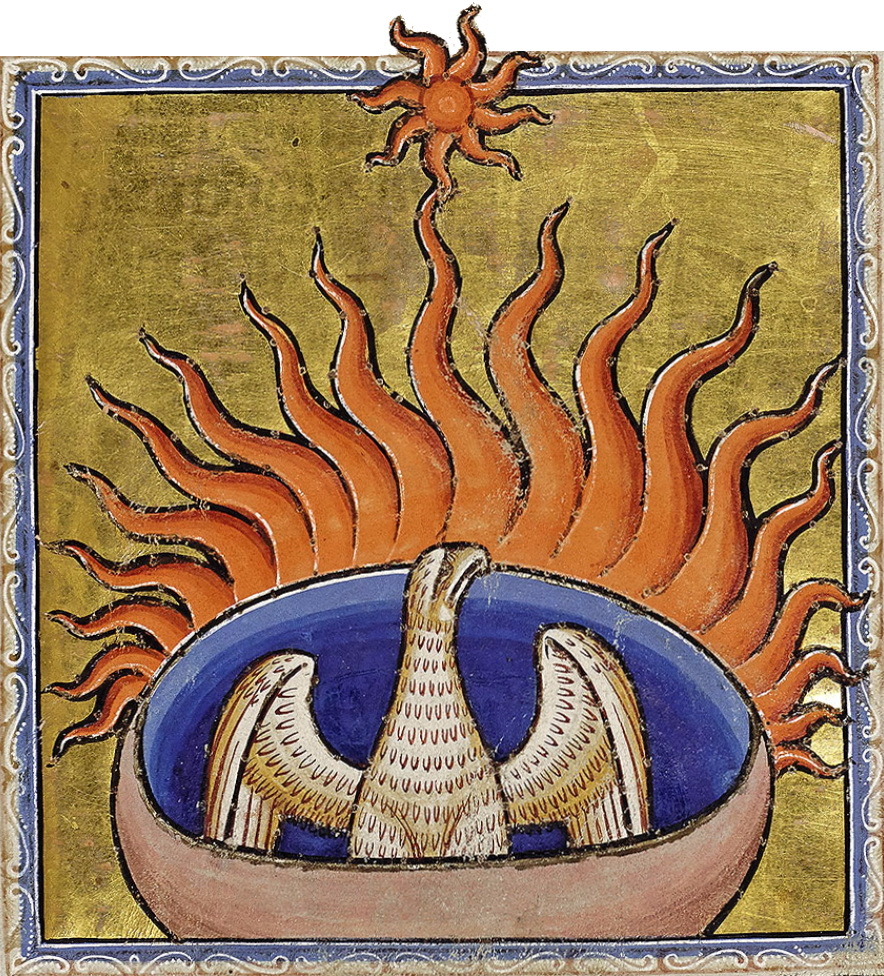
Eye of the Soul

"It is only after the Second Threshold that the awe-struck Faithful begin to
progressively discover this world through the medium of their higher centres.
About the working of these centres we have already quoted the following words
of St Isaac the Syrian: 'The soul, like the body,has two eyes: but while the eyes of the
body both see things in the same way, those of the soul see them differently; one
contemplates the Truth in symbols and images; the other contemplates it face to face.'

Davidic Covenant

ince it emanated from the Absolute II, the first Mosaic Decalogue was of
Christian inspiration and, in spite of evetything, it was never completely
eclipsed in the consciousness of the chosen people by the Second Decalogue.
The Second was of pagan inspiration, in the sense that it emanated from the
Absolute III. In the consciousness of the spiritual elite of the Jewish people, the
monotheism relative to Jehovah never managed to replace the true monotheism
of the consubstantial and indivisible Holy Trinity that was openly proclaimed in
historical Christian history.

This esoteric tradition was revealed from the time of Moses through the line
of the prophets, and found its highest possible expression in the Old Testament
period in the person of the prophet-king David. It is true that, as a man, King
David was not unblemished—the Bathsheba-Uriah affair is a flagrant proof of
this—but the nobility of his soul and the greatness of his work brought him not
only absolution but the sublime promise that the Messiah would be born of his
line.7 Psalm CXVIII, which summarizes the esoteric doctrine, designates him as
a prophet, and the creation of the unified State of Israel crowns his work as a
king.