I.P.: But if the spiritual heart is not manifested physically, how can you tell where it's located and whether it has awakened or not?
A.M.: When the spiritual heart has awakened, you feel a kind of burning, an influx of energy, a feeling of peace in your chest. When it only starts awakening, you feel pain in the chest. At first it's like heart pain, often quite strong. Those who don't understand what's happening, think it's heart trouble. We've had cases in our commune when people felt acute pain at the time when their spiritual heart began to awaken. Doctors thought it was a heart attack, but cardiograms showed no heart disorders. Objective evidence spoke of good health. When the action of the spiritual heart expands, you may feel pain in your chest or even your shoulders. At first the area of action expands, but then it is localized and forms a kind of sphere in the middle of your chest. After a while the pain goes away and you feel the action only once in a while.
At the time of acute self-consciousness at the birth of adulthood, when the
soul is still innocent and open, has not been hardened, and the world is a
big apple with possibilities that are seemingly limitless, and relationships
can seem to be so perfect and so easily perfect, and the soul has been just
awakened to the intense sense of personhood, self-hood, and asks (for the
first and sometimes only time in one's life) the question of who he is and
why he's here, the soul is wide open and seeks to go beyond itself. The
person feels deeply and intensely, having not yet learned to block and hide
these feelings which later prove too painful, and he longs to share this
feeling, this self-awareness, this itensity, this pain with others and to feel
what others feel, especially those who are going through the same thing.
Everything is poured out freely, sometimes too freely, and there is no
attempt to guard one's inner world from being trampled on. The child who
has never been hit by a car, if he is not told of the dangers, will have no
fear of walking into a busy street.
However, when the person gets older, as time passes, the perfect "soul-
mate" relationships which began so intensely, like a wonderous blossoming
flower, become disappointing because there was nothing higher to hold
them together; and the seemingly endless possibilities which present
themselves in youth become smaller, one possibility closing itself off after
another once one goes further on a certain path ( for each person can only
take one path at a time). And then occurs what has formerly been feared
and rejected - a layer forms on top of the raw person, a protective  coating;
and it cannot be helped, for pure vunerability is too painful.
All this explains why youth of today fear so much to get old, why they will
do anything to prevent it.
Dedicated to the red and the white rose, to the eyes and the flame, to a more perfect unity... You can reach me @ cathasach71854@gmail.com
Saturday, July 31, 2010
The Burning Heart
Children are at the heart of the Kingdom. Let us be like children, and trust not to our own understanding...


Friday, July 30, 2010
Traditio?
 It's always useful to ponder, what if? Here is one of the oldest churches in England. Tradition can be viewed, not merely as calcified accretion (with a life/death all of its own) but as the product of human choice - That which endures is that which we choose and re-choose, and choose again. That which is sustained, and sustains over time, nourishing with a life blood that connects us to the past and the future. There is no "Tradition" which needs to die, is outmoded, etc. etc. Tradition exists because the sacred dead exist. God is a God, not of the dead, but of the living. This is more true than the "postmoderns" realize. Tradition exists because our life is not our own, and also because it is our own. There is no war between Fate and Love, Tradition and Life, etc., etc. Here, all is One.
(Photo from Blog, Cotswold Peeps)
July 31, One Cosmos Blog
Why is this the case? First of all, how can two such diverse modes -- sight and hearing -- equally create the thing called "art?" Or, perhaps more to the point, what is art that it can express itself in two such diverse modes? Why are a painting and a symphony both called art? And why are the other senses excluded?
One of the classic definitions of art is that it combines, wholeness (integritas), harmony (consonantia), and radiance (claritas, which is similar to Plato's "splendor of truth").
Thus, painting and music can obviously embody wholeness and harmony, but it is difficult to imagine how the other senses could do so. For example, touch is inherently fragmentary; one cannot "touch the whole," nor can the fingers perceive radiance. And no one imagines that truth can be tasted or smelled (except in a subtle, analogical manner).
Let's go back to Joyce, who is speaking through Stephen: "An aesthetic image is presented to us either in space or in time. What is audible is presented in time, what is visible is presented in space."
The "mysterious instant" of aesthetic reception occurs when "the supreme quality of beauty... is apprehended luminously by the mind which has been arrested by its wholeness and fascinated by its harmony." There is in "the silent stasis of aesthetic pleasure, a spiritual state very like to that cardiac condition which... [is] called the enchantment of the heart."
Perhaps vision conveys the image of eternity, while sound is the moving image of eternity. As Schuon says, aesthetics is "the science of forms," and music presents us with temporal form, or architecture in motion. But the form must convey what is non-formal, i.e., the supra-formal light -- and truth -- from another world. It is limitlessness expressed by a limit, or divine radiance expressed through wholeness and harmony.
Interestingly, Schuon writes that "ignorant and profane aesthetics places the beautiful -- or what its sentimental idealism takes to be beautiful -- above the true..." This leads to idolatry of beauty, and of "art for art's sake." But beauty should be for truth's sake. If it is not subordinate to something higher, it will be appropriated by something lower.
Sri Aurobindo says something similar in a letter to a disciple, that through sound or image, "in a moment mysteriously, unexpectedly, there is a Presence, a Power, a Face that looks into yours, an inner sight..."
However, "so long as one is satisfied with looking through windows, the gain is only initial; one day one will have to take up the pilgrim's staff and start out to journey there where the Reality is forever manifest and present."
Or, one must follow the light to the sun and sound to the moon, for "in a certain sense, the sun makes known space and the moon, time" (Schuon).
A Study in War and Dominion
The Norman Conquest was perhaps the most significant event in Western History for several centuries, perhaps more. Troy Southgate argues here that the Conquest lead to a general desecularization and "reform" of the monastic orders in England, which had become quite lax. The monks literally hunted, diced, etc., etc. However, it is also undoubtedly true that such artifacts as the missal of St. Guthlac (preserved by William of Jumieges) went the way of all flesh as well. The freedom of Saxon Christianity was regularized, preventing excess but also rounding up the "hermitic" tradition. New administrators were able, however they were sometimes chosen purely for their loyalty and adminstrative facility. Lanfranc would have been a notable exception, but not too much of one. I can't find it just now, but there was actually a prominent Norman cleric (from Normandy, not Anglo-Norman) named Guillame (I believe) who argued in an extended Latin treatise portraying William I (Guillame le Batard) as a predator and violator of God's peace and the rights of Englishmen. What is interesting is that it appears that the waves of depopulation during the Black Death (1348) significantly advanced the class integration and racial inter-mingling of Saxon and Norman. After this period, it was difficult to distinguish anyone but "Englishmen". My suspicion is that the Norman Conquest is part of the Papal rise to power, yet also part of the irrevocable change to England into a fundamentally forward-looking, dynastic, energetic, royal state, a paradox later embodied (and resolved) in the person(s) of Henry VIII and Sir Thomas More. There is still something special about "Albion" today. Certainly, the shadows and ghosts of England are not dead, nor are they quiet. The fact that England retains more actual safeguards on personal liberty (as opposed to theoretical American ones that could mean nothing in practice) is of tremendous importance, as is the survival of the Anglican Church, the High Church movement, the monarchy, and other salient facts of English national life.
Thursday, July 29, 2010
Why Conservatism is Doomed
 http://en.wikipedia.org/wiki/Guillaume_Groen_van_Prinsterer
The world's leading expert in English-speaking milieux, and translator of the Dutch political thought and influence of Groen, Dr. Harry Van Dyke, has summarized Groen's mature view in this way:
"
We are living in a condition of permanent revolution ... revolutions are here to stay and will grow much worse in scope and intensity unless men can be persuaded to return to Christianity, to practise its precepts and to obey the Gospel in its full implications for human life and civilized society. Barring such a revival, the future would belong to socialism and communism, which on this view were but the most consistent sects of the new secular religion. To Groen, therefore, the political spectrum that presented itself to his generation offered no meaningful choice.
"In terms of his analysis, the 'radical left' was composed of fanatical believers in the godless ideology; the 'liberal centre,' by comparison, by warm believers who warned against excesses and preached moderation; while the 'conservative right' embraced all those who lacked either the insight, the prudence, or the will to break with the modern tenets yet who recoiled from the consequences whenever the ideology was practised and implemented in any consistent way. None of the shades or 'nuances of secular liberalism represented a valid option for Christian citizens." Groen called for a rejection of the entire available spectrum of political positions, calling for a "radical alternative in politics, along anti-revolutionary, Christian-historical lines" (Harry Van Dyke, Groen van Prinsterer: Lectures on Unbelief and Revolution (1989, pp. 3-4).
Church Unity
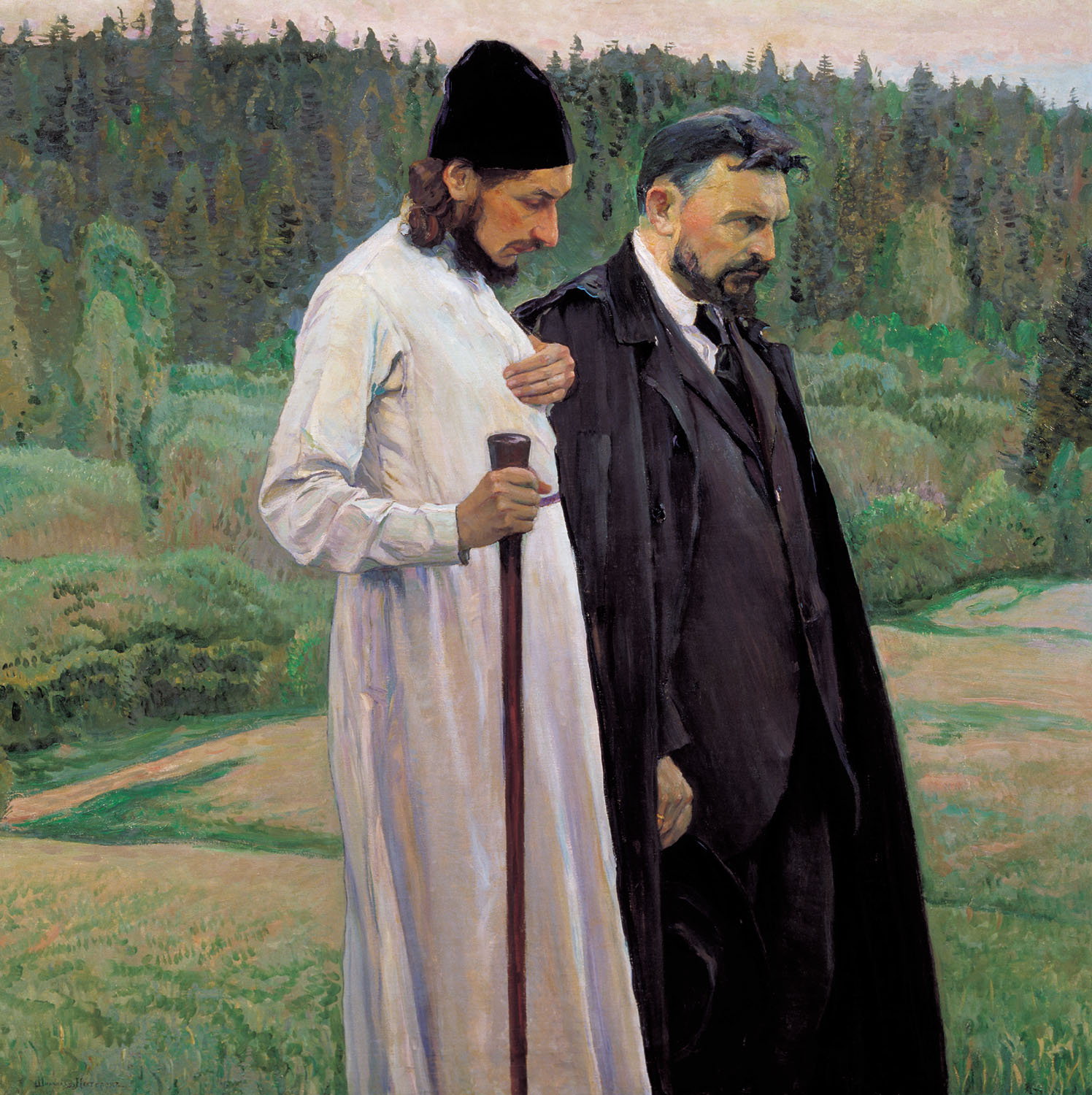
Bulgakov seemed to think liturgy a more effective means of reunion than Theology. This, I have thought. It's also possible that the priestly elements of the Christian Church will need to sit and listen at the feet of some warrior-king figure. Isn't the story of David? Didn't he violate the priestly taboos and establish the new dynasty?
"Almost as a postscript to the heavenly warning issued at Fatima in 1917, Saint Maximilian Kolbe, two years later, reviewed the three Great Evils of the latter times, noting: “In 1517, the Protestants rebelled against the Church; in 1717, the Freemasons rebelled against Christ; and, in 1917, the Communists rebelled against God.” In a single sentence the Polish martyr had exposed common origin and natural succession of each of these Apocalyptic nightmares...."
http://catholicism.org/clement-maria-hofbauer.html
How will the Protestant Church begin to cleanse itself of its associations with Progress? Might not the occasion of America fighting for its reason for existence, its very soul, be the time to begin "anew"? Wasn't Jonathan Edwards soaked and permeated with the God-centered, solar, masculine theology which forms the basis of (in Augustine's words) true religion?
"Almost as a postscript to the heavenly warning issued at Fatima in 1917, Saint Maximilian Kolbe, two years later, reviewed the three Great Evils of the latter times, noting: “In 1517, the Protestants rebelled against the Church; in 1717, the Freemasons rebelled against Christ; and, in 1917, the Communists rebelled against God.” In a single sentence the Polish martyr had exposed common origin and natural succession of each of these Apocalyptic nightmares...."
http://catholicism.org/clement-maria-hofbauer.html
How will the Protestant Church begin to cleanse itself of its associations with Progress? Might not the occasion of America fighting for its reason for existence, its very soul, be the time to begin "anew"? Wasn't Jonathan Edwards soaked and permeated with the God-centered, solar, masculine theology which forms the basis of (in Augustine's words) true religion?
Subscribe to:
Posts (Atom)