
Never the Twain Shall Meet
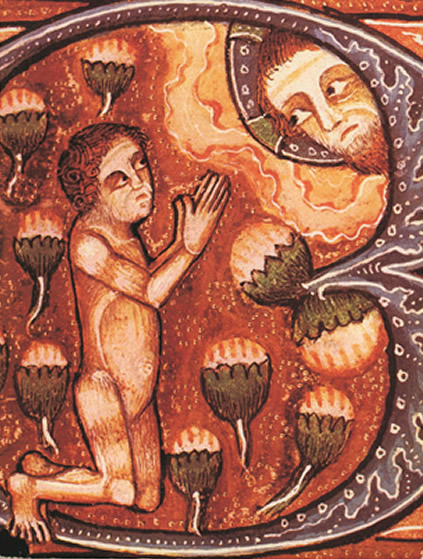
I chose to write on The Dark Cloud of Unknowing to illustrate something that is true that has been discussed here (that East & West are not divergent in Tradition). The author was an anonymous Englishman during the 14th century; ergo, a quintessential “Western” mystic on an isolated island in the West. It is unknown who he was, but it is thought he was in the East Midlands (based on his language). He came after Richard Rolle, and before Walter Hinton, and is roughly contingent with Julian of Norwich. On the Continent, during this time of the Hundred Years War & plague, the great German mystics also appeared. Europe was stirring with heresy, and the Reformation was not far off.
Romanides and Athanasios Bailey (whose Orla.Pubs is off the web now) maintain that the West lost the concept of “energetic” salvation; that is, the West favored a juridical model in which God “reckoned” righteousness or (prior to the Reformation) “declared” or “atoned” man into righteousness. This is the “ransom” theory that developed from Anselm. While we agree that certainly the deviations of Truth in the West have taken the form described by Romanides, we do not concur that the essence of Western Tradition is accurately described: the trend, perhaps, but not the essence or remnant (and there is always a remnant, Romanides should know this).
Specifically, the Frankish and Norman conquests of the West (followed by wars of conquest aimed at the Eastern Empire) are supposed to have caused the entire and widespread loss of genuine Christian understanding (and, given Eastern theology’s emphasis on right wisdom of God and categories of thought, any resultant vital Christianity). However, as we shall see, Western communions made use of negative theology, and were aware of the same dogmas which governed Eastern apophaticism, however much it may be granted that it received less emphasis the farther West one went. As one author points out, the more cataphatic Western theology has (as a safeguard against God-in-man’s-image) the idea that the Logos is the archetype of man’s Image. As an aside, I will note that the Eastern Church considers the 12th or 13th centuries an era in which sensual pleasure and softness enter the Western spirituality; the reply to this would be to note that while this is true, undoubtedly, it also came as part of the Troubadour movement, and could be viewed more positively (as Cologero has suggested) as a particular emphasis on Logos, peculiar to the West.
Additonally, John Scotus Erigena had translated Dionysius from Greek into Latin much, much earlier in the Isles, so the English had access to negative theology, which influenced the author of the Dark Cloud, and bore fruit in his treatise. It should be unnecessary to point out that the age of Cathedral building was founded on Dionysian theology, and had already taken shape.
No one can think of God. Therefore it is my wish to leave everything that I can think of and choose for my love the thing that I cannot think. For while God may be loved but not thought. God can be taken and held by love but not by thought. Therefore though it is good at times to think of the kindness and worthiness of God in particular, and though this is a light and a part of contemplation, nevertheless, in this exercise, it must be cast down and covered over with a cloud of forgetting. You are to step above it stalwartly but lovingly, with a devout, pleasing, stirring of love and desire to pierce that darkness above you. You are to smite upon the thick cloud of unknowing with a sharp dart of longing love and do not cease no matter what happens. 6:130-131.The author makes the same energy/essence distinction that the Eastern Church makes: we never become God by nature, but only by grace.
This, “For the love of Jesus is very well said.” For in the love of Jesus there is your help. Love is so powerful that it makes everything one (common). Therefore love Jesus and everything that he has is yours. By his godhead he is the maker and giver of time. By his humanity he is the very keeper of time. And by his Godhead and humanity together he is the truest guide of the choice and use of time. Knit yourself then to him by love and by faith. And by virtue of that knot you shall be a familiar partner with him and with all who are so knitted to him by love… 4:366-373. The example of all this is shown in the life of Christ. PC23:24.170 Mary models the way of contemplative prayer. So she hung her love and her longing desire in this cloud of unknowing, and learned to love what she could not see clearly in this life by the light of understanding in her reason, nor truly feel in the sweetness of love in her affection; so much so that she paid little attention to whether she had been a sinner or not. Yes! And so often I think that she was so deeply affected in the love of the Godhead that she scarcely noticed the beauty of his precious and blessed body as he sat so handsomely speaking and teaching before her. It seems from the gospel that she was oblivious to anything else either bodily or spiritual. XVI: 834-842
Rather than “the Jesus prayer”, we instead have this:
“Schort preier peersith heven.”(This, by the way, would even find an echo in the Puritan theology of “Heaven Taken by Storm”). The use of one syllable words like “God” or “Love” are recommended for unceasing prayer, which builds on confession and regular meditation on revealed mysteries.
It is preferable to meditate on God’s goodness, rather than one’s own sin (contra-Calvinism), since whatever one thinks about “sits between” God & the self, although he does not deny that exoteric or ordinary religious meditation lays a foundation from which to build true contemplation, by God’s grace, later on, which is given regardless of merit or dis-merit, but according to desire.
Thinking may not goodly be getyn withoutyn reding or heryng comyng before…Ne preier may not goodly be getyn in bigynners and profiters withoutyn thinkyng comyng bifore.How will they believe, if they have not heard? He suggests that many are against contemplation, and have a false humility (thinking that their piety is perfected as high as may go in exoteric meditation) because they are simply unaware of any higher path (they have not heard, and are deceived in imagination). So this is a defense of the esoteric or contemplative way, but he preserves their unity by arguing that the higher active path & the lower contemplative path are actually the same path. Additionally, he links these three paths with the “beginner”, “proficient”, & “perfect” which we see used by Garrigou-Lagrange in his small work on Christian conversions.
I will also note some affinity in this work with later Western development in Pierre-Caussade’s Sacrament of the Present Moment. I believe that one could take Western manuals such as these (while recognizing legitimate shortcomings and criticism) and build an impressive library of religious contemplation that would bear and stand comparison with modern day Eastern modes or models.
The point is not to say “nu-uh, we have it too” but rather encourage Western readers to look deeper into their own tradition – not without reason is it said (not to our honor) that prophets are not without honor, except in their own country. But why go so far East? Surely there are far spiritual and physical countries at hand, who have more elective affinities with our background, that remain, yet, Christian?
The author of The Cloud advocates two interesting strategies for overcoming mental “thoughts” and entering into love. Firstly, one can “look over the shoulders” of the daily thoughts which crowd you, focusing on something beyond them, while not obliterating them directly. Secondly, one can “cower down to them and surrender to them”. This last strategy is particularly recommended by him as a means of annihilating the enemies, for God will swiftly come to the rescue of His children who lie helpless before a wild boar. Additionally, this keeps the Ego from getting involved in combat, which only “messes things up” (according to this mystical author).
He is not advocating Quietism (since one continues outward religious observance) but, rather, the attention to thoughts: observing their arrival with discretion and judgement, a practice that is fundamental, say the Fathers of the Philokalia. One surrenders to the interior work of God, while exercising patience and obedience outwardly. Again, we see that Christianity is in this sense, martial, since the soldier maintains discipline in a fight which is not necessarily (even by esoteric standards) appearing to go well. Hope is instead placed in the action of Grace, rather than merely the enhancement of Nature. This is the Christian legacy, both inwardly and outwardly.
The author also translated Dionysius’ Divinitie Hid, & wrote several other treatises, which quote Augustine, Aquinas, Aristotle, and Richard St. Victor (placing him within the European stream). Those who will pursue God through “un-thinking” Love will end up grasping many intellectual mysteries along the way, and the Love we have is passive only towards God : it actively overcomes discursive thought (placing all creatures whatsoever in a “cloud” of forgetting) and is naked only towards God, being active in the sense that it moves instinctively back to the source of all Being, God who exists by Nature in the state we must attain through Grace alone.
The same attention to thoughts that is recommended in other Traditions is found here, embedded within the Christian tradition.
…If a man happened to be your deadly enemy and you heard him cry out with such terror, in the fulness of his spirit, this little word “fire!” or this word “out!” you would have no thought for his enmity, but out of the heartfelt compassion, stirred up and excited by the pain expressed in that cry, you would get out of bed even on a night in mid-winter, to help him put out the fire, or to bring him comfort in his distress. O Lord, if a man can be moved by grace to such mercy and compassion for his enemy, his enmity notwithstanding, what compassion and what mercy will God have for the spiritual cry of the soul welling up and issuing forth from the height and the depth, the length and the breadth of his spirit, which contains by nature all that a man has by grace, and much more!.


 Meanwhile,
Roman revolutionary activity in Gaul had not yet been fully suppressed.
Pippin III had died the year before and Charlemagne and his brother
Carloman had taken over the rule of Austrasia and Neustria. Within the
surprisingly short period of only twenty-two years, from 732 to 754, the
Franks had defeated the Roman-Arab alliance, swamped all the provinces
of Gaul, and had swept into Northern Italy. This was made possible by
the new feudal order which was first established in Austrasia and
Neustria. The Roman administrative units of the civitates were abolished and replaced by the military comitates. The former free Romans were transferred en masse from the cities and were established on the slave labor camps called villae and mansi, alongside the serfs. They were called villeins (villains), a term which, for understandable reasons, came to mean enemies of law and order.
Meanwhile,
Roman revolutionary activity in Gaul had not yet been fully suppressed.
Pippin III had died the year before and Charlemagne and his brother
Carloman had taken over the rule of Austrasia and Neustria. Within the
surprisingly short period of only twenty-two years, from 732 to 754, the
Franks had defeated the Roman-Arab alliance, swamped all the provinces
of Gaul, and had swept into Northern Italy. This was made possible by
the new feudal order which was first established in Austrasia and
Neustria. The Roman administrative units of the civitates were abolished and replaced by the military comitates. The former free Romans were transferred en masse from the cities and were established on the slave labor camps called villae and mansi, alongside the serfs. They were called villeins (villains), a term which, for understandable reasons, came to mean enemies of law and order.
Matthew:
I don't disagree with anything you said, except that history demonstrates that it is quite difficult to maintain any dynamic synthesis over time. Even if Guenon were correct about the necessary deterioration brought about by time -- and I reject that thesis entirely -- there is no virtue in simply surrendering to entropy. Nor do I think that we should in any way devalue the historical time into which we are born, which is as providential and valuable as any -- or, it is our duty to render it so.