Showing posts with label Dionysius. Show all posts

Monday, September 23, 2013

Hercules' Fourth Labor: The Erymanthian Boar

Labors of Hercules, Part 4

The Erymanthian Boar

Hercules had been given the (originally) ten labors as a penance for letting Hera drive him to wrath, in which he slew his six sons. So don’t let anyone tell you that penance is a “Catholic” thing. All of the labors center around a primordial world of monsters that will be rededicated to the sun-God Apollo, or to Zeus, from whom the power to cleanse & purify this region of the world comes.

Hercules originally received the wrath of Hera because he was the illegitimate son of Zeus and Alcmene. He is half-born, a godling, immortal by birth right, but not in actuality. Hera is one of the daughters of Chronos, but also a wife to Zeus. Hera represents an older form of matriarchal worship connected with earth rites and the underworld (like Demeter) that is incorporated into the male & solar spirit of the “new gods” of Greece. Her typical function is rage against Zeus’ consorts and love affairs.  We can view Hera as a suppressed kind of female power that tends to take vengeance on the half-god offspring of Zeus’ spirit mingling (like the wind) with mere mortals. Not only is he creating a race that is superior to those who worship Hera, the warrior and martial ethos threatens the earlier balance. As such, Hera is ambiguous. She is both a reminder that the Greeks “breathed their truth through lies” in the new myths (a fact Clement of Alexandria alludes to), and also a principle of retardation: there is no “going back” to the earlier stage.

We have to view this evolution from a solar perspective. On the one hand, the revolt of the warriors against the priests heralded a new Dark Age. On the other, man never rises except by suffering. As the ancients would say “he suffers into Truth”. Hera is fighting a lost cause. The forces of chaos have penetrated the ancient ordering of the castes, turning each against the others. Corruption begins with the priests, who compromise (out of fear) with the warrior caste, which is ascendent. The priests should suffer like Prometheus to bring them into a proper order. They lash out with curses and penances, after the betrayal of their compromise, which they should never have agreed to (we see the underground Occult engaged in such a struggle today). An analogous event occured in the West, in which the Frankish nobility went over to the Revolution through decadence and compromise, with the priests like Abbe Sieyes courting natural nobles such as Mirabeau, who of course caters to the third estate, who will later flirt with the masses. Garibaldi and his ilk (natural aristoi) become leaders of “Revolution”. As Cologero has written, we can see in these modern events Time greatly sped up, during the Kali Yuga, for our own edification, if we could but read aright. It is no accident that the natural dramatic flair of the French was interested in Classical themes!

Some men, like Hercules, will rise to the challenge, and prove themselves, redeeming the turbulence of the purely horizontal swirl of the world-snake Ourobous into a vertical ascent. Evolution always operates: the snake writhes and awaits the champion to bend it to a will. Even today, our genetic structures are engaged in such programming; they await men capable of rising, like eagles on a vertical lift of heated wind, up into the heavens. This ascension has to involve Christian “ideas” (not necessarily formally) as it is only through sacrifice of some sort that the necessary purity is invoked. Even in Hercules’ time, penance is necessary. That is why Hera is still important – the solar spirit embraces Fate, suffers into Truth, and guides it upward. The true man sees in the Modern World an immense potential opportunity, and begins the ascent, without for all that, endorsing the degeneracy he finds around him. Hera represents the Karma of past sins, in this case, “sins of the Father”.

Hera is “the adversary”: not an enemy per se, but someone (who for the strong man) is fulfilling a purpose & role. Without the consent of Hera, Hercules cannot be deified (as we shall she). It is her job to test the hero, and although she is insufficient to initiate solar truth, she has the power to test it.
The great boar is tracked through the snow, driven over the mountain ranges by Hercules, who descends upon it relentlessly, driving it before him. Chiron the centaur had advised him to track it in the snow. Hercules is now succeeding more easily in his labors, and the boar proves “easy” to track down. The hero is gaining more power.

What is interesting is the tale of the centaurs. While visiting Pholus during the hunt, Hercules desires wine, and convinces Pholus to open the one vessel he has, a gift from Dionysius. The centaurs do not know how to drink moderately, and end up becoming drunk and attacking Hercules, who drives them off with arrows. Chiron is hit, and the pain it causes this immortal makes him volunteer to replace Prometheus on the mountain, being tortured by the eagle. Hercules shoots the eagle, to deliver Chiron. This teaches us that Hercules is receiving the immortality which Chiron was unable to utilize properly. The drunken man-beast who tragically frees Prometheus is imbuing the rising hero with his powers.
Hercules has already conquered the passions, so he is worthy to drink of Dionysius’ wine, and can easily disperse the dangers arising thereby. His arrows, dipped in the Hydra’s blood, are more than equal to chastening the centaurs, who are wise up to a point, but unruly.

There is only so much immortality floating around at one point of time. Those who misuse this gift (their talents) will have it given to someone else more worthy. This should be an encouragement to everyone who is a spiritual seeker. When you see the powerful and ignorant, or the mighty and the evil, squandering their gifts, you should know that these will become available to you, if they continue to defy the deathless and immortal source of these divine blessings. “The meek inherit the earth”. This is taught explicitly in the Psalms, and endorsed in the Beatitudes and apostolic teaching. “Run the race, as if to win”. When someone releases their anger unjustly upon you, a right response will not only help them, it will put their lost energy at your disposal. Behind the “meekness” of the Christian tradition is hidden an ancient teaching concerning the accumulation of power. When Saint Peter crosses himself in the presence of the emperor Nero, causing Simon Magus to fall from the sky (Magus was demonstrating the power of his magic), the lost energy will go to Saint Peter. This happens with Cyprian the Mage & Justiana, as well (cited by Tomberg in Meditations).

Since we are discussing magic at Gornahoor, it would be helpful to meditate on how to make it as powerful as possible: counter-intuitively, it would seem that purity is that which renders it deeper and whiter magic. This purity takes different guises, but purity it is, nonetheless, & necessary to avoid the trap indicated by Dante, who places Simon Magus in hell. “To whom much is given, much is required.”
The tale ends humorously: the Greeks loved to depict the scene in which Hercules presents the boar to the tyrant, only to have him hide inside of a large vase. These endings are further vindication of Hercules’ divine authority and power, and an important “unmasking” of the powers-that-be: they are unequal to even receive the gift of Hercules, which they asked for.

The legend of Hercules remains a beautiful re-telling of what was good in the pre-Olympian world, a transmuting of it through the might of Hercules into something even higher and even better. Something similar occurred in the West, and one can discern the operations of Christianity on the classical ideals in much the same manner. In each case, the essence or import is preserved, but the eagle makes another turn in the gyre of the circle, and achieves greater altitude. Like the hero, it rises, on steady wings and a strong upward draft. For an instance of this, see Matthew Arnold’s essay on Maurice du Guerin’s tale of the centaurs.

Hercules represents the new warrior, the best of that breed, who dare to will a union of warrior-priest, in order to achieve immortality. One might say that a warrior is potentially an aspirant priest: if he succeeds, if he navigates the divine-demonic world successfully, he discharges his penance (against which and with which he fights), achieving the essence of immortality. Later on, in the West, this baptized chivalric ideal would be made more explicit in the body of the king. The loss of the primordial world, its descent into chaos, has to be redeemed, through the storming of heaven. If Christianity had not existed, it would have had to be invented. For those willing to undertake a similar labor, modern Christianity has its primordial monsters and jealous and offended goddesses which are willing to oblige you, in standing the test.




Sunday, July 14, 2013

Never the Twain Shall Meet

Never the Twain Shall Meet

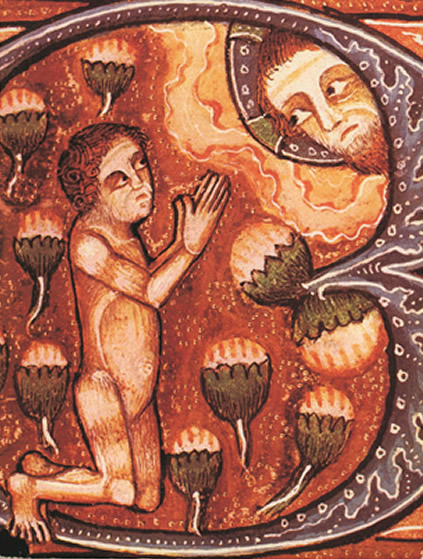
LuttrellPrayer
I chose to write on The Dark Cloud of Unknowing to illustrate something that is true that has been discussed here (that East & West are not divergent in Tradition). The author was an anonymous Englishman during the 14th century; ergo, a quintessential “Western” mystic on an isolated island in the West. It is unknown who he was, but it is thought he was in the East Midlands (based on his language). He came after Richard Rolle, and before Walter Hinton, and is roughly contingent with Julian of Norwich. On the Continent, during this time of the Hundred Years War & plague, the great German mystics also appeared. Europe was stirring with heresy, and the Reformation was not far off.

Romanides and Athanasios Bailey (whose Orla.Pubs is off the web now) maintain that the West lost the concept of “energetic” salvation; that is, the West favored a juridical model in which God “reckoned” righteousness or (prior to the Reformation) “declared” or “atoned” man into righteousness. This is the “ransom” theory that developed from Anselm. While we agree that certainly the deviations of Truth in the West have taken the form described by Romanides, we do not concur that the essence of Western Tradition is accurately described: the trend, perhaps, but not the essence or remnant (and there is always a remnant, Romanides should know this).

Specifically, the Frankish and Norman conquests of the West (followed by wars of conquest aimed at the Eastern Empire) are supposed to have caused the entire and widespread loss of genuine Christian understanding (and, given Eastern theology’s emphasis on right wisdom of God and categories of thought, any resultant vital Christianity). However, as we shall see, Western communions made use of negative theology, and were aware of the same dogmas which governed Eastern apophaticism, however much it may be granted that it received less emphasis the farther West one went. As one author points out, the more cataphatic Western theology has (as a safeguard against God-in-man’s-image) the idea that the Logos is the archetype of man’s Image. As an aside, I will note that the Eastern Church considers the 12th or 13th centuries an era in which sensual pleasure and softness enter the Western spirituality; the reply to this would be to note that while this is true, undoubtedly, it also came as part of the Troubadour movement, and could be viewed more positively (as Cologero has suggested) as a particular emphasis on Logos, peculiar to the West.

Additonally, John Scotus Erigena had translated Dionysius from Greek into Latin much, much earlier in the Isles, so the English had access to negative theology, which influenced the author of the Dark Cloud, and bore fruit in his treatise. It should be unnecessary to point out that the age of Cathedral building was founded on Dionysian theology, and had already taken shape.
No one can think of God. Therefore it is my wish to leave everything that I can think of  and choose for my love the thing that I cannot think. For while God may be loved but not thought. God can be taken and held by love but not by thought. Therefore though it is good at times to think of the kindness and worthiness of God in particular, and though this is a light and a part of contemplation, nevertheless, in this exercise, it must be cast down and covered over with a cloud of forgetting. You are to step above it stalwartly but lovingly, with a devout, pleasing, stirring of love and desire to pierce that darkness above you. You are to smite upon the thick cloud of unknowing with a sharp dart of longing love and do not cease no matter what happens. 6:130-131.

This, “For the love of Jesus is very well said.” For in the love of Jesus there is your help. Love is so powerful  that it makes everything one (common). Therefore love Jesus and everything that he has is yours. By his godhead he is the maker and giver of time. By his humanity he is the very keeper of time. And by his Godhead and humanity together he is the truest guide of the choice and use of time. Knit yourself then to him by love and by faith. And by virtue of that knot you shall be a familiar partner with him and with all who are so knitted to him by love… 4:366-373. The example of all this is shown in the life of Christ. PC23:24.170  Mary models the way of contemplative prayer. So she hung her love and her longing desire in this cloud of unknowing, and learned to love what she could not see clearly in this life by the light of understanding in her reason, nor truly feel in the sweetness of love in her affection; so much so that she paid little attention to whether she had been a sinner or not. Yes! And so often I think that she was so deeply affected in the love of the Godhead that she scarcely noticed the beauty of his precious and blessed body as he sat so handsomely speaking and teaching before her. It seems from the gospel that she was oblivious to anything else either bodily or spiritual. XVI: 834-842
The author makes the same energy/essence distinction that the Eastern Church makes: we never become God by nature, but only by grace.
Rather than “the Jesus prayer”, we instead have this:
“Schort preier peersith heven.”
(This, by the way, would even find an echo in the Puritan theology of “Heaven Taken by Storm”).  The use of one syllable words like “God” or “Love” are recommended for unceasing prayer, which builds on confession and regular meditation on revealed mysteries.
It is preferable to meditate on God’s goodness, rather than one’s own sin (contra-Calvinism), since whatever one thinks about “sits between” God & the self, although he does not deny that exoteric or ordinary religious meditation lays a foundation from which to build true contemplation, by God’s grace, later on, which is given regardless of merit or dis-merit, but according to desire.
Thinking may not goodly be getyn withoutyn reding or heryng comyng before…Ne preier may not goodly be getyn in bigynners and profiters withoutyn thinkyng comyng bifore.
How will they believe, if they have not heard? He suggests that many are against contemplation, and have a false humility (thinking that their piety is perfected as high as may go in exoteric meditation) because they are simply unaware of any higher path (they have not heard, and are deceived in imagination). So this is a defense of the esoteric or contemplative way, but he preserves their unity by arguing that the higher active path & the lower contemplative path are actually the same path. Additionally, he links these three paths with the “beginner”, “proficient”, & “perfect” which we see used by Garrigou-Lagrange in his small work on Christian conversions.

I will also note some affinity in this work with later Western development in Pierre-Caussade’s Sacrament of the Present Moment.  I believe that one could take Western manuals such as these (while recognizing legitimate shortcomings and criticism) and build an impressive library of religious contemplation that would bear and stand comparison with modern day Eastern modes or models.

The point is not to say “nu-uh, we have it too” but rather encourage Western readers to look deeper into their own tradition – not without reason is it said (not to our honor) that prophets are not without honor, except in their own country.  But why go so far East? Surely there are far spiritual and physical countries at hand, who have more elective affinities with our background, that remain, yet, Christian?

The author of The Cloud advocates two interesting strategies for overcoming mental “thoughts” and entering into love. Firstly, one can “look over the shoulders” of the daily thoughts which crowd you, focusing on something beyond them, while not obliterating them directly. Secondly, one can “cower down to them and surrender to them”. This last strategy is particularly recommended by him as a means of annihilating the enemies, for God will swiftly come to the rescue of His children who lie helpless before a wild boar. Additionally, this keeps the Ego from getting involved in combat, which only “messes things up” (according to this mystical author).

He is not advocating Quietism (since one continues outward religious observance) but, rather, the attention to thoughts: observing their arrival with discretion and judgement, a practice that is fundamental, say the Fathers of the Philokalia. One surrenders to the interior work of God, while exercising patience and obedience outwardly. Again, we see that Christianity is in this sense, martial, since the soldier maintains discipline in a fight which is not necessarily (even by esoteric standards) appearing to go well. Hope is instead placed in the action of Grace, rather than merely the enhancement of Nature. This is the Christian legacy, both inwardly and outwardly.

The author also translated Dionysius’ Divinitie Hid, & wrote several other treatises, which quote Augustine, Aquinas, Aristotle, and Richard St. Victor (placing him within the European stream). Those who will pursue God through “un-thinking” Love will end up grasping many intellectual mysteries along the way, and the Love we have is passive only towards God : it actively overcomes discursive thought (placing all creatures whatsoever in a “cloud” of forgetting) and is naked only towards God, being active in the sense that it moves instinctively back to the source of all Being, God who exists by Nature in the state we must attain through Grace alone.

The same attention to thoughts that is recommended in other Traditions is found here, embedded within the Christian tradition.
…If a man happened to be your deadly enemy and you heard him cry out with such terror, in the fulness of his spirit, this little word “fire!” or this word “out!” you would have no thought for his enmity, but out of the heartfelt compassion, stirred up and excited by the pain expressed in that cry, you would get out of bed even on a night in mid-winter, to help him put out the fire, or to bring him comfort in his distress. O Lord, if a man can be moved by grace to such mercy and compassion for his enemy, his enmity notwithstanding, what compassion and what mercy will God have for the spiritual cry of the soul welling up and issuing forth from the height and the depth, the length and the breadth of his spirit, which contains by nature all that a man has by grace, and much more!.