Monday, October 21, 2013

Hercules’ Seventh Triumph

As I have argued, Hercules has decisively “come into his own”: he has achieved the unstated goal of the classical polis, which was to become an Aristotelian unequal. He is not yet equal to gods, but he no longer lives under mortal law, because he has suffered its stroke, and lived (which is the only way to transcend it). He has passed through the difficult time of his hero saga. In any heroic legend, there are moments, particularly early on, when the hero is set upon by all seemingly legitimate forces. In doing so, these forces either illegitimate themselves, or show themselves to have been (in fact) illegitimate from the beginning anyway: they “fall away” before the great individuality. Traditionalists should never forget that King Arthur, King Alfred, Robin Hood, and any other number of folk heroes, saints, and strong men were initially persecuted, not merely or even especially by the wicked, but by their “own”. They are inevitably portrayed as “wolf’s head”, painted as demons or villains, and an attempt is made to exterminate them in the name of all that is sacred. Often, this attempt actually succeeds, and gives us legends of martyrs (at best) or legends of villains (at worst). Thus, the entire nation of Germany (for example) occupies the dubious position of being an arch-villain in the modern narrative, in which Kaisers and Barons and tool mechanics from the Wehrmacht fare no better than Hitler himself. The modern world has spent enormous spiritual energy probing the “dark side” of the nobility of Old Europe. How many movies have given us the stereotypical aristocrat who is bent on murdering and pillaging and oppressing those unlucky enough to fall under his aegis? Until an equivalent effort is made to diagnose and bring to light the even more hideous brutalities of the mob during the modern era (does anyone even count the number of automobile accidents on the roads against the “age of the Machine”?) we will not be remotely out of the woods. And there is a disadvantage – the educated classical liberals were well-equipped spiritually and intellectually to critique their predecessors, whereas we are much less able to critique the enormities that have emerged in the modern age of the Mass. So Traditionalists should expect to encounter massive reserves of energy that will attempt to blindly preserve their grip on power. This is one of the reasons I warned in one of my posts against violating General Law in an indiscriminate way: the mindset of an era represents a spiritual energy (however degenerate and blind) which is guaranteed to activate and suppress dissidence of any kind. We should be more adept at “reading the times and seasons”, and knowing what can be accomplished, and how it should be done. A great many people will make the mistake of becoming Don Quixotes, and end up being battered by windmills. It will not be easy, quick, or safe to extricate mankind from the spiritual darkness it has fallen into, over two centuries or more, in the West. Hercules started out as an underdog, with the gods against him, the nobility of the time actively seeking his death, and the common people (no doubt) simply channeling their basic desire to “witch-hunt” into the approved mode. Interested readers might wish to consult the subject of Ponerology for a closer look at this dynamic. In any case, in order to be a hero, you have to be willing to be painted (if the need arises) as a villain, perhaps even by those closest to you, not for the sake of the black hat, but out of a clear apprehension of what is right. Read King David’s Psalms, for instance, for more examples.

You must be willing to stand against the world, like Athanasius, if you wish to overcome it. Indeed, how could it be otherwise? In our time, the one position that is guaranteed to be a challenge to “all-comers” is the position of antique Europeanism, in the chivalric Christian tradition. It will infuriate almost anyone, for (indeed), we have all been very subtly programmed against it, given antidotes and immunization shots to prevent “catching it”, and taught in the very bosoms of our Churches that such a world should have never existed (at best) or even did not exist (at worst). Go and stand in some of the older Churches of Europe or North America. The pictures of the monks or founders or patrons tell a very different story from the bleak world we are taught that they inhabited. Read an older and sympathetic novel or biography of that period – something irrevocable has been publicly lost from that period. The clear look, the firm jaw, the clean heart – they are gone from our consciousness. They are submerged.
It is to restore such that Hercules comes. Not to achieve immortality directly, but to right what is wrong, and to spill sweat, tears, toil, and blood. Will he come unopposed and welcomed as a hero? He comes tasked with labors, and against the “odds and the gods”, against heaven and earth. Not everyone has to be a public Hercules, but everyone has a dragon or two in his circle that needs a-killin’. Rest assured, the dragon knows your name, and will exploit this. How else can evil exist, except to stay in the dark, and how else can evil have union, except in the dark? And who does not have dark within them? This will be an arduous progression.

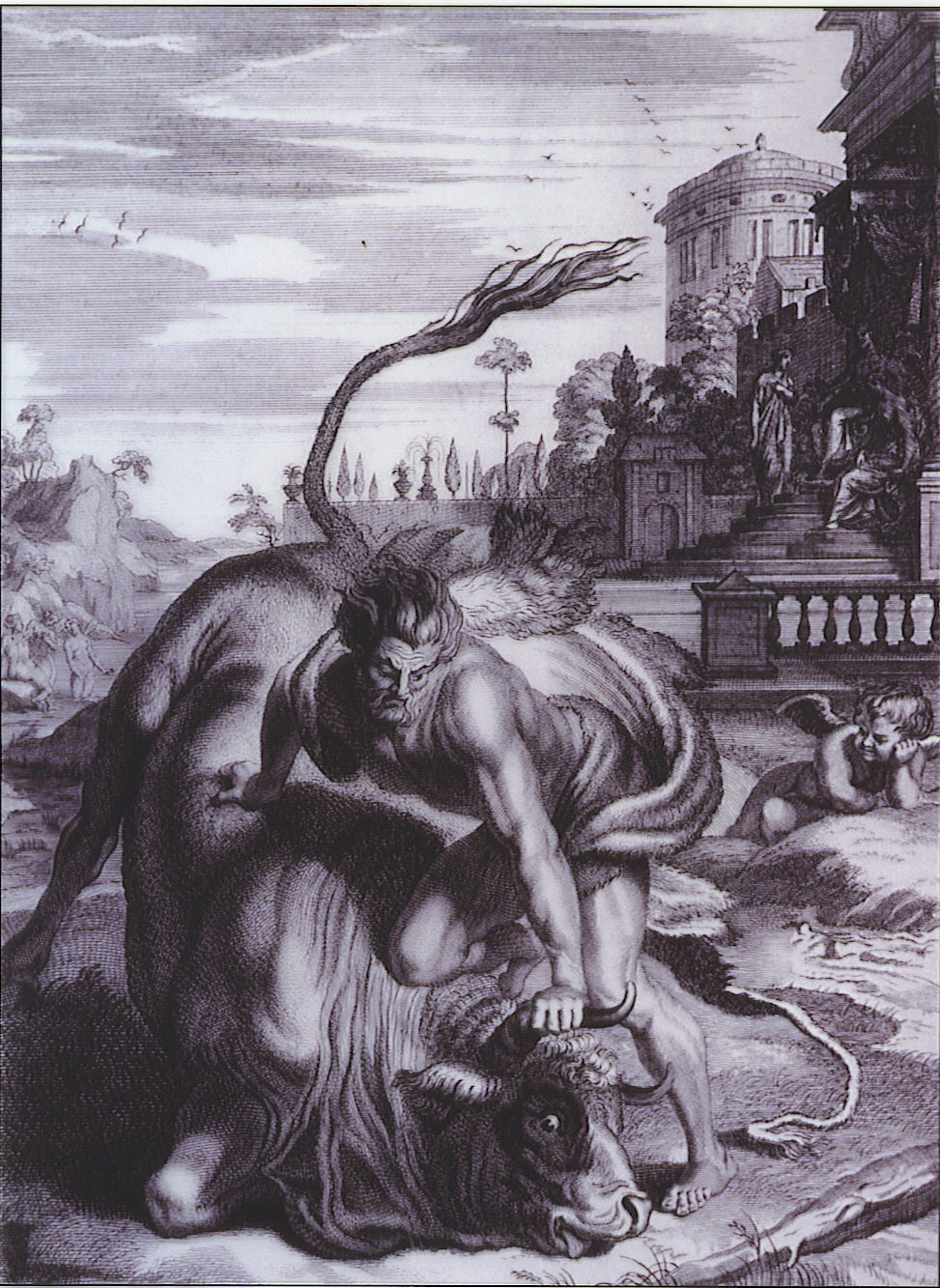
For the seventh labor, Hercules is sent against the Cretan Bull. It is tearing up vineyards and terrorizing the island. When Martin Luther reared his head in the wolds of Germany, the pope noticed and said “a wild boar is loose in God’s vineyard”. We do not know all of what Luther had to reckon with, only that his coming marked the end of a unified Western world. When the Reformation was finished, the age of Atheism and Liberalism began. It may seem harsh to say this, and there are no doubt many things to salvage from Northern European spirituality, but Luther left Europe in rags and flames.
Interestingly enough, Hercules submits the bull of Cretes in a strangle-hold, refusing to kill it, instead sending it back to his royal tormentor, who wishes to offer it to Hera as a sacrifice. Hera declines to do this, and is offended, so the bull is shipped off somewhere else, and ends up being sacrificed to Athena and Apollo. Hercules has restored the natural order of things, the Logos, since Athena (wisdom) and Apollo (war/arts) are higher divinities than the jealous Hera, who is obsessed eternally (much like a feminist) with ancient and perceived wrongs and injustices that can never possibly be “righted” except by making more suffering now.

The bull is associated with animal-instincts and drives. Not only was Crete known in Biblical times as a lustful and lazy island, but the bull itself wreaked a moral havoc on the order of the island:
Minos himself, in order to prove his claim to the throne, had promised the sea-god Poseidon that he would sacrifice whatever the god sent him from the sea. Poseidon sent a bull, but Minos thought it was too beautiful to kill, and so he sacrificed another bull. Poseidon was furious with Minos for breaking his promise. In his anger, he made the bull rampage all over Crete, and caused Minos’ wife Pasiphae to fall in love with the animal. As a result, Pasiphae gave birth to the Minotaur, a monster with the head of a bull and the body of a man. Minos had to shut up this beast in the Labyrinth, a huge maze underneath the palace, and every year he fed it prisoners from Athens.
The broken promises and moral decay had birthed the Minotaur, a beast which would also have to be slain by another hero. But that is another story. And here is a goodly lesson – it is better not to vow, than to vow, and not pay. If we fight with monsters, the only way to not become one is to keep one’s vows. This relates not merely to not using the dark arts (for one is already pledged to what is noble and high) but also to wisely watching one’s actions, not thinking more highly of Self than one ought. Some monsters are other people’s property – it is their destiny to slay them, and they are chosen to do so. If you wish to aid, aid them – do not usurp their rightful place as slayer of the beast. Slay your own beasts. The restoration of a proper moral Order in the thoughts and hearts of those who oppose the modern temper and spirit is the sine qua non of Victory, since the Victory comes from above, vertically, just as initiation does. Becoming Captain Ahab or Don Quixote will not do anyone much good. We should be looking around for the chosen ones, all the while, doing all we can to make sure we can hear the still, small voice ourselves, for God will surely call each of us to some labor of Hercules, big or small. In short, the restoration of Order will come in a divine web or hierarchy of spiritual intervention, with the sacred hero-priest-king as the focal point. Squabbling and in-fighting are trademarks of the Left, what thieves and criminals do when they have despoiled someone and are dividing the loot. A man of the Right stands for the invisible and absolute order which he alone discerns, and suffers to make visible. The unveiling of this invisible web, through each one of us, will annihilate the plots of darkness, but it has to be (as the old preacher used to put it) “all of grace” or “of God”. Here we see that Christianity still has a mission for the “New Right” – until something greater than it is found (and how could that happen, without victory?), victory will require a re-harmonization between Christian Tradition and the remnants of the West. This will be resisted on all sides, and itself proves that it is the salient point. 

It is entirely possible that Hercules could have died or failed, in which case, he would be portrayed as a massive freak and fraud. This risk will have to be born up under, but born up under wisely, and strongly, and with the best possible chance of success. This is the path of the strong – not to fight invincibly and surely, but to triumph over a multitude of doubts and anguish and sins within, and to win through (if God wills) against a greater multitude of such externally, to a doubtful and dark destiny, under the shade of the laurel and the oak and perhaps the cypress. Invincibility is coming, but for now, is not yet.
One of the greatest strengths and services and preparations for this is to read the exploits of the past and to “right the wrong” of the ancestors. Look at the Iron Guard, for example, and their fate. How could they have failed? Most men are simply unwilling to risk a similar fate, or even honor their memory, and so they conform in their thoughts. The man of the Right pays respect and honor to his ancestors, which means learning their stories and “righting the wrong” in his heart, both by avoiding their mistakes and faults, but also by re-baptizing their memory and burnishing it till it shines brightly. Only thus, in the path of the Past, can we expect to find blessing for the dangerous Future, and strength for the present. This will be unappealing to the immense majority of men, who are depressed by such efforts, and cling to a hope for a brighter future through democracy, chemistry, and modern organization. They are often more decent, more intelligent, and more accomplished than many who see the beauty of the Past for today. There are many emoluments, amenities, graces, and goods that accrue to those who forsake this fight, however reluctantly and with whatever good intentions. Others will mock the futility of the “martyrs”, and use it as an occasion to desert the men of honor from the past.

Nevertheless, after all, Zeus will be vindicated, and He is not mocked. Who will wear his laurel leaves? He who struggles to the end.

There are compensations. After each labor, you get to see Eurystheus hiding in his piloi, and hear Hera cackling with rankled and wounded pride. Zeus will send his compliments, secretly. Those who have suffered will acclaim you as their local hero. You will be allowed the noble and theatrical gesture of noblesse oblige. After all, who asked them to annoint themselves as god of this world? Who asked them to invade the past and obliterate it?
But the Consul’s brow was sad, and the Consul’s speech was low,
And darkly looked he at the wall, and darkly at the foe.
“Their van will be upon us before the bridge goes down;
And if they once might win the bridge, what hope to save the town?”
Then out spoke brave Horatius, the Captain of the Gate:
“To every man upon this earth, death cometh soon or late;
And how can man die better than facing fearful odds,
For the ashes of his fathers, and the temples of his Gods,
And for the tender mother who dandled him to rest,
And for the wife who nurses his baby at her breast,
And for the holy maidens who feed the eternal flame,
To save them from false Sextus, that wrought the deed of shame?
A man like that might make a difference, no matter what may come. That is why creating a spiritual elite (nobility) is the first task of the Counter-Revolution. Those who wish for adventure, to see brave deeds and to truly live, will be drawn to their course, and will uncover the stone of their destiny, which may be dark or bright, victorious or defeated, but which will be uniquely their own, with their own name written upon it. And this stone is part of the final victorious Temple, so that the death of a Byrhtnoth is still triumphant.

Let me sum it up to be crystal clear – the Hero will fight wisely, not beating the air, with the best chance of success, but he will also fight nobly, not avoiding an inevitable or symbolic death if the situation calls for such. God is able to equally deliver him, in either way, either before or after his physical demise or failure.

Hercules’ seventh triumph is a public act of wrestling the immorality and violence of an entire island to its knees, and sending the trophy as a taunt and a gift to his persecutors. The death of the bull, sacrificed to two war gods of wisdom and the fine arts, founds an era of moral stability, which the slayer of the Minotaur will lengthen and perpetuate. He is almost invincible, and is now acting almost openly on behalf of Zeus.

Could a determined alliance between a remnant Church and honorable pagans (who understand the divine mission of Christianity) wrestle the bull to its knees, in the tradition of Mithras, and of the Christ of Revelation? If enough men advance through the Labors, it will be a real possibility. Perhaps there is a man out there, reading this, who has within him both the Church and Valhalla, and will embody this possibility.

Monday, October 7, 2013

Labors of Hercules: The Augean Stables

The Labors of Hercules, Part 5


The Augean Stables
Hercules does not go immediately into action or battle, following his insult from the gods: Hera’s madness that causes him to murder his own offspring is the “fall” or primordial condition of sinful man who is an enemy to himself and his own kith/kin, let alone everyone else – man as a “wolf to other men”. Finding one’s self in this condition requires “penance”, but is really not the loss of anything, since it is illusory to begin with – the hero doesn’t find penance distressing. The path out of his dilemma is not “out”, but “deeper in and through”. This we have seen – The Man awakes to his sinful or mad condition, & rather than rage against the gods, he shoulders his karmic burden, such as it is, channeling his energies into carefully executing the appointed labors. So the Leftist solution of railing at the universe or shaking one’s fist at the sky is a non-starter – change begins with the Self. But even further, with some change begun, one does not therefore jump up and “clean out the Augean stables”, by reforming the Church, cleansing the State, defeating the forces of modernization and liberalism, etc., etc. It is much easier, when awakened, to immediately but covertly “rage against the machine” by marching off to clean out the Augean stables: let’s reform the Church of Rome! Let’s get rid of our traitors at home! Let us take counsel together, and purge the earth of the presence of all that is impure!

No, Hercules has worked up to this condition, & is being given tasks to perform in a logical and precise sequence. He doesn’t nominate or choose himself for any of them – he is the man for the job, and even the gods recognize this, but the jobs are being chosen proximally by his enemies. He is submitting to government through Providence, and trusting in a higher power than himself. This, of course, means that within the Hercules-cycle, there will finally be no “higher Power” but Hercules, but that is for the final chapter, upon his exaltation as a constellation.

The Augean stables are a problem that everyone knew about, and no one had solved. We could say that this is “the modern world”. What in the world do we do with all the refuse and offal from the “madding crowd” which inhabits the round globe, one and all having fallen prey to madness and imbecility? How will this impurity be cleansed?

Once again, Hercules does not come raging in headlong, like a Conan the Barbarian or Pol Pot, bent intently on ridding the earth of “undesirables”. He uses the forces of Nature itself, altering their course, to bring together the natural remedy for such a large heap of trash and garbage: he seizes a river and changes the course, immediately washing the stables.

He does this, presumably, for gratis, as the labor will be determined a “failure”, since he did not rely on his own two hands to do it. Hercules has been more cunning than those, however, who cunningly disqualify the trick. He has succored fellow man and beast, through the bounty of Nature, and provided a tangible good to all of those who are beneath him. He has stooped and entered the world of “common man”. This is what makes of Hercules more than a hero and an adventurer, and begins to give him the title of benefactor or popular hero. He will enter the mythos as a man like unto King Alfred, who brought permanent peace to England by sponsoring and converting a noble pagan, Guthrum, thus creating the Danelaw and bringing a new era of harmony, although he Alfred was redoubtable in battle nonetheless. The gods and test makers disqualify this test, but one can see that Hercules would have done it anyway. Why? Because it needed doing. Often it happens that those who make the “most progress” esoterically are those who are least concerned about it, because detachment really means detachment. Have you ever heard of the old Puritan preacher who found peace in the thought that he would at least be a monument to God’s justice in Hell?
 
It may be that the gulfs will wash us down….
Tennyson has Ulysses say this, looking out over his realm.
That is the spirit in which to embark upon dread tests, to balance out the focus and energy one brings to them (also requisite). One must play the game because the game matters. In esoteric matters, it really is “how you play the game”. Intention and personal goals, rather than a lust for power, are relevant. Even personal salvation takes a back seat to the “point” of what is happening. A hero who has no time to “stoop” and assist someone is a hero who is worried too much about husbanding their strength. Spend it, and it will be given again. Whatever your hand finds to do, do it with all might. That is the path of Hercules.

His digression is actually part of the Zodiac pattern, which must in any case have 12, not 10 labors.
An important point Cologero has made over and over is that esoteric studies is not hostile to exotericism. This, in itself, is more than likely a result of the action of God upon the human psyche, as expressed in Christianity. It is now revealed that a man not only can, but ought, to pursue esoteric studies in harmony with the Logos: that is, if you desire enlightenment, you should not neglect the study of what “sane and noble men” of the past thought, how they comported themselves, and what they believed. It is permissible to “prepare for enlightenment” in this way – by finding mentors (in the past if necessary). If done properly (in a healthy way), this does not “add” to psychic accretions or burdens, but functions as a means of restoring normal function in the psyche.

For Hercules, this is accomplished dramatically in his willingness to do an altruistic and noble deed, even though it prolongs his labors, formally. He stoops to conquer, and aids the disharmony of Nature, with sheer physical power and the elements at his disposal. In modern language, this is the much derided “helping a little old lady across the street”. It is the Earps cleaning up Tombstone. It is Oliver Cromwell threatening to send English warships against the Turks. It is the hero standing against a playground bully on behalf of someone quite small. The hero, here, seems to forsake his task and disqualify himself – he is “distracted” by the enormity of evil around him. In reality, he simply does what a real man would do, if he comes across that which he cannot abide. This comes later in the growth of the warrior-saint. It is not an immediate goal, but emerges organically as he progresses. He is, in reality, being swiftly drawn out of his esoteric path, by a deeper current, which is directly connected to the Divine. This current only seems to cost him in the short run. In actuality, it defines the essence of what he will become, although he is not yet purely and entirely ready. It is reflected frequently in popular culture, whose subconscious is aware of much of these truths.

It is analogous to distracting the already distracted psyche by giving it a “bone to chew on”. In esoteric practice, this is Ora et Labora. This is the power that gave rise to the dominance of Christendom’s arms, time and again, against much greater odds, when by all rights, Europe should have crumbled, collapsed, or shattered under the hammer blows of a much more “this-worldly” religion – Islam during its height. The religion of silver, and of the crescent, was better organized, less complex dogmatically, more victorious in arms, and oriented towards secular power and monolithic outer form. Time and again, the waves of its seas lapped at the fragile edges of Christendom, and time and again, Christendom provided men who put a pause to their own progress to take up the sword in behalf of the altar. In secret studies, one one would meditate on images, icons, or sacred “words” or phrases given one by the Spirit, while one is learning to concentrate the power of the nous, first of all towards the body, then, into the psyche, and finally into the nous-itself, prior to re-divinization in the “Self beyond the Self”, as the nous travels back to God. Robin Amis teaches that the double arrow, or the straight line and the circle, symbolizes the power of the nous that is “in the world, but not of the world”. This might also be the double-headed eagle, so commonly seen in European royal symbolism.

Here, Hercules meditates on a relatively simple and mundane problem, but one that no one has been able to solve. He came, he saw, he conquered. It doesn’t matter what the gods decree – Hercules will finish, and the labor will count unofficially, if nothing else, in the popular mythology of the folk, who recognize the good deed for what it is. In any case, Hercules is now beginning to have “power to spare”.
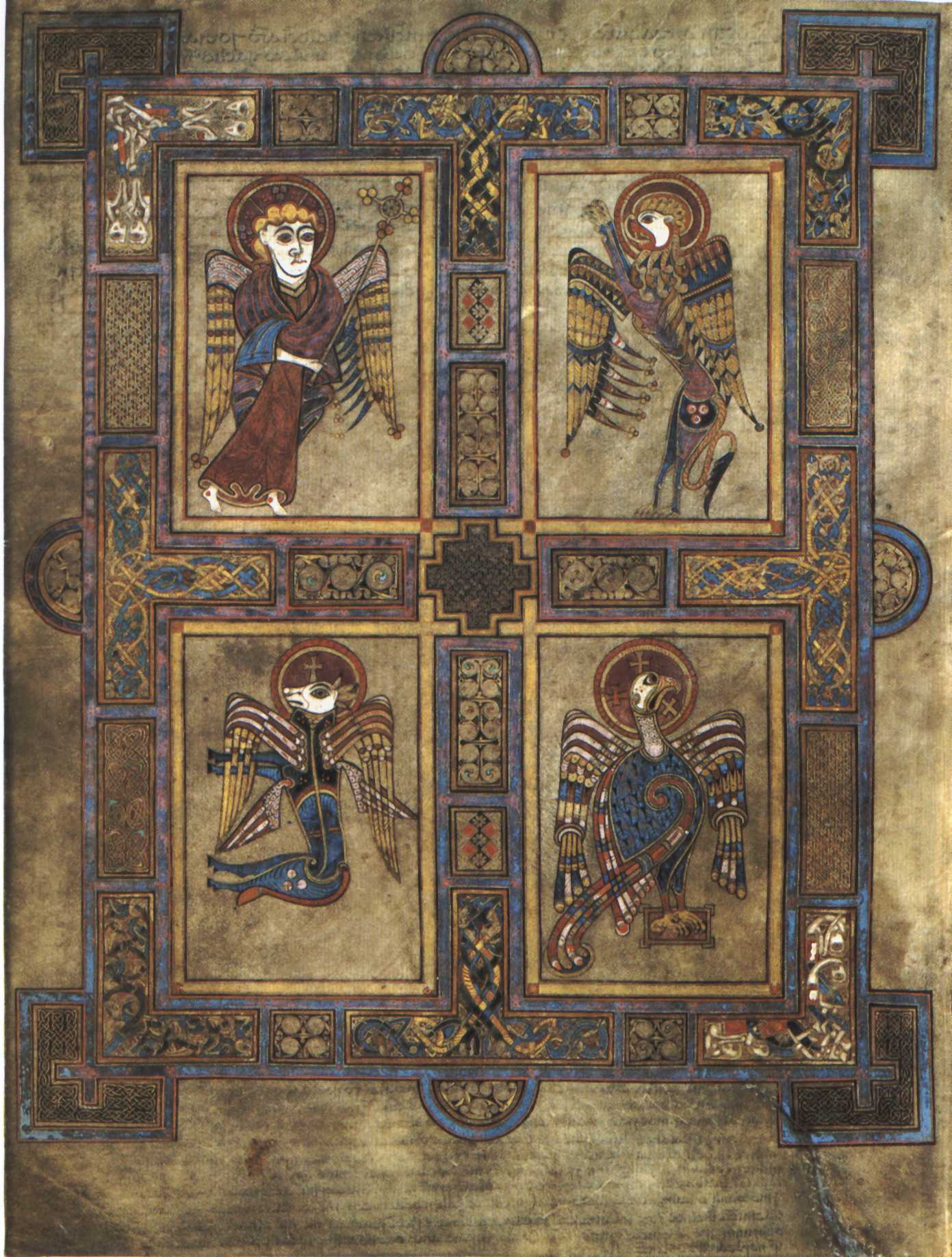
A poem beautifully expressing this is Thomas Moore’s Prince’s Day. The body and psyche, “in chains” and suffering, nevertheless expresses a strong yearning for the will of the Prince. Paradoxically, the suffering and yearning of the body/psyche provide a “distraction from distraction” – the nous is turned farther inward, and the path rather than being deflected, is intensified. The ocean wave withdraws to gather its strength. I include the whole poem – it is part of the Logos, the gift of the true West to men. When the book of Kells was created, something was added to the religion of Christ (I say “added”, but rather revealed as latent). The East isolated images in their essential purity, but if you look at the pages of the book of Kells, you see knot-work, playful animals and creatures, and a kind of background dance and delight in Nature. The Celtic and Frankish saints who converted the West were immersed in the world, and yet, still, not of it.
The Prince’s Day
Though dark are our sorrows, today we’ll forget them,
And smile through our tears, like a sunbeam in showers:
There never were hearts, if our rulers would let them,
More form’d to be grateful and blest than ours.
But just when the chain, Has ceased to pain,
And hope has enwreathed it round with flowers,
There comes a new link, Our spirits to sink –
Oh! the joy that we taste, like the light of the poles,
Is a flash amid darkness, too brilliant to stay;
But, though ’twere the last little spark in our souls,
We must light it up now, on our Prince’s Day.
Contempt on the minion who calls you disloyal!
Though fierce to your foe, to your friends you are true;
And the tribute most high to a head that is royal,
Is love from a heart that loves liberty too.
While cowards, who blight Your fame, your right,
Would shrink from the blaze of the battle array,
The Standard of Green In front would be seen –
Oh, my life on your faith! were you summon’d this minute,
You’d cast every bitter remembrance away,
And show what the arm of old Erin has in it,
When roused by the foe, on her Prince’s Day.He loves the Green Isle, and his love is recorded
In hearts which have suffer’d too much to forget;
And hope shall be crown’d, and attachment rewarded,
And Erin’s gay jubileee shine out yet.
The gem may be broke By many a stroke,
But nothing can cloud its native ray;
Each fragment will cast A light to the last –
And thus, Erin, my country, though broken thou art,
There’s lustre wiithin thee, that ne’er will decay;
A spirit which beams through each suffering part,
And now smiles at all pain on the Prince’s Day.


Monday, September 23, 2013

Hercules' Fourth Labor: The Erymanthian Boar

Labors of Hercules, Part 4

The Erymanthian Boar

Hercules had been given the (originally) ten labors as a penance for letting Hera drive him to wrath, in which he slew his six sons. So don’t let anyone tell you that penance is a “Catholic” thing. All of the labors center around a primordial world of monsters that will be rededicated to the sun-God Apollo, or to Zeus, from whom the power to cleanse & purify this region of the world comes.

Hercules originally received the wrath of Hera because he was the illegitimate son of Zeus and Alcmene. He is half-born, a godling, immortal by birth right, but not in actuality. Hera is one of the daughters of Chronos, but also a wife to Zeus. Hera represents an older form of matriarchal worship connected with earth rites and the underworld (like Demeter) that is incorporated into the male & solar spirit of the “new gods” of Greece. Her typical function is rage against Zeus’ consorts and love affairs.  We can view Hera as a suppressed kind of female power that tends to take vengeance on the half-god offspring of Zeus’ spirit mingling (like the wind) with mere mortals. Not only is he creating a race that is superior to those who worship Hera, the warrior and martial ethos threatens the earlier balance. As such, Hera is ambiguous. She is both a reminder that the Greeks “breathed their truth through lies” in the new myths (a fact Clement of Alexandria alludes to), and also a principle of retardation: there is no “going back” to the earlier stage.

We have to view this evolution from a solar perspective. On the one hand, the revolt of the warriors against the priests heralded a new Dark Age. On the other, man never rises except by suffering. As the ancients would say “he suffers into Truth”. Hera is fighting a lost cause. The forces of chaos have penetrated the ancient ordering of the castes, turning each against the others. Corruption begins with the priests, who compromise (out of fear) with the warrior caste, which is ascendent. The priests should suffer like Prometheus to bring them into a proper order. They lash out with curses and penances, after the betrayal of their compromise, which they should never have agreed to (we see the underground Occult engaged in such a struggle today). An analogous event occured in the West, in which the Frankish nobility went over to the Revolution through decadence and compromise, with the priests like Abbe Sieyes courting natural nobles such as Mirabeau, who of course caters to the third estate, who will later flirt with the masses. Garibaldi and his ilk (natural aristoi) become leaders of “Revolution”. As Cologero has written, we can see in these modern events Time greatly sped up, during the Kali Yuga, for our own edification, if we could but read aright. It is no accident that the natural dramatic flair of the French was interested in Classical themes!

Some men, like Hercules, will rise to the challenge, and prove themselves, redeeming the turbulence of the purely horizontal swirl of the world-snake Ourobous into a vertical ascent. Evolution always operates: the snake writhes and awaits the champion to bend it to a will. Even today, our genetic structures are engaged in such programming; they await men capable of rising, like eagles on a vertical lift of heated wind, up into the heavens. This ascension has to involve Christian “ideas” (not necessarily formally) as it is only through sacrifice of some sort that the necessary purity is invoked. Even in Hercules’ time, penance is necessary. That is why Hera is still important – the solar spirit embraces Fate, suffers into Truth, and guides it upward. The true man sees in the Modern World an immense potential opportunity, and begins the ascent, without for all that, endorsing the degeneracy he finds around him. Hera represents the Karma of past sins, in this case, “sins of the Father”.

Hera is “the adversary”: not an enemy per se, but someone (who for the strong man) is fulfilling a purpose & role. Without the consent of Hera, Hercules cannot be deified (as we shall she). It is her job to test the hero, and although she is insufficient to initiate solar truth, she has the power to test it.
The great boar is tracked through the snow, driven over the mountain ranges by Hercules, who descends upon it relentlessly, driving it before him. Chiron the centaur had advised him to track it in the snow. Hercules is now succeeding more easily in his labors, and the boar proves “easy” to track down. The hero is gaining more power.

What is interesting is the tale of the centaurs. While visiting Pholus during the hunt, Hercules desires wine, and convinces Pholus to open the one vessel he has, a gift from Dionysius. The centaurs do not know how to drink moderately, and end up becoming drunk and attacking Hercules, who drives them off with arrows. Chiron is hit, and the pain it causes this immortal makes him volunteer to replace Prometheus on the mountain, being tortured by the eagle. Hercules shoots the eagle, to deliver Chiron. This teaches us that Hercules is receiving the immortality which Chiron was unable to utilize properly. The drunken man-beast who tragically frees Prometheus is imbuing the rising hero with his powers.
Hercules has already conquered the passions, so he is worthy to drink of Dionysius’ wine, and can easily disperse the dangers arising thereby. His arrows, dipped in the Hydra’s blood, are more than equal to chastening the centaurs, who are wise up to a point, but unruly.

There is only so much immortality floating around at one point of time. Those who misuse this gift (their talents) will have it given to someone else more worthy. This should be an encouragement to everyone who is a spiritual seeker. When you see the powerful and ignorant, or the mighty and the evil, squandering their gifts, you should know that these will become available to you, if they continue to defy the deathless and immortal source of these divine blessings. “The meek inherit the earth”. This is taught explicitly in the Psalms, and endorsed in the Beatitudes and apostolic teaching. “Run the race, as if to win”. When someone releases their anger unjustly upon you, a right response will not only help them, it will put their lost energy at your disposal. Behind the “meekness” of the Christian tradition is hidden an ancient teaching concerning the accumulation of power. When Saint Peter crosses himself in the presence of the emperor Nero, causing Simon Magus to fall from the sky (Magus was demonstrating the power of his magic), the lost energy will go to Saint Peter. This happens with Cyprian the Mage & Justiana, as well (cited by Tomberg in Meditations).

Since we are discussing magic at Gornahoor, it would be helpful to meditate on how to make it as powerful as possible: counter-intuitively, it would seem that purity is that which renders it deeper and whiter magic. This purity takes different guises, but purity it is, nonetheless, & necessary to avoid the trap indicated by Dante, who places Simon Magus in hell. “To whom much is given, much is required.”
The tale ends humorously: the Greeks loved to depict the scene in which Hercules presents the boar to the tyrant, only to have him hide inside of a large vase. These endings are further vindication of Hercules’ divine authority and power, and an important “unmasking” of the powers-that-be: they are unequal to even receive the gift of Hercules, which they asked for.

The legend of Hercules remains a beautiful re-telling of what was good in the pre-Olympian world, a transmuting of it through the might of Hercules into something even higher and even better. Something similar occurred in the West, and one can discern the operations of Christianity on the classical ideals in much the same manner. In each case, the essence or import is preserved, but the eagle makes another turn in the gyre of the circle, and achieves greater altitude. Like the hero, it rises, on steady wings and a strong upward draft. For an instance of this, see Matthew Arnold’s essay on Maurice du Guerin’s tale of the centaurs.

Hercules represents the new warrior, the best of that breed, who dare to will a union of warrior-priest, in order to achieve immortality. One might say that a warrior is potentially an aspirant priest: if he succeeds, if he navigates the divine-demonic world successfully, he discharges his penance (against which and with which he fights), achieving the essence of immortality. Later on, in the West, this baptized chivalric ideal would be made more explicit in the body of the king. The loss of the primordial world, its descent into chaos, has to be redeemed, through the storming of heaven. If Christianity had not existed, it would have had to be invented. For those willing to undertake a similar labor, modern Christianity has its primordial monsters and jealous and offended goddesses which are willing to oblige you, in standing the test.


Tuesday, September 3, 2013

Hercules, Part 3

The Labors of Hercules, Part 3

The Third Test, The Ceryneian Hind


For the third labor, Hercules was given a retrieval task instead of a slaying to accomplish. Since Hercules could not be overcome with guile & brute force, it was hoped that he could be made to trespass against a god, & have divine fury invoked upon him. Specifically, Eurystheus hoped that this labor would infuriate Artemis, who would presumably give him the terrible fate that Pentheus met with on the Holy Mountain.The hind, additionally, traveled faster than an arrow. How was it to be supposed that Hercules could conquer both the speed of flight & the jealousy of the female Huntress?
Since deer did not inhabit Greece, this myth carries an echo of Northern Lands. The white or golden stag is not merely a supernatural symbol, but a regal one. Hercules sees the deers antlers’ glinting very far off, & begins the chase, which lasts (some say) an entire year, possibly in the Hyperborean north. At last, either by a ruse or skill of the arrow (possibly shooting one between its legs to trip it, or by using a net) or by direct permission of Artemis herself (who sides with the rugged and manly hero), Hercules comes into possession of the golden deer, on the promise that he will return it to Artemis when he is done.
 
When he brings it to Eurystheus, who intends to keep the deer, Hercules wisely lets the deer go seconds before delivering it up – the deer slips away, & the mighty Herc shrugs it off: “You aren’t fast enough.” Hercules proves himself a man of honor in this task, as he does not slay or injure the deer, but returns it as promised to its rightful owner. Here we should note that, in esoteric action, as in any other portion of Life, there are laws that obtain. Although those who travel in the astral realm encounter far fewer laws than we do, there are strictures that (for all that) may be even more indurate than gravity. One of these, according to Gnosis (Mouravieff) is that a man cannot advance in practice unless he trains or leaves behind a replacement. Karma is another law that obtains; repentance can mitigate or erase it, but still, there is something that holds true & fast – in this case, another bears your sins. Or who did you think paid your trespass?
 
I say this to encourage readers to not set up a dichotomy in their mind between royal liberation and the lesser mysteries. Not until one is set free from Time & Space itself does one become “free of all Law”, not even if one is “awakened” fully into the etheric, astral, and spiritual realms. Besides, the dichotomy itself is deadening. If one is truly free, is one not silent? Hercules is careful to observe piety and honor; it is not forced, out of fear: he speaks and converses with Artemis almost as an equal, as a better, but someone he may speak before, and she grants him favor in her eyes. There is one equal to, and worthy of, capturing the devoted and precious hind. It is the pious warrior, who nevertheless speaks with “Frankness” before the very gods. St. Paul spoke of this when he said, “all things are lawful, not all things are useful”.
 
Hercules is wise enough to insult and belittle his enemy; after all, if one doesn’t add a little salt to the wound, who is going to arrange the rest of the tests? Such a jibe befits the warrior. It is the jibe of the Russian general Kutuzov to the French prisoners of Napoleon’s army, after he has magnanimously spoken of forgiveness. Rallying his own troops, he says to them: “But after all, who asked them to come here, anyway?”. It is Frederick the Great shouting out to his fleeing men, “Ihr wolt, ewige leben?!” It is Brennus before the conquered Romans, speaking very simply back to them something that would become their own watchword- Vae Victis. Forgiveness and detachment are the rocks on which the raging sea breaks, and falls, dashing those who ride it. There should be a kind of sacrosanct danger about sinning against a truly pious man; when defers his own judgement and wrath, the wicked should tremble. Archangel Michael, no doubt in a very great wroth and sorely tempted to pass his bounds, declared to Satan’s impudence, “May the Lord judge between us!”. The wrath of the righteous, the fury of the hero, the anger of the good man pushed too far, should resolve into that ritual and controlled resistance, a detached willingness to see it through bitterly, without bitterness, which heaps coals of fire upon the head of those who take the part of Satan. This is how the enigma of forgiveness & resistance is resolved – in the action of the hero, who must understand both. Could he not forgive, he could not formalize his actions and discipline them to undergo a trial, but would simply “rage out” and go for the throat of his persecutor. Could he not resist, he would forever remain under their feet. This tension drives the warrior, like a bow drives the arrow. To those who cannot see the union of this, they are either not warriors, or do not see that “the insanity of God is greater than the wisdom of man” (Plato).
 
Guided by the wisdom of a Solomon, forgiveness and power are inseparable. Are not detachment and passion reconciled by the warrior? When someone loses their temper and lashes out in anger and injustice against you, the ability to bear the stroke without retributive ire in the same manner is actually an esoteric technique for transferring the energy they are losing to yourself. This is the secret meaning of “heaping coals of fire” upon their head – a person who gives in to the “wrath of man” loses enormous reserves of spiritual energy : especially if some physical scapegoating occurs, those energies often go to the victim, rightfully. Received in the right frame of mind, they become available as a “lost talent”. This is why God invites the “poor” of the world to his banquet : the rich folk turned him down. Their loss, our gain. If Christianity is the religion of the Kali Yuga, do not therefore conceive that it is bound to share its inadequacies: it is made to triumph over the greatest enemy, the last enemy, to devour it inside out.
 
If it wasn’t the Kali Yuga, we wouldn’t be here, reading and talking to each other to determine the fate of the new world. Other, better men would be leading. “The better man” in the end is just the one who does more things that are difficult for him – if that is the test, it is a blessed time to be alive. He who plants a garden in the Kali Yuga, against all odds, stands above he who conquers worlds, with some odds in his favor.
 
“The last shall be first – greater are those who have not seen, yet believed.”
Hercules triumphs by his ruse, his skill, his polity, his innate dignity as a true man, before man, beast, or gods. He is not to be deterred or thwarted. Nor will he stoop, except to make a well-earned jibe to further incite his opponent to useful wrath.
 
He doesn’t show up off the street and demand to be Hercules. He IS Hercules, by virtue and dint of a long process, created in heaven, ratified in the mud of earth. He has conquered mental fog and the physical passions. He has risen above those things which men almost never even begin to subdue. He is already heads and shoulders above all men, and even though, as a god, he could use his liberty and peerage, he does not. “Not counting himself to be equal to God, he humbled himself…” Hercules prefigures the gracious and valiant and terrible true knight Jesus, who is far from the lamentable and tragic figure some neo-pagans think him to be. Hercules is the new Sun.

So, in this third test which seems not so deadly because it was so successful, Hercules wins the affection and protection of Artemis; he is effectively adopted. The gods themselves are beginning to take sides. Heaven is being moved by earth. Hercules has swayed an eternal-feminine power to his side, and a mighty one at that, Artemis-Diana of the Hunt. It is a wild and primeval power that is now declared for the hero, who has presumed nothing, but has simply stood as a man ought to stand.
As Hercules’ divinity grows more obvious, the divinities who favor him, and yet remain worshiped and honored by him, begin to light up. It is as if they are lights which come alive and shine upon the hero, cutting his contours out of the dark, healing and supporting him. He grows greater, as he makes the gods greater than he. Further, he grows greater than the gods.

In the eternal moment at the end of time, when Christ delivers the kingdom of God back to the hands of the Father, the eternal warrior announces the end of all things and annihilates the worlds with the breath of the Father. This is how the warrior becomes God: with the gesture of the true man, who yields fealty, forever indominant, to the rightful and original Lord. This makes Him the destroyer of worlds, for it is this act which is the deeper magic. Our world does not understand or accept this: that is why “the wisdom of the world is foolishness with God”.

If Evil cannot stand in the days of mercy, how shall it stand in the hour of judgement, which comes? What will Eurystheus do? He is running out of labors. Hercules is proving a difficult adversary. Satan himself may have to enter the lists, as there is a “man worth killing“.

Illustration:
[Berlin, Neues Museum Herkules besiegt die goldbekrönte Hirschkuh (Herkules fängt die Hirschkuh von Ceryneia) Maler: Adolf Schmidt]

Wednesday, August 14, 2013

The Labors of Hercules, Part One


Hercules is a picture of the strong man, who binds: in Christ’s parables, he uses the image to refer to Satan, who always imitates God in a perverse manner. Esoterically, we might say that for most people (excluding Tomberg’s mysterious “just man”), “Satan makes the first move in the chess game. A greater than Satan has to come to bind the strong man, and so Hercules is also a picture of “the Lord” or the “true Self”. Since we live “in Middle Earth” & find ourselves “in media res” (in the middle of things), there is work to do. Power comes, not necessarily all at once, but in a series of revelations. As the Western Tradition teaches, God “respects” free will – we have to side with Him, or else the Asuras will bind us in service to Anti-Christ, under the dominion of a sunken Lucifer and an exalted Ahriman, the unholy Trinity.

This teaching even enters the popular imagination, in unexpected ways: in Star Wars, the line is given – “No…there is another.” This is Luke’s “sister” (who, of course, seems more like a bride, at first), with whom the Force is strong. The Self has “another Self”, & also serves the “Self Beyond the Self”.
Hercules is given tasks – he has to attain heaven by storm. Yes, he is already Hercules, who as an infant, strangled the serpents in his crib. Yet, still, there is combat, storm, warfare. As Isaac Watts penned in the hymn, “shall we look to go to heaven, on flowery beds of ease?”. However, it may be closer than we think, if we ride the storm.

His first task is to slay the Nemean Lion. King David had to slay a lion, it is worthy to note.
The Fathers mention, in the Philokalia, several means of slaying demons. Some of the demons can be scorned or ridiculed, & cannot bear focused attention on themselves, & so the basic posture of “awareness”, even letting the mind wander, to see where it goes, can bring fire upon their heads & cause them to flee.

Which demon are we dealing with, here? The demon can change into a wounded damsel in distress, luring men into her cave, & then devouring them. Since  most men’s sins revolve around sexual desire, we should naturally begin to examine this area of our lives? How & why & when are we tempted? In what manner?

The Biblical writers start the sequence with “the lust of the flesh (and the pride of life)” – and this is the first temptation of the wilderness, to desire earthly food rather than God’s Word. Women, for men, represent an appetite and a need, & it is not too much to say that, for most men, they could not live without woman, and that much if not all of their Ego is bound up in psycho-sexual desire for the woman.

Even in popular culture, it is apparent that the “outsider” status & rough wanderings in the wilderness produces, not the Alpha Male, but the Sigma male, who is capable of attracting a beautiful consort, but in many senses, does not “need” or “use” her. This freedom from the woman, inner and outer, is a necessary prelude to true spiritual potency. Hence the medieval ideal of celibacy. If this appetite can be mastered, then one can engage the Nemean Lion. (Note, I am not endorsing, absolutely, these categories, but pointing out primarily that the rigid worship of “Alpha” status by males is misplaced, even as I acknowledge that their virtues are necessary, & could be redeemed. It is they who “set the tone” of society, & they are likely to be of a latent warrior class, who are “masterless samurais”).
Scupoli advises the seeker to treat the lower chakra as a “burning fire” and to flee even the physical proximity of beautiful women, even women who are “family” or “friends”. Since this is all but impossible today, the initiate must be even stronger. He must know, with absolute certitude, that the gravitational pull of beautiful women is a reflection of an inner illusion which must be absolutely put down, with all the ruthless of the Roman generals who sowed Carthage with salt. Carthago delenda est, was the founding of the “Pax Romana”.

This does not disparage woman. Rather, it creates true freedom. What real man & father would ever experience real temptation toward their own flesh and blood? None, if the man is healthy. Even so, the healthy initiate, in spirit, must view all woman, even the most desirable, as someone he must sweep the veil of sexual illusion from, in order to see properly, at all. Paradoxically, this will make him more more attractive to woman, & invite further assault, for which he must be prepared, as a most cunning general. In ancient Christian tradition, the “necessary lie” was even advocated (eg., I am sick, I am mourning, etc.).  Part of what drives the Kali Yuga is the misplaced sexual turmoil of alpha & beta males (and to a lesser degree, everyone else’s failure to not see through the illusion).

I would encourage all the men who read these articles to do whatever it takes to master the tiger of lust, absolutely. It will look differently, in various types and conditions. Chaste marriage to one woman is a form of celibacy, if exalted and properly nurtured. It absolutely constrains the sexual desire in all but one area, &, eventually, in modified form, even that area. The details & circumstances will vary.
The mingling of races and flesh is inevitable in some ways, to some degrees, but in our time, it is actually the new Ideal. The initiate who comes to slay the Lion can take no part in this delusion, regardless of the consequences, personally. He has come to slay the Lion, not to sleep with the Demon. St. Benedict threw himself into thorns and brambles in order to master his lust. What have you done?

The power of the Holy Spirit that resides in the sexual chakra is typically the last center to be mastered by the initiate. It often remains, undisciplined, to the final breath. Along with pride, it is perhaps the most dangerous weakness of men (or women, for that matter). Man’s creative organic power that resides there was meant to issue in the mouth in a word of power that commands and creates a new world (the mouth is the lower third of the head, and corresponds to the waist). It cannot do this if a man gives himself up to Lust, under the guise of “riding the Tiger”, not perceiving that the meaning is twisted.

The foundation of asceticism is a denial of the need to quench our thirst for the female in anything other than God’s sanction and God’s time (which may be after our deaths, and not in the literal “physical way”). It also cannot be accomplished without an invocation to Zeus (made explicit in the story of the Nemean lion, in which a sacrifice to Zeus is involved in the bargain). A higher desire is required to cast out the lower one, to make room for the action of God.

This is the foundation of power. This is Rome, who resisted “Eastern luxury”, Phoenician materialism, & the violent turbulence of the unprepared Northern tribes.. Rome, in the power of Ahriman (at that time, not overly exalted), held the line and upheld the true virtus. Hercules is a warrior and a priest, at once.

Issac the Syrian actually explains how this process of “mortifying the flesh” works:
 ”The effect of the cross is twofold; the duality of its nature divides it into two parts, One consists in enduring sorrows of the flesh which are brought about by the action of the excitable part of the soul, and this part is called activity. The other part lies in the finer workings of the mind and in divine meditation, as well as in attending to prayer, etc.; it is accomplished by means of the desiring part of the soul and is called contemplation. The part of the soul by dint of its zeal, while the second part is the activity of soulful love, in other words, natural desire, which enlightens the rational part of the soul. Every man who, before perfectly mastering the first part, switches to the second, attracted out of weakness–to say nothing of laziness, is overtaken by God’s wrath because he did not first mortify his members which are upon the earth (Col. 3:5). In other words, he did not cure his thoughts of infirmities by patiently bearing the cross, but rather dared in his mind to envision the glory of the cross” (Word 55).
“It is evident from these words of Isaac the Syrian that what we call prelest proper exists when a man starts trying to live above his capabilities. Without having cleansed himself of passions, he strives for a life of contemplation and dreams of the delights of spiritual grace. Thus the wrath of God befalls a man; because he thinks too highly of himself, God’s grace is withdrawn from him and he falls under the influence of the evil one who actively begins to tickle his vainglory with lofty contemplation and [spiritual] delights…” Source
 
St Theophan offers even more detail:
“”In the soul we find three powers: the intellect, the will, the heart, or, as the Holy Fathers say, the intellectual, desiring and incensive powers. Each of them is assigned particular curative exercises by the holy ascetics. These related excercises are both receptive and conducive to grace. They need not be contrived according to some theory, but rather chosen from tested ascetic labors particularly suited to a given power:”
-St. Theophan the Recluse in “The Path To Salvation”

Our wayward, random thoughts are “women” which attract the identification of Self: we chase them, they then transform into a demon, and “slay” us, by drawing us into illusions. It can be a long time before Hercules ever makes it out of the cave.

Saturday, July 27, 2013

Esoteric Christianity & the Anti-Christ


Saint George
Part of the problem with standing in the Western ruins involves clearing away the fog of spiritual war, which is deliberate and has the effect of turning the conflict into a free-for-all, in which chaos and confusion deepen demoralization. Rudolf Steiner’s work is important in any history of esoterism, however, his reliance on evolutionary terminology and concepts, and the deterioration of Theosophy/Anthroposophy following the acceptance by those movements on modernist or New Age categories of thought, make this a perilous project. Nevertheless, Steiner potentially gives Western minds the ability to cognitively “discern the spirits” and rightly “divide Thoughts”. Specifically, the work of Gemmdy Bondarev is helpful in accomplishing this.

Bondarev’s magnificent chapter on the Mystery of Good and Eviloffers a platform from which we can see what is happening upon the world stage, in a manner compatible to Christianized minds, given that the Anglo-Saxon & the Romanity blocks of mankind were given the task of developing man’s consciousness in a certain direction, thus giving them the Imperium but also exposing them to unique dangers. Corruptio optima pessimi, so they say.

In a nutshell, the teaching is this:

In this era, for which the Christ was necessary to guide and develop man’s increasing Luciferic impulses in the imagination and the growing Ahrimanic dominance of Number/Measure, the specific danger is that a New Trinity will be formed, not from Christ upholding Lucifer with his left hand (from falling into fantasy) and suppressing Ahriman with his right (from reducing everything to King Whirl and the God Number), but from the Asuric powers which will harmonize Lucifer and Ahriman in their own Anti-Christ, to replace Christ. The issue is as much about Higher vs. Lower, as it is, “Good” versus “Evil”.

The Asuras are demons (archai) of the lowest order of angels, spirits of sub-personal impulse, which will attempt at this moment in history the subversion of the Luciferic gift of the ability to choose between Good & Evil, and will use Ahriman to initiate or incarnate a one-world order or earthly paradise, in which man is made comfortable and easy in all of his animal impulses; thus the spiritual degradation will occur unnoticed, apace.
To those steeped in Tradition, this sounds not only plausible, but familiar.

Christ knew the danger of this moment, and His descent into hell was designed to redeem the possibilities of Lucifer and Ahriman (higher angelic powers) in order to maintain a balance, only accomplished under the higher “I”. The Asuras, by contrast, need man’s spiritual energies to be directed to lower, or sub-personal ends, in which man will become an animal, and eventually, lower than an animal. They are incapable at this time of being redeemed (they are Legion, and Christ sends them into the pigs), and will collapse during Cosmic Ascension into the “eighth sphere”, or the outer darkness, where there will be Aeons of gnashing of teeth and weeping, as no one knows (at this time) how they will be redeemed, or if anything of humanity they have carved out for themselves will survive this outer darkness to be Recapitulated when the Eighth Sphere is regained.

This is “feeding the Moon” on a vast scale, or something even worse. The Fathers dealt with these creatures in the deserts of the Thebaid, because these misguided angels need man’s energies either to survive at all or simply out of envy (no one really knows for sure – their intentions are not “enlightened”, even to the extent that Lucifer’s were). This lower order of fallen angels is purely demonic and sub-lunary. That is, they cannot expect to be mastered by man (as other fallen daemons may be capable of), but actually have to be “killed” or left behind. They are not nature spirits, angelic archons, or even “daemons”, but sub-personal demons who are seriously retarded, and have “evolved” by degeneration. It is their power that is evident and prime during the Kali Yuga

The prelude to Anti-Christ is the milieu of a coming earthly utopia in which life is made easy for Shudras and Out-Castes. These peoples identify with the Asuras. They reflect cosmology, by being parasitic, and needing the higher elements to be made lower, so that Life is made easy for them. However, unlike Lucifer or other fallen angels, who were the “gods” of the old myths, they are not “higher” than man in any sense, and it is doubtful whether they can be “taken with us”, so to speak, even on our terms. The Christian Tradition’s solution was to excise them totally, to separate from them. Modern esotericism entertains more hope. This is an interesting question: all agree that they are sub-personal. They may specifically be sub-personal, in particular, to the Western project of generating a sanctified Ego under the direction of Logos, an Ego capable of being “raised up”. This was the basis of the Super-Ego which dominated Western high culture until recently.
Evil acts when Good is exalted (although it appears the other way around to us in the Kali Yuga). Thus, the danger of man as he attempts to redeem his consciousness and integrate his lower and higher I (Alchemy) is that he is exposed to the action of the Asuric forces, in a false Trinity: this is the Reign of Quantity, or the Age of the Anti-Christ, or “Modern Times”. It is a necessary step with laws of its own, one of them being that Man has to be capable of discerning cognitively what is happening in order to clearly resist. 
Here is Bondarev on discerning the times, & it would apply interiorly, as well:
The earthly human ‘I’ arises through the combining of these ingredients: thinking, feeling and willing. They all owe their genesis to the earthly existence of man: the higher nerve activity, the sensations and perceptions and a certain unconscious, instinctive force – the will. All three ingredients have a positive and a negative pole: affirmation is opposed by negation, a positive feeling by a negative one, constructive will is opposed by destructive will or absence of will. All this has long been known to the traditional sciences. Spiritual science completes the picture by adding the knowledge of the personified nature of all psychic and spiritual manifestations of man – his qualities. When physiology speaks of the decay of nerve substance during the thought process, Anthroposophy provides in addition the teaching of ahrimanic beings, of their goals and world-mission. When psychoanalysis describes the ‘sludge’ in the soul and the various confusions arising in the human ‘libido’, Anthroposophy places over against this the teachings of the ‘Doppelgänger’-being dwelling in the sub-nature of man, and of reincarnation and karma. The conditions prevailing in the cosmos require of man that he should attain knowledge of the world-battle waged by the Gods against the luciferic and ahrimanic hordes. In this battle the highest God, who passed through death on earth and pointed the way to the final overcoming of the world-dualism of spirit and matter, is on the side of man. But man can follow Christ only in the ‘I’, for He is the God of the human ‘I’. This means that, in his ‘I’, which he lives out in the combined faculties thinking, feeling and willing, the human being should strive for the ideal of the higher life, which brings not impoverishment and loss but enhancement of self-consciousness and the wealth of individual being.
The spiritual elite will have to sharply “discern spirits” in order to brighten the Light sufficiently to discern the second coming of Christ, both to battle Anti-Christ, but also to accept and know Christ – too many Christians will think that the Anti-Christ is Christ himself, or be demoralized. Likewise, many of the esoteric high initiates in the West are like the misguided spirits, and cannot discern the possibility that they have not “arrived”. They are living in a “false heaven”, and are vulnerable to subversion. In fact, in the West, they have succumbed en masse.

This plays out in history, following the triumph of Christianity, as a second temptation:
The new epoch brings yet another problem. If we disregard mass culture, which is already in a terminal state of decline, and we turn to those who, in the face of all hindrances, have found through their connection with esoteric Christianity the strength and ability to balance the working of Lucifer and Ahriman through the impulse of the Christ – the God of the human ‘I’ who reveals Himself through the Holy Spirit when the human being overcomes everything that is national, tribal, racial – we find these people confronted now by the retarded spirits of time, the Asuras. They lie in wait for those who are striving towards the consciousness-soul and cause them to lower this into the sphere of the instincts. For this reason the Anglo-Saxon and German-speaking peoples, whose task it is to bring to birth the ‘I’ in the threefold soul, and who therefore have to master the consciousness-soul, and also those who turn to Anthroposophy, incur the greatest risk in the new epoch. Dangers have always lurked on the path of development, and this will always be the case. But if we expose ourselves to dangers, we should do so with understanding. It is a purely Asuric idea to want to build an earthly paradise where man is not exposed to any risks. The majority of people will be led in the new epoch to a certain degree of individualization. Intellectualism will increasingly become a possession of the broader masses, but for the sole purpose of harnessing these masses completely to mechanized culture, to the extent that the human being will be incorporated as an element into the various mechanical-cybernetic systems of the future, and also, in part, of the present. The ‘Highest’ to which man can look up will be, instead of the Spirit Self, ahrimanic immortality, while the most varied cybernetic-parapsychological refinements will spread over the earth, which not only prolong human life, but also rob souls of the possibility of passing through a spiritual evolution after death. In the last resort it will be possible to convey a not inconsiderable portion of humanity into the sphere of the electro-magnetic energies, the fallen ethers, in order on this foundation to build up an anti-world, an anti-cosmos, which will be placed over against the divine world creation.  The initiates of the Latin and the Anglo-Saxon race know of this and look upon such a perspective of development as being quite acceptable. But it is not given to them to understand and become conscious of the fact that there is no place in it for the human soul and spirit, as they are subject to the influence of ritual (ceremonial) magic. Already these people are the virtual rulers of the world. Must we keep silent about all this, and wait patiently for the events to unfold? – May every thinking person answer this question for himself. We owe a certain forbearance to the person who simply does not want to believe all this, who thinks that the world is moved by the chance fortuity of events and the play of arbitrary choice or of the noble intentions of human beings standing in isolation to one another. But it is quite different for those who have grown out of the swaddling bands of their social, political and occult infancy. They should on no account underestimate the significance of present events. Rather, they are such that their significance cannot be estimated highly enough. We are the witnesses and participants in a cosmic mystery drama, the course of which has an immediate bearing on our own destiny.
So we are in the middle of a morality/mystery play. Hence the popularity of such works as Harry Potter. Voldemort is coming back.

1. The goal of those who wish to stand should be to master themselves first of all. Guenon, the Church Fathers, traditional Eastern wisdom, and the insights of Western “mystics” all agree on this fundamental point of discerning the origin and arising of spiritual impulses. In the West, the emphasis on Logos was designed to structure and rule the mass of the inner world, providing a way of discrimination. No Western project will be able to do away with Dogma and Logos, both because of prior shaping and because of the unique Western task of integrating the lower I with the higher I, which implies not a retreat from matter, but its spiritualization. I don’t intend to debate or discuss whether the difference with the East is fundamental or a matter of perspective, as others are more qualified. For the beginning Westerner, it hardly matters, except to point out that Christianity is likely a more suitable vehicle for their climbing of the Ladder than anything else. Part of learning to stand is mastering the fear and fog of our currently engineered situation: God’s winds are still blowing; friends and enemies are not easily discerned, but they can be discerned. Use the Logos to help decide.

2. Secondly, the structuring of society in a Traditional order will have to occur, but it will have to be done voluntarily and in full spiritual freedom and insight. Establishing an outright spiritual tyranny, however desirable from the point of view of the alternative, will not work. However, this doesn’t mean that the accusations will not be made, even if Western man “returns”. As Westerners return to the Eternal Fountain, they will have every name in the Book hurled at them: Fascism, Totalitarianism, Elitism, etc. A patient ability to refute and answer and hold fast (Apologia) will be in order. We will be in the same position of the early Christians, who had to be ready at all times to give a gracious and seasoned answer for the hope within us.

3.Thirdly, one can see that the old religions are not irrelevant, since generic “initiation” doesn’t necessarily solve the problem on a grand scale, but rather opens one to the possibilities of subversion on the astral plane. The post-mortem state is still relevant, and indeed, may be a safer mode of spiritual transit (if Reason is allowed to guide the soul) than outright spiritual baptism during the Kali Yuga. In fact, one might even argue that Christianity is the religion par excellence of the Kali Yuga, in that it does not require elite knowledge, but only that a connection to such be vital (through apostolic succession, angelic influence, and/or esoteric Christianity). It may actually be a “shell” to protect a vulnerable and newly born “ego” for the post-mortem transit. Isn’t this precisely Evola’s point in regard to Roman Catholic theology?

4. Regarding Steiner, if Steiner’s “evolution” is seen as prior in Time, but not in logical priority (as Cologero has written is possible), or in terms of Inner Form, then his views of ascension are not necessarily New Age, but rather can describe the trajectory of man’s development during the dark Age of the Kali Yuga. It is unimportant that he has become a “movement” subject to degeneration: the Roman Church endorsed Vatican II, but this doesn’t mean that the war is over, or that all is lost.
The Chaos of the Asuras is allowed because it will deepen the strength and insight of the newly born Western Ego under Logos, to not only freely choose God, but to even pierce to the possibility of discerning Christ and Anti-Christ, which is a different task than discerning Good and Evil. The old liberal mindset sees only cardboard Good and cartoon Evil. In the coming storm, man will definitively be lead to choose between Higher and Lower, and maybe even Good and Best. Man will acquire Sophia, the gift of judging angels, and discerning/commanding demons.

In the Christian Tradition, we would say, God doesn’t want angels, but “sons”. Perhaps the innocent child, the Ego that looks up to the Heavenly Father, the “sheep of the personality” (Tomberg) is the only inner warrior capable of beginning combat in perfect humility against the infernal forces of the Kali Yuga.

Friday, July 19, 2013

The Trivium & Mystery


Cologero’s translations have provided this gem, from de Giorgio:
“We could also call it “intuition” although no psychological quality is given to this term: the psyche in fact is below the spirit, the intellect, the heart—these three terms denoting, under three aspects, the same type of integrative activity of the divine. The spirit expresses the direct integration whose absolute type is the divine breath, the intellect expresses the cognitive permeation, the heart expresses radiant receptivity: by means of the first, one is elevated, with the second, absorbed, in the third, one is welcomed and realizes himself. Representing here a vertical axis, the spirit is the peak, the intellect the base, the heart the center that gathers the two extreme points and extends them, prolonging them horizontally, hence the Cross as radiant symbol of universality and unifying centrality.”
The intellect, the heart, and the spirit are One. I would like to relate this to the Trivium, in the Christian Western Tradition. The Trivium consists of grammar (which is emphasized first), then logic (which crops up second, as the pupil reaches puberty, which is age-appropriate), and finally, rhetoric, where the student begins to be the master of his knowledge, rather than being eternally dominated by Facts in a kind of Gradgrindism. Now, none of these occur without the other – even young children learn a form of rhetoric, in the form of songs and poetry and stories. It is merely that the emphasis of the logical progression occurs in an age more suited for it, while the other two categories receive only their due. If we were relating this to a knowledge of castes and Order (including internal order) we would say that the Spirit correlates to Fact, the Heart to Logic, and the Intellect to Rhetoric (for true self-consciousness is consciousness of the Master inside, allowing domination of both Self and Destiny). The Spirit initiates, or factualizes the supernatural; the Heart has its inner logic that we must learn to listen to; the Intellect realizes and epitomizes the power of the Invisible made Visible, the fruit of what has gone before.
This explains, by the way, the strange association of heart & head, the primacy of God’s calling, and the divinization of man within Supernature, becoming God’s equal by Grace.

I did not read this schema – it was obvious to me, latently so, when I read the passage above from de Giorgio. On the contrary, one might choose to say, at times, that the Spirit leads by an inner logic, the Heart creates a vision or rhetoric of the goal, and the Intellect deals with the “facts” the matter. I would reply – the student/pilgrim will at various stages emphasize different portions of their Trivium, and so a change of emphasis or the seeming appearance of a “shuffle” of responsibility in certain circumstances, does not destroy the analogy. The exception, in other words, should strengthen the rule: the analogy fits.
The Trivium was made explicit during the Carolingian period of Western civilization, and is surely cognate in some inner way to the doctrine of Trinity; if nothing else, reflection such as Augustine’s on the tripartite nature of the soul and its relation to the tripartite functions of the persons of God encouraged a numerical attention to Three. Adding this to the Quadrivium produces a perfect number, Seven.  There were, of course, ancient Pythagorean doctrines (derived from Egypt) which taught ruler-ship by the Hebdomads or Sevens. It should be unnecessary to point out that the medievals would have seen significance in Four Gospels, Three Persons of the Trinity, Two Natures in One Christ, and the Divine Unity.

Are the “Three” related to the Spirit, the Water, and the Blood of Saint John?
And there are three that bear witness in earth, the spirit, and the water, and the blood: and these three agree in one.
One of the discouraging things I see in Christianity is an inability or unwillingness to reconsider previous meditations in light of new ones. Are the liberals the only ones who are allowed to be daringly adventurous, since the Fathers who wrote the Philokalia have not their like today?

For instance, we might ask ourselves, as Christians, more than just where the revelations to Adam or Enoch went. We could even ask more than whether Guenon was right to argue that Christianity was just one vehicle or aspect of the Tradition, or whether men like Jean Borella are right to criticize Guenon as a “Judaizer” of sorts (the answer to this is mostly irrelevant to the spiritual level that most Christians, or most people, for that matter, would find themselves at in this life). My belief is that, in looking for correspondences in other religions (if done in obedience to the Spirit), Christians will be strengthened and surprised in ways that intensify the experience of their own Tradition, if it is kept rich enough. Who, for instance, is the Sophia in Proverbs? We have an advantage in our Era, in that, certain questions having been tentatively elucidated and put forward, the modern situation is such that no conclusively binding regulation on conscience has been reached by the Faith. Perhaps we are missing great opportunities here?
I will suggest something else for those who are interested in esoteric Christianity. During Pentecost, each person heard the sermon of Peter in their own tongue. Since Pentecost only recapitulates what had already happened  I would like to posit, as a means of reconciling the findings of Nag Hammadi with Orthodoxy, that Jesus’ inner circle of discipulos each heard the Christ speaking in the language of their soul certain secret sayings known only to them. Whether this occured at once, or whether it was done mystically, or one at a time, we take it at face value what the Gospels and other texts confess: that these are the sayings of Jesus given to this or that one of the disciples. In other words, each was given the “One” in a form that they could understand and pass on. The Synoptics look very much the same, book to book, but try reading Mark and then skipping to John.

This presents no problem for Christian theology, in that there may still be preserved four exoteric Gospels, perhaps (also) for that reason kept more accurately and therefore more reliably. This presents no problem for esotericism within Christianity, as it is not dependent on the Letter or written record in any case. But it does reconcile what we know about history and archaeology, in broad enough terms, to declare a peace with Tradition.

If Christians were more attentive to our own Trivium, we would have no need of Traditionalists to teach it to us, today. Or Gnostics, for that matter, real or imagined.