Friday, October 2, 2015

De Quadriformisratio

On The Quadrivium
Preface
"For what avails a golden key if it cannot give access to the object
which we wish to reach, and why find fault with a wooden key if it
serves our purpose?" (De Doctr. Christ., IV, 11, 26). - Augustine
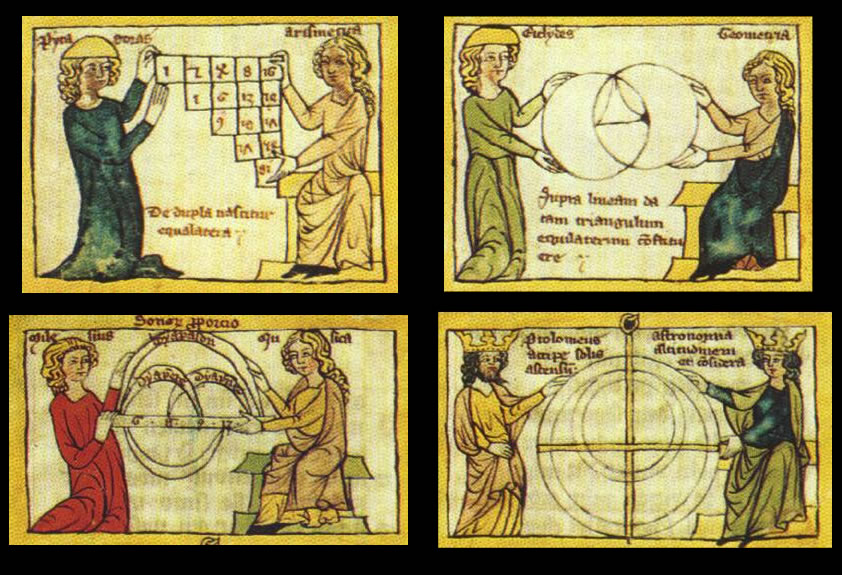
This book is an extended argument for the utility, beauty, and subtle necessity of an ancient discipline and practice known as the Quadrivium. As we discuss the Quadrivium in detail in the following chapters, we will see that it is higher Number, as manifested by itself (Mathematics), in space (Geometry), in time (Music), and in Space plus Time (Cosmology). If the Trivium (grammar, logic, and rhetoric) is the means whereby the Egyptians are spoiled of their treasure, then the Quadrivium is the design for the tabernacle of the Lord, which was built with attention to mathematics, order, detail, and according to a design which was divinely inspired, according to the archetype of the true Jerusalem, which is from above and heavenly. The Trivium properly is the glory or the spirit of the Faith, but the Quadrivium properly represents the body or wisdom of the Faith, the matter of what is made known.
I say this as a generalization, since it is quite equally true to assert that the matter or content of the Quadrivium generates a style or form all of its own, just as the style and flair derived from the Trivium is capable of generating content or substance. Yet this, all the more, should inform us that the Trivium and the Quadrivium go properly together – they are indivisible at the highest level of human knowledge, and each is indispensable to the other.
In order to put this case at length, I will start in media res (in the middle of things) with the Trivium, its better known twin sister. All too often, both the Trivium and the Quadrivium have been allowed to rest in the hands of the enemies of the Faith, but lately, we have made progress in recovering one of them. It is a start, and a beginning. But there is more to the story, and much more to even that part of the story.
The 20th century witnessed the unexpected resurgence of something called the classical Christian school movement. Inspired by the famous 1947 Oxford essay by Dorothy Sayers, the movement took (as its hallmark) not only a return to God-centered education, but a focus on the ancient Trivium. In Sayers' words, she retrieved what she called a "modern Trivium – with modifications", from the dusty shelves of Oxford and the medieval period, and dusted it off to show it in a new light. Although she said her views were “neither orthodox nor enlightened", Sayers had the interesting and admittedly personal insight that there are roughly three stages of learning that you naturally see in the development of the human psyche, and that these three stages can roughly be correlated to the grammar, logic, and rhetoric of the old Trivium. She identified a poll-parrot stage elementary school stage, followed by a “difficult” stage of argument in the junior high years, and finally a rhetorical stage of expression in the late teen years, and beyond. This essay was republished in The Lost Tools of Learning, by Douglas Wilson, and became a set-piece for the classical Christian school movement.
Regardless of the possible critiques, objections, and second thoughts one may proffer to and about Sayers, her essay inspired the movers and shakers of the late 20th century in what may justly be called (along with homeschooling) a massive rebirth of Christian education. It is not too much to say that her essay was the efficient means of sparking a revival, of Christian education in America. Whether she was right or misguided, can be debated – those who began the movement were inspired by her essay, although it remains to be seen whether the revival will result in renaissance and restoration. Certainly, recovering the Trivium tradition was on the whole immensely important.
Dorothy Sayers, in her essay, asks if you've ever watched and wondered why it is that modern literate people cannot seem to define their terms, distinguish first principles, respond to arguments appropriately, or follow a highly complex chain of reasoning. She wishes us to see that it is the neglect of the Trivium disciplines which are indirectly responsible for the slobbish and retarded condition of our public discourse, & I for one am inclined to agree with her line of thought. It is certainly true that the medieval ancestors would have never tolerated such sloppy public discourse in their dialectic quod libetas or university debates. Whether Sayers was right or not in her theories of human learning and development, it is certainly true that restoring the Trivium to a central position would add lucidity to modern thought. Even her staunchest opponents would have to admit that it was a “happy blunder”, in that sense. It is not too much to expect, of a high school graduate, that they can define their terms (grammar), reason soundly and recognize confused reasoning (logic), and express themselves clearly (rhetoric).
Sayers, in her essay mentions the Quadrivium but skips over it for the time. She also concludes her essay with this striking paragraph:
The combined folly of a civilization that has forgotten its own roots is forcing them to shore up the tottering weight of an educational structure that is built upon sand. They are doing for their pupils the work which the pupils themselves ought to do. For the sole true end of education is simply this: to teach men how to learn for themselves; and whatever instruction fails to do this is effort spent in vain.”
I would like to raise a question, at this point, one which she might (perhaps) have answered had she discussed the Quadrivium in more depth. Is there not a difference between Learning (on the one hand) and (Wisdom) on the other? The medieval idea (and the ancient one) was that education's goal was Wisdom, and not Learning per se at all, as much as it was cherished. The modern idea that education's purpose was the “shoring up of civilization” was only one aspect of their aims in instruction. Perhaps her choice of words was dictated by the audience she spoke to, and that is certainly the charitable point of view. Yet I would ask the reader to go with me a little deeper, into the Quadrivium, and the quest for Wisdom with a capital W, beyond the statistics of the US Dept. of Education, beyond the degrees and the dollars, beyond even the scholars, and certainly beyond what today is called “higher education”. To bring lucidity to modern thought is certainly desirable, but not if the assumptions of modern thought go unchallenged: it is certainly possible (for example) to hold a purely material view of the world, and defend it with grammar, logic, and rhetoric.
We may well go on to ask then (as she does not), why it may be that even were our collective discourse to become sharp and precise, it would still be lacking both elevation and sublimity. That is, having addressed the method of “how do we learn” and offered a strong correction, there still persists the question “what shall we learn about?”. What is the content and the form and the goal of Education? Originally the Trivium's whole point was to create a fortress and weapon of the Mind (in the service of Wisdom, and later, “the Faith”). Now along the way and incidentally, it certainly does manage a great deal of this, for in order to study the Trivium, students read a great deal in the classic humanities. It is hard to read Cicero and Virgil and Milton without acquiring some elevation and also some profound sublimity. Contact with the “classics” often imparted some of the tone and moral style in them to the mind of the student.
Nonetheless, reintroducing the Trivium will not formally or substantially solve the horrifying problem of the lack of substance, sublimity, and richness. By itself, the Trivium gives us comprehensiveness, efficiency and clarity, and style: but it can only borrow substance from the humanities which it uses to cut its teeth on - Greek and Roman history, literature, and philosophy. This is done indirectly, as the Trivium student works through the humanities. The humanities proper are to be considered as principle subjects, as opposed to the tool disciplines of the Liberal Arts (the Trivium + Quadrivium). Now it is true that Christian education addresses the issue of content directly through the confessions of Faith which over-arch the classical Christian movement. New Saint Andrews makes it clear that the context of the Faith defines the context which the Trivium works upon:
The Scriptures of the Old and New Testaments are our only infallible rule of faith and practice. The Lord Jesus Christ committed these inspired Scriptures to His Church (1 Tim. 3 :15). We therefore defer to the witness of the historic Christian Church as a genuine but fallible authority, subordinate to the Scriptures themselves, in discerning what the Scriptures teach. Because they faithfully witness what is taught in the Word of God, we receive the great creedal statements the Church has affirmed throughout the ages: The Apostles Creed, The Nicene Creed, and the Definition of Chalcedon. Moreover, we believe that the reformational confessions of the 16th and 17th centuries (including the Westminster Confession of Faith of 1646, the Heidelberg Catechism, the Belgic Confession, and the Canons of Dort), of all historic statements, most fully and accurately summarize the system of orthodox Christian doctrine revealed in Scripture. Therefore, the specific headings below do not exhaust our doctrinal understanding, but rather identify those doctrines that merit greater attention today.
NSA (New St. Andrews is the college which Douglas Wilson started and an intellectual headquarters of the movement in Moscow, Idaho) mentions the Quadrivium as something people can “go on to study” as part of more “advanced study”. So hasn't this settled the issue? Isn't this the way to “enhance the Trivium”? To do more than just impart lucidity to the conditions of modern thought, but to begin to challenge its core assumptions as well?
Their argument might run as follows - Christ Himself is the Substance of what the Trivium studies, and provides the treasure which the well trained classical Mind defends by attacking every thought hostile to Christ and taking it captive. So why cannot we say that the Faith, or Christ Himself, is the beauty, truth, and goodness which we seek? The “more” which the Trivium helps us to learn how to learn about? Can't we just weave the Greco-Roman (Hellenistic) world into a narrative which dovetails with the narrative of God's redemption in His people? And content ourselves with the history, literature, art, and philosophy of the classical era, spoiling its riches (to use Augustine's phrase) to adorn the tabernacle of the Faith of God? Can't we just develop a grammar, logic, and rhetoric of Truth, Beauty, and Goodness, as summed up in Jesus Christ? Why would we have to make things more difficult by adding canonical subjects which can handled electively? For that matter, why is music or geometry anymore important than pre-medical studies or foreign languages for high school students, or anthropology or nano-technology for our collegiates? In short, aren't we hunting snipes here? Or maybe just cow-tipping? Finally, doesn't the Quadrivium have a funny name? Just what is the Quadrivium, anyway? Doesn't it have something to do with mathematics?
Just as we define our method in the Trivium, a method for the mind, so we can call Christ our goal and content, the treasure chest of Beauty, Truth, and Goodness. So we seem to already have an answer of sorts, ready made, within the classical Christian movement – the sovereignty and majesty of the King becomes the material which the mind exercises itself upon. The Faith is the body of knowledge and belief which the Trivium uses and meditates upon, and even as students read about the wars of Caesar or savor the poetry of Homer, they are being taught to look through the lens of that earthly beauty, toward something “more”. By faith, we know what that “more” is. It is a sound argument, both cogent and well constructed, and the conclusions follow from the given premises; it can be beautifully expressed, and often is; it is capable of defining its terms, and it is an improvement on just adding Bible class to a public school education. This much, this far, is very sound.
The corollary to the above is that we really don't need the “Quadrivium”; not as Tradition defines it, or at least not the Quadrivium per se. Students can supplement the Trivium training, the theology and the philosophy of the Faith, and the exercises in the humanities, with courses in practical art, music, perhaps a foreign language other than Latin, maybe some athletics. We have our method, and we have our standard, goal, and our motive, which points us to the great body of truth - Christ. We seem to have it all, here. All that remains is the carrying it out. Go forth, we tell our young students, and take every thought captive to Christ! The Quadrivium is optional, but certainly not necessary or even extremely useful. At the very least, it is the mysterious younger sister of the pair, and by far the least important.
Now while the recovery of principal subjects (under the eye of the confessions of the Faith) does constitute a direct address to the problem of content, it still remains true that it fails to address the issue of the innate form of the content, by neglecting the tool disciplines of the Quadrivium, which impart a certain form or structure (a discipline) to the content indirectly preserved in the principle subjects and indirectly recovered through texts encountered in work with the Trivium. This includes, but goes beyond, mathematical Form in general, just as the Trivium includes, but goes beyond, linguistic Form in general.
If the Faith points us towards God, and the Trivium helps us sharpen our Mind, then the Quadrivium tells us something about the body and scope of Nature, considered in and of itself. Faith reaches the summit of the Divine (Super-Nature or the Lord God), and the Trivium teaches the Mind to reach its own summit in lucid self-reflection. But the Quadrivium investigates that which is Logos – that is, the specific and real union between God & Man. All three (confessional, linguistic, and mathematical) forms have a proper center of gravity, but all three include (or touch) each other. Remove one of the legs, and it weakens the structure of the whole, a structure which we express in the principal subjects like History, Literature, and even Philosophy and Theology.
We might go even further to illustrate this hunch. If the Trivium helps us "learn how to learn" (in Sayers arresting and concluding turn of phrase), the Quadrivium helps teach us what to teach, and how to teach it. The Quadrivium demonstrates intuitively how the Logos knits together the world of all that is, including God Himself. The Quadrivium tells us about the actual pattern God uses to draw Nature up into Super-Nature, transforming it and sublimating, making it One with Him. It teaches us to discern the method whereby God incorporates Nature (or the world) into Himself. It is a bridge between the Trivium and the Faith, just as it is a bridge between the Mind and Super-Nature. It considers all things as part of a whole, which is God.
Perhaps this is why the Quadrivium is not more discussed – it involves very old and deep theological realities which have been forgotten or distorted. We follow CS Lewis on this point – God is that which is most Real. In The Great Divorce, Lewis makes the case that the reality of God is the source of “reality”, and is therefore, more “real” than mundane reality. We become real by restoring His image and being transformed into His likeness. God created the world by an act of Love, withdrawing or “wounding” Himself, and then speaking the Creation into existence with the power of His word, out of the “Void” or “Nothing” which was created by His wounding. We do not live in a world of dead matter and empty space, but a world that is groaning and trembling as it works through the process of Redemption. Now, each of the theological confessions of the Church differ as to the details of how this works, but they all agree (at least in principle) that the end reality is that God will be “All in All”. Against the modern worldview of “atoms in motion” in a permanently cold and lifeless space, the Christian confesses that the world is being born again (however slowly this may happen). Indeed, the Christian confesses that God is already “all in all”, and that we work with Him (however slowly) to manifest this in time and space, which is not empty or dead.
The Quadrivium is important because it gives us very vivid and detailed hints and clues (often in mathematical form) how that “all in all” began, and towards what it is tending. While the Trivium may anticipate the final destination, showing us the foundations of grammar-Logos in the “Word”, giving us a peak at the inter-relations of the Logos between various entities and in certain processes, and revealing the beauty of the Logos through the highest flights the human mind and imagination is capable of, it is the Quadrivium which deals with the very concrete details of Creation and Redemption. As we shall see later on, the last of the Quadrivial sciences is cosmology, and this science actually unifies the Trivium with the Quadrivium, as well as linking it with the principal subjects and with the religion and reality of the Christian Faith.
If the Trivium is the energy which saturates knowledge and makes it lucid, allowing the mind and the subject to become one in order to “hit the mark”, the Quadrivium is the technique of the archer as he aims the arrow at the goal. The goal or aim is the Logos, that through which the worlds were spoken, and that towards which the worlds return. The Logos is the re-unified world restored to its original state and then glorified, as seen in the Logos-Incarnate, the first fruit of this redemption. Christian education (then) is not merely becoming useful or skilled in manipulating data or objects in a plastic, passive, dead Nature. Nature is not a supine and mechanical Artifice that can be assigned a “spiritual” direction, arbitrarily. This Nature is something which, eventually, will become the body of God, when the marriage of Heaven and Earth takes place, just as man and woman become One on their wedding night.
When this is clearly understood (and it is often not understood at all), the ancient Quadrivium appears in an entirely different light. Rather than being the “weak sister” of the Trivium, it is the disciplined inquiry into the Pattern of Patterns, the supra-rational Order which has order (Number), structure (Geometry), harmony (Music), and is becoming a Body (Cosmology) – the four paths of the Quadrivium. The medievals and the ancients, however imperfectly, had gotten this far, and in this respect, were far more advanced than we are today.
The Quadrivium is the science of the Logos, understood in its relationship to Nature. Nature is here used as a term to encompass what is both human and Divine. Since the worlds were created through the second person of the Trinity, and since Christ is fully man, and totally God, Nature itself partakes of this totality in a derivative manner. When this is applied to history, it readily and explicitly shows us how the Hellenistic world was part of the “fullness of times” mentioned in Galatians:
So also we, while we were children, were held in bondage under the elemental things of the world. 4But when the fullness of the time came, God sent forth His Son, born of a woman, born under the Law, 5so that He might redeem those who were under the Law, that we might receive the adoption as sons.…
God was using the Mediterranean basin (the cradle of Western civilization) to incubate a culture which dared to give full scope to man's rational powers (weak though they were) in the context of aiming for something “more” (Beauty, Truth, Goodness). It is for this reason that the Gospel of John opens with the words, “In the beginning was the Logos.” This is why the New Testament was written in koine Greek. It is why Paul quotes Aratus and Epimenides. It is why Christ refused to take up the mantle of the Messiah made in the image of Jewish nationalism. He was the “light of the World”. It is why Caesar came across the Rubicon with his soldiers to save a dying Rome. It is why Alexander was born to conquer the world. All of this was foreseen in the vision of Daniel, in which the dying Empires which prepared the way and inevitably fell short of the mark are replaced by an enormous boulder which covers the Earth and becomes the Holy Mountain. In Acts, Paul addresses the king:
"I am not out of my mind, most excellent Festus, but I utter words of sober truth. 26"For the king knows about these matters, and I speak to him also with confidence, since I am persuaded that none of these things escape his notice; for this has not been done in a corner.
The mighty acts of God were both grounded in Creation from the beginning, and yet were culminating in a holy purpose. While the Trivium may analyze the contents of Revelation in the Scripture (as well as the natural revelation in the spiritual and humane writings of the most noble and notable humans of the ancient world), it is the Quadrivium which shows us the full extent to which Creation remained faithful to the patterns of God, and how those patterns were achieving a subtle and wise purpose through God's Providence.
The Quadrivium is the missing arch in the classical Christian movement. It is the link between the Faith and the Trivium, a link which so many have questioned, impugning its integrity, sincerity, and holiness. It has the potential to energize the movement with a fullness of purpose that is impossible without its moorings and underpinnings. If the Trivium is a flying buttress of a Gothic cathedral, transferring the soaring weight of the vaulted roof safely to the ground, then the Quadrivium is the stained glass of the Rose window, which admits, tinctures, and filters the overwhelming brilliance of the sun. The Quadrivium is the architecture of the temple of God, the pattern and the design of the stained glass.
The Quadrivium course of study is what keeps the sharpness and efficiency of the Trivium from veering away from the stated aims of the Faith, by indissolubly linking it closely to the Logos, Who is the express image of the Father, source of Creation and Re-creation. It is the the link between Reason and Faith, in the context of Christian education; it is the making explicit of what should already be known and understood, but too often, sadly, is not. Without it, the Trivium risks attack from those who see in it an unholy alliance between the “world” and Christ, or perhaps just a slick marketing strategy designed to churn out good Christian rhetoricians who can be culture warriors, even just another smuggling in of anti-Christian doctrines in the form of humanistic reason. Without the Quadrivium, the Trivium is more exposed to charges that it is humanism, paganism, and anti-Christianity, since the glory that was Greece and the grandeur that was Rome can easily be mistaken for the City of God, and indeed was, by people more noble, wiser, and virtuous than many of our day. It is the Quadrivium which argues for a supra-rational Order or divine Reason which is antecedent to the brain and even the mind of Man, but towards which Man's destiny is tending. And it not only argues, it argues by the persuasion of concretely showing, or demonstrating, how that supra-rational Order has moved and is moving through the interstices of Nature to accomplish the divine plan of God.

Friday, December 26, 2014

The Emperor

The Emperor

johnbaptist
“The ones who truly love their traditions don’t take them too seriously. They march to get their heads shot off with a joke on their lips. And the reason is that they know they’re going to die for something intangible, something sprung from their fancy, half humor, half humbug. Or perhaps it’s a little more subtle. Perhaps hidden away in their fancy is that pride of the blueblood, who refuses to look foolish by fighting for an idea, and so he cloaks it with bugle calls that tug at the heart, with empty mottoes and useless gold trim, and allows himself the supreme delight of giving his life for an utter masquerade. That’s something the Left has never understood, and that’s why its contempt is so heavy with hate. When it spits on the flag, or tries to piss out the eternal flame, when it hoots at the old farts loping by in their berets, or yells “Women’s Lib!” outside the church, at an old-fashioned wedding (to cite just some basic examples), it does so in such a grim, serious manner — like such “pompous assholes,” as the Left would put it, if only it could judge. The true Right is never so grim. That’s why the Left hates its guts, the way a hangman must hate the victim who laughs and jokes on his way to the gallows. The Left is a conflagration. It devours and consumes in deadly dull earnest. (Even its revels, appearances notwithstanding, are as grisly an affair as one of those puppet parades out of Peking or Nuremberg.)The Right is different. It’s a flickering flame, a will-o’-the-wisp in the petrified forest, flitting through the darkness…”
The Camp of the Saints,  Jean Raspail (1925–) a French author, and explorer.
The Number of the Emperor is Four; this is the sign of Earth’s four elements, and also the procession of the movement of Being out of the perfect triangle-circle of One-Two-Three, into the world of material creation, the union of spirit and matter. The Emperor has authority because he has achieved existence, he knows something, & he is capable of acting (1-2-3): he can therefore assume the post of emperor because he is “earth of earth”, “the most human of humans”, King David – a shepherd, a hero, a champion, a warrior, an outlaw, a king, a sinner, a saint. He is the manifestation of the Divine in the form of he who bears the sceptre, and is (therefore) the wielder of the sword not in vain.

The rise of the emperor to the post appointed for him by God occurs in the topsy-turvy world: for this reason, the emperor is “out on the green grass”, under the skies. His authority originated in the fact that the power of his being is such that he can hold court in the wilderness, and indeed (most likely) this may be where he plants the seeds that lead to his rule. As Rosenstock-Huessy argues in Out of Revolution, real political authority is worth nothing unless it is so powerful that it first begins “under the stars” or the clear blue skies. We reject the “whiff of Hegelianism” that wafts from Huessy’s work; however, he is correct to say that political authority changes with the revolution of the stars, and that even the secular revolutions (which aped legitimate procession of government) adhere to this change that which falls from the skies first (particularly when government is corrupt and asleep at the wheel). Auctoritas comes from the one who is self-restrained and crucified: that is, the emperor does not need the outer symbols to rule – they come to him like gravity draws smaller objects: he is comfortable at first, not with worldy power, but with naked Being. Like the sage on the mountaintop, the emperor sits by the river banks, or in the woody dells, or out in a cow pasture. He dwells outside the “city”, when the city is falling apart and degenerate. He is at home within his own skin, and is free from worldly A influences which dominate the “kingdom of this world”. He is King Alfred living in the swamps, awaiting his chance to reconquer England from the Vikings.

This is the opposite of the career politician, the demagogue, or the opportunist. His power comes from power over self, not over other people. He holds sway over others, and carries or embodies real authority over them, and as a result, he exercises legitimate power. Tomberg makes the strong case that compulsion is superfluous for those with real authority: “where there is authority, there is present the breath of sacred magic filled by the rays of light of gnosis emanated from the profound fire of mysticism, there compulsion is superfluous”. Viewed this way, Leftism or revolutionary thought is basically like a mental disease, which is healed by true action on the body politic through the esoteric organs. This is consistent with the doctrine of the Gnostic Church as the “heart” of the organized Petrine and Pauline Churches.

“The Emperor has renounced movement by means of his legs (they are crossed) and action by means of his arms (one hitches the belt, the other holds the sceptre).” The “instinctive and impulsive” nature of the Emperor is restrained, by self-restraint acting under Divine influence. It is this, and this alone, which allows him to hold the post of guardian of the office of Empire. When King Alfred made peace with the Danes, but had Guthrum baptized, he secured the Anglo-Saxon kingdom of England and the Danelaw as a united realm, bringing peace to the land. He could have hid vengeance in his heart, but instead, he converted his enemy, quite literally, to a friend. It is this type of action which the Holy Roman Emperor aimed at, being king of kings and lord of lords, the means by which the petty rivalries of monarchs (which would later destroy Europe in repeated conflagrations) were brought to heel before the sacred body of the King. Tomberg remarks that the Middle Ages contain a wealth of political theory (which is unique, even from classical Greece and Rome) on the post of the Emperor: under this list, we include Dante (who sided with the White Guelphs in the Ghibelline controversy) and John of Paris.

“The emperor has renounced personal opinion to receive revelation of Truth, personal action in order to become a vehicle of sacred magic, the way of personal development in order to be guided by the Master of the Way, and his own personal mission in order to be charged with a mission from above.” This makes him the “source of Law and Order”.

I think I have quoted Bonaventura before: That which is not confined by the Great, but is contained by even the smallest, it is that which is Divine. God (the Self beyond Self) becomes King in respect of those who freely worship Him, and He is crucified in relation to those who choose to fight or struggle with that freedom against the Font of Freedom. In both cases, a withdrawal is accomplished in order to establish a realm of freedom. Hitler and Napoleon, both, attempted to occupy the post of the shadow of the Emperor, but they took up the sword to do it. That is, they placed their trust in worldly machinations: power and the grapeshot or Panzers that were seen to produce such.

There is an Emperor of Europe, of Christendom. The post is occupied. It in our day is occult, in shadow, but God does not allow a vacuum in Nature: the man who has a vacuum of Ego and Pride will be courted by the Spirit for the post of Emperor, and there is undoubtedly an occulted Emperor today, in 2014. The complete synthesis of mysticism-gnosis-magic which is effected in the Emperor is also, Tomberg states, the definition of initiation, where eternity and the present moment meet together.

Mysticism becomes true without falsehood (Gnosis), and most certain (magic), and then absolutely certain in the light of pure thought as both subjective and objective experience (Hermetic philosophy): the Emperor is the hermetic synthesis of the emanations of God’s light upon the world, though he may be unappreciated, unknown, hidden, or occulted.

“Presumption? It would be a monstrous presumption if it were a matter of human invention instead of revelation from above.”

“Ask” (mysticism or touch), “seek” (gnosis or hearing), “knock” (magic or sight/vision) – Luke 11:9. These become comprehension. This is initiation. The goal of initiation is depth, or “niveau”. For the post of emperor, the aim is the realization of patriarchy, the “father-man”, the most human of all men, the heir of David. It is the four wounds spoken of which mark the Emperor, and provide him with the concrete experience to fulfill his destiny, to be anonymous, or (rather) synonymous with the post of Emperor itself : hence it is said, King Arthur only sleeps, as does the “King under the Mountain” (the Holy Roman Emperor). If the king sleeps, he shall return.

Indeed he is already here.

This bears reflection upon in the present day, for those who want to rebuild the monarchies. It was the Empire which gave birth to kings, the Holy Empire, and not the kings who built up the Empire. Rather than seeking to restore a particular pedigree or bloodline, thus exposing these men and the movement to an undoubted reaction which will be most violent, more thought should be put into finding the occulted Emperor, and also, collating and honing the methods and practices which will produce divine candidates of this quality. There is a lot of synthesis to be done in esoteric studies, and it can only be done rightly by those who have experienced it. The Emperor will require men of depth around him to respond to his authority, & also to embody emperorship in their little field of influence. Has anyone given thought to joining the Gnosis seminar? Mouravieff gives a practical method for recovering the initiation of Christendom.

One ought to try to recognize Emperor within one’s self, by seeking that which is truly Just. As Cologero has outlined, justice is the synthesis of moderation (the man of the senses), courage (the man of the emotions) and wisdom (the man of the intellect). You can see the same symbolism of numeric progression: what does Courage have to do with Gnosis? This is surprising, as one would expect Intellect to correlate with Gnosis, and Courage with Magic. When such a deliberate contradiction to our “everyday” wisdom or literalness is generated, there is an opportunity to look more deeply. The man of Gnosis needs courage as the primary virtue because it goes so strongly against the “naive realism” which dominates worldly thinking. The man of Magic requires intellect, because he has already mastered courage (or courage has mastered him) and he requires mastery of the science and art, since Magic is potentially quite dangerous. Fast (senses), Watch (master passions), and Pray (effect the use of Magic under the name of God alone).

Sunday, December 21, 2014

The Curious Case of the Missing Latin Inscription: James Jordan's view of Classical Education


James Jordan's position is somewhat between that of North and Wilson:

I submit that to far too great a degree, Bible-believing Christians are allowing Roman Catholics and secular conservatives to do their thinking for them. Both of these groups advocate a return to the synthetic culture called “Western Civilization,” an unholy (and unstable) mixture of Greco-Roman paganism and Biblical religion. Many writers in these groups are brilliant and sometimes have penetrating insights, but this does not change the fact that what they advocate is basically a mixture of Baal and Christ. The so-called “canon” of Western literature is such a mixture, often including far more non-Christian work than Christian work. The situation as regards political philosophy in Western Civilization is, if anything, worse.1
 
Aha. Here we have the old charge of syncretism. Like the words fascism or sexism or racism, it has increasingly come to mean merely “whatever I don't think is Biblical” or (worse) “whatever I don't like” in polite circles of debate and conversation. Actually any word with an -ism on the end is essentially a short circuit for thought. Thus, Puritans could denounce Christmas as “paganism” without actually bothering to deal with the spirit of Christmas. As a kind of shorthand, which one is willing to define at the drop of a hat, and in detail, we may perhaps forgive the use of the term. But Jordan uses the term, here, moralistically. That is, you are already supposed to know exactly what he is talking about, and to agree with it.
He continues:
These men and the many others like them have much good to say, but essentially they want to turn back the clock to a situation where pagan and Christian thinking is merged into the “Western” synthesis. To be sure, they tend to read the pagan Greeks and Romans through Christian eyes, creating imaginary Platos and Ciceros who did not ever really exist. But also, they do not take a high view of the Scripture, especially of the societal directives God spoke to Israel at Mount Sinai, and thus are much influenced by pagan ways, often without realizing it. As mentioned above, Western Civilization is over. That is to say, the tradition of that civilization has been broken now by two generations of ignorance and apostasy, extending from the “Sixties” to today. Therefore, the question before us as Bible Christians is this: Do we strive to restore that tradition, or should we look to the Bible and strive to create something better?


      Again, he is describing something he takes as a given, and appealing to a moral evaluation in common with the reader. But what, really, is the “merged synthesis with a Plato that never existed”? What does Baal plus Christ look like? I would imagine he would cheerfully chirp, “a classical Christian school, of course!”. The lack of a high view of the Deuteronomic social objectives, he cites, specifically characterizes the syncretizers.
The early post-Apostolic Church was engaged in spiritual warfare with the Greco-Roman civilization, and was not interested in forming any kind of synthesis with it. Even in this time, however, many of the leading thinkers of Christianity were adult converts from philosophy, and they brought with them a great deal of pagan baggage. With the conversion of Constantine and the recognition of Christianity as true religion, things changed. Many people came into the orbit of the Church who were only scantily discipled, and with them came a host of pagan concepts and practices. 

      This is demonstrably incorrect. Clement of Alexandria (to mention a notable an unusual example) headed the catechetical school at the old Greek city-state of Alexandria in modern day Egypt. This “mystery” school actually initiated new converts in two stages into the Christian religion. Their philosophy was based, not merely on Greek categories of thought, but Egyptian myths. At one and the same time, they gave full authority to Scripture. Where people like Jordan see a rift or dichotomy, they insist there is full harmony. Clement and James Jordan cannot both be right. And Clement was no exception. Virtually without exception (Tertullian is the raccoon in the pantry) every single patristic early Church father that we have any written record of was a “syncretizer”. So we know exactly what this syncretism looked like. It wasn't Baal plus Christ (you can thank Rome for that, as Chesterton argues in The Eternal Man), it was truth plus Christ. Or, truth plus Truth. Some Christians may have gone so far as to argue it was Truth plus Truth. They thought this way because (unlike the modern man who specializes in binary dichotomies, or what he calls “logical antitheses) they thought that the culmination of Truth illuminated that which preceded it, and so to them, the truth of the Moon “lit up” with the truth of Sun. So Jordan needn't be vague in his terminology here: he has a wealth of things to choose from. Bonaventura, for instance, explained that the “intellect” or “heart” (this is the Scriptural word) has stages of contemplative illumination which can actually lead to the vision of God. By “explained”, I do not mean in the same sense Jordan takes the Old Testament: as a kind of lawnmower manual or schematic diagram which we can re-apply to human condition. Bonaventura is unfolding symbols that which actually have objective existence in the subconscious structure of the human mind, and the method he uses for this can be fairly described as Platonism. Has Jordan actually read Itenerarium Mentis ad Deum?


     Here is how Douglas Wilson characterizes Jordan:

      God interrupted the Hebraic world, moving to Hellenistic thought forms, argues Douglas Wilson, where God grafts in wild olive branches, so that we would have to deal with new issues, new categories. Wilson, in his comments on Jordan, thinks that we have to assimilate without capitulating, not by syncretizing, but combining and interacting in a way that is faithful to Scripture. In addition, you “play cards with the hand you are dealt”: this means being familiar with Roman categories and language and thought which is more accessible, and doable, than recovering Greek and Hebrew, right away. He thinks that the Hebrew contribution to local democracy, for instance, is much too often minimized, and that a “false dichotomy” is being set up between academics and character. His college, New St. Andrews, does in fact teach Hebrew. Your brain is not like a shoebox that can be filled up, but is more like a muscle, which can be conditioned. He cites the Reformation, in which scholars learned Greek and Hebrew, and wrote in Latin. All of this is a ladder, which we shouldn't kick out from under us, but rather use to try to get to where we are going.2
 
      Jordan almost stumbles over the truth when he says in Part 3:
This is the development of “philosophy,” which came about in pagan lands at about the same time as the prophetic movement was raised up by God among His people. Siddhartha Gautama (Buddha), Kung Fu-Tsu (Confucius), Lao-Tse, Plato, and Aristotle were roughly contemporary. Each sought to replace worship with contemplation, a further step of apostasy from God. Each of these three was a Cain.
      The tendency of the early Church was to see, instead, that these men came at the same time as the prophets because they represented the same spiritual development or revelation, from God, suited to the types and groups of people they were sent to. The Eastern mind (and body) is not identical to the Hellenistic one (which is not the same as the Hebraic, for that matter). That being the case, God's prophetic challenge to the Far East looked a great deal different than His mission to the Hebrews. Now, yes, it is fair to say that the mission to the Hebrews was unique and special. This does not entail that God had no revelation that was parallel or analogous in other parts of the world. In fact, this contradicts Romans 1, Psalms 19, and even Pentecost, where everyone heard them “speaking in their own tongue”. The problem with this “Biblicism” is that it is so un-Biblical. Even the prophets proclaimed that other nations would “come up to Jerusalem” for spiritual learning, just as the Magi came for the Christ child. Listening to Jordan, you'd think that the Magi were little Cains lead by demons to come and mock baby Jesus in the manger.
    
      Jordan's problem is really larger even than this. What he wants to do (essentially) is to rip out Greco-Romanism, and plug in the Old Testament. To his mind, this is “safer” and more Biblical. Thus, instead of learning about and emulating the Mediterranean basin peoples, we would learn about and emulate (or not emulate?) the ancient twelve tribes of Israel. The Old Testament would become our canon, and (presumably) Old Testament canon law would become our politics, Old Testament canon literature our light reading, and Old Testament canon prophecy our philosophy. What's odd about this is not apparent at first glance. Indeed, there is nothing wrong with studying Job instead of Euripides: Job is a very under rated tragedy, and indeed, is more sublime and profound than Aeschylus or Euripides. What's odd is that the very thing he objects to in classical education (the syncretism) becomes the very thing desired in this new form of education. If Christ's coming made nothing clear, it certainly showed how Biblical culture ended up in the very opposite condition, so opposite that they crucified God's son. In other words, they performed the ultimate Satanic and pagan act. I don't deny that learning and studying this has profoundly necessary lessons – in fact, that's the same reason Greco-Roman culture can be studied – what is odd is that Jordan seems to think that substituting Hebrew for Greek will somehow magically ward off this end result, which he doesn't (for obvious reasons) talk much about.

     While Jordan admits we can and ought to learn artistic or scientific technique from paganism, he doesn't think this applies to the “liberal arts”:
Second, and more importantly, political philosophy (law, statecraft, etc.) operates in a different sphere from music, agriculture, and metallurgy. The latter operate in the area of dominion, the world beneath man. Politics operates in the area of man himself, the image of God, the social arena. And religion operates in the area above man. These three zones of life have different qualities, different languages, different psychologies. We can learn statecraft from the Greeks and Romans only if we start with the assumption that other people are merely things, like musical instruments.

      Apparently, we should learn religion and politics from the ancient Jews. Except this isn't quite right either. But I have to ask the most obvious question here: if we can learn politics and religion from God, by paying attention to His corrections of the ancient Jews, why can't we do the same thing with the Greco-Romans? That is, isn't God's wisdom principled and profound enough to apply in either case? If you are going to view the Old Testament as a lawnmower manual, can't you use the knowledge learned to work on another lawnmower? Wouldn't the prophetic injunctions apply just as much to ancient Greece and Rome, as to Jerusalem, perhaps even more so?
Jordan continues:
Because human beings are images of God, and because human society is to mirror the fellowship of the blessed Trinity, the Bible contains as much (if not more) teaching about social matters (man to man) as it does about religious matters (man to God). Indeed, the Bible says that how men relate to God is displayed in how they relate to one another (e.g., Matthew 25:31-46). By way of contrast, the Bible says next to nothing about dominion over the lower creation. The ways to make musical instruments, the ways to yoke animals, the ways to refine metals, etc. — all these we can learn from the city of Enoch.
      If the Bible teaches man how to relate to man, then a well taught and devout Christian young student should be able to relate to Plato. That is, if, the wisdom of God is greater than the wisdom of man. There is almost a practical atheism at work here, this secret, gnawing fear that if (gasp!) we let our young people pick up Plato, they “wont' be able to handle it”, and will be seduced by demons into deep, deep idolatry, worshiping the God-hating Cain-man in their own heart.

      If the Old and New Testaments teach anything, it is that you don't need Plato to become a God-hating, narcissistic, philosophical Satanist. The Scriptures are full of them, in both Testaments.
Jordan continues, and begins to really veer off the path:
Third, one has to ask what is the actual content of the political philosophy that we are asked to borrow from the Greeks and Romans. The answer to that question shows just how anti-God their thinking was, for the classical (Greco-Roman — and Buddhist and Confucian) view was that the virtue of self-control makes us fit to rule and to obey the rule of law. Education and self-discipline are essential to overcome our natural tendency toward slavery. Now, what is so wrong with that? The answer is that it is totally Satanic. It makes man into God. The Biblical picture is that it is not our control of ourselves, but our submission to God and His Word that makes us fit to rule and be ruled. However important and useful education may be, it is not the avenue by which we overcome sin. Rather, that avenue is faith-filled obedience. God tells us what to do, and we believe Him and do it, and that reshapes us. True society is formed not by a group of self-possessed mini-gods ruling everyone else, but by all people joining in obeying God’s commonly published and publicly available Book.


      Good God, sir. This isn't Biblical at all: this sounds more like what Sayiid Qutb or a post-modern Muslim terrorist would say about finding God. It certainly doesn't accord with Jesus' dark saying: The Kingdom of God is within you. Or, you search the Scriptures because in them you think you have Life, but I am He who testifies of them. At this point, Jordan is not being un-Western, but anti-Western: that is, he is embracing a thoroughly Koranic view, self-consciously poised over against, the Western theologies of the divine that developed out of the likes of Erigena, Bonaventura, and Aquinas. He is artificially contra-posing self restraint and submission to God. The Western view (and it is informed by the Greco-Roman philosophies) is that these are the same thing. When a man controls himself and restrains his evil impulses, he is cooperating with Divine grace which is always speaking to the soul.

First, the Bible teaches that God has clearly revealed Himself and that He clearly speaks in the Bible, so that there is no need for any quest. Second, sinful man hates God and is not on a quest for the true God at all, but is rather on a quest for anything that will block out his innate knowledge of the true God. Now, just what is all this “great classical literature” about? Homer is about the sin of man trying to make himself too big in the eyes of the gods, who then humble him. There is a truth here, but it is no different from the truth you’ll hear from any pagan tribesman anywhere in the world. Moreover, as much as anything else Homer’s gods are actually jealous of Achilles and Odysseus, and little else is admirable about these gods either. So, why should Christian children be subjected to Homer? Or, why Homer rather than the Gilgamesh Epic or the Kalevala? The sole reason seems to be that Homer is part of “Western Civilization.” But we are entitled to ask: Who cares? Why keep this baggage? Let college students studying the ancient world read Homer as a curiosity, but don’t use him in the attempt to form fundamental mind of the Christian future.

     I agree with his comments about the Kalevala. JRR Tolkien took just such an approach, and produced one of the greatest epics of all time. So we shouldn't get hung up, here. There is no need for any quest? If sinful man is on a quest away from God, then the quest is to forsake that quest by undertaking a greater, that of returning to God. Quoting the Bible at those who are voyaging through the abyss won't be nearly as effective as opening the Odyssey, and talking about God.
So he rejects classicism for “maturing minds”:

Such dangerous pagan literature can be appreciated by mature minds, but is just intellectual pornography for young minds, continually reinforcing the notion that man is the only god there is — which brings us back to pagan political philosophy.

I can see a point here, but it is poorly made. Who determines who is mature enough? What should maturing minds read? Wouldn't the best approach be to admit that we need teachers who can guide these young minds through the ancient world? And isn't this exactly the task classical education sets itself?
Now, personally, I tend to favor Christian European texts. That is, read Rosenstock-Huessy's Out of Revolution, rather than Polybius, or Humboldt or Alexander Vinet or Groen van Prinsterer, rather than Aristotle's Politics. If you start from where you're at, it may be advantageous to save Greco-Roman learning for more mature phases of development, and to concentrate on Kafka and Camus or something like that. But they're still dangerous too, maybe more so to some. You see the problem? His objection is that it is dangerous. Since Life is dangerous, at all times, moments and places, an emergency (as Rosenstock-Huessy describes) this objection carries merely rhetorical weight. And while danger can't be used as an argument to positively engage in something (eg., the student shouldn't have to read the Marquis de Sade), it is not really a good negative argument, if that is the only objection against it, and the person on the other side has positive reasons for selecting the literature. Maybe classically educated people just like and prefer Homer more than the Kalevala? Maybe there's just more scholarship and tradition on that side. And maybe Homer's a better poet than the Finn who jotted down the epic of the North.

      What texts would he have them read, as punching bags for their minds? Greco-Roman texts are admirably suited for critical teenagers. If you give a critical and argumentative person the Bible as their text, they may end up being needlessly critical of God's Holy Word. So an argument could be made that to do this is more dangerous, and more sinful, than to give them Greco-Roman tomes to shred and tear up and have fun with. I don't give my one year old a nice book to play with on the floor – I give him a cheap coloring book he can happily wad up and shred and crumple and sit on. I speak as if I agreed with his fundamental outlook here, but one can see that even from his standpoint, he's being arbitrary.

      I agree that man is homo adorans, not homo sapiens (worshiping, not thinking, man). But what makes Jordan think that thought and contemplation aren't worship? Again, false dichotomies. Is false dichotomy the essence of being a “modern man”? I tend to think so. How very un-Hebraic and very “Greek-like” of him.

The full empowerment of God’s people by the coming of the Holy Spirit meant that they were sent out into existing cultures to transform them, not that they were to go to a desert island and set up a “city on a hill.” 

      But...you've already said, sir, that we aren't to transform things like Greco-Roman culture, but reject them totally, and go out into a desert on a hill and refound Hebraic civilization.
When Jordan gets down diatribing against Greco-Romanism, he is eminently sensible:

The first is the centrality of worship. That means a daily chapel service. There is no need for preaching in this service, since supposedly the child is learning information all day long. Rather, the focus should be on singing the psalter and Bible passages, and memory of the proverbs. Do this every day for 30 to 45 minutes, and by the time the child is out of the eighth grade, he or she will know the entire Psalter by heart. Why would we settle for anything less? How dare we settle for anything less? Yet, though I have read here and there in Christian school material over the years, I have never seen this advocated anywhere. Second, we should take our cue from the Bible regarding what is important. Certain things stand out as very important in Biblical education: Bible content, music, martial arts. Certain things are obvious from their absence from Biblical culture: sports. I suppose most Christian schools do a fairly good job on Bible content, but what about music? If the second person of God is the Word of God, the third person is the Music of God, for Breath (Spirit) means the sounding of words out loud, which involves tone and timbre and rhythm, etc. It is pretty clear that worship in the Bible is musical (even if this is not much the case in American Christianity), and we are told that the Father seeks worshippers. The first goal of Christian education is to train worshippers, and that means to train musicians. It is clear in the Bible that the next thing people learn after they learn the Word of God is how to make music with it.

     I couldn't agree more with the emphasis on music, martial training, and sports. John Milton (who knew Latin and Roman mythology) argued precisely this same approach in the Aeropagita. Young men should know how to ride a horse and hold a pike and throw a ball. That's just the way things should be. So no disagreement here.

Well, then, what about other languages? The reason why learning a foreign language is regarded as a crucial part of a liberal education is that learning to view things from the standpoint of another language and culture sets a person free from the boundaries of his own. It makes him culturally free, and “liberal” means free. 

      And how can you learn a foreign language, Mr. Jordan, if you don't read the Literature? It appears that James Jordan has no quarrel with German or Russian, but only with Greek or Latin. I suppose he sees them as competing with Hebrew in a way that German does not. Well, perhaps he is right. Yet Spanish can displace God's word with man's wisdom as surely as any leather-bound tractacte of Aristotle. There is nothing magically demonic or especially horrible about Plato and Aristotle: you can go to hell reading Cervantes and Octavio Paz just as well, can't you, if you try? It's almost as if he believes that a knowledge of Hebrew will actually make man more holy. It perhaps could, but it could also make man more unholy. Nowhere is the temptation to evil so strong as at the foot of the altar. Surely that is the lesson of the Old Testament and even the cross, Mr. Jordan?

     Classical Christian education doesn't set up a competition between Greece and Rome on the one side, and Athens and Jerusalem on the other. Nor does it try to make them into a mush of porridge, the “same thing” by another name, interpreting the Bible with Greek concepts. Rather it is being faithful to the idea that “when the time was right”, Christ came into the world, not “into a corner”, but into the Hellenistic Mediterranean basin, and that the entire Levant and all Europe was illuminated by the light of that Incarnation, which showed the high holy Jerusalem which is in heaven, as she should have been, and the beauty that was Greece (as she should have been) with the power that was Rome, as little daughters and worshippers of that heavenly light. It is illuminating to see how Athens and Jerusalem differ, and how they are the “same”: they are both the same in that they both rejected Christ, but remember, Athens didn't crucify the Lord of glory. Jordan should be more imaginative, in the Inklings' sense, here. He's seeing false dichotomies and hunting witches; when he sobers up, his practical suggestions are very sound.

      It's no surprise that Jordan prefers the rascal Tertullian, who asked “what has Athens to do with Jerusalem?”, just as Pascal was said to have written “the God of Abraham, Isaac, and Jacob is not the god of the philosophers”. Just so. There is a point to both meanings. But if the slogan is taken as absolute truth, and pushed farther than it will go, we end up contradicting the God of the Bible Himself, who is the “true Light that lightens every man that comes into the world”. No matter what categories or language he may happen to speak. Otherwise, there is no Pentecost.

1James Jordan, Biblical Horizons, The Case Against Western Civilization, December 2007.
2Interview with Douglas Wilson, Canon Wired, 2010.

Saturday, December 20, 2014

Athens and Jerusalem: A Reply to Gary North and Douglas Wilson

Keepers of the Secret Fire – Reformation, Revival, Renaissance and how they all can prevent the Restoration

"You cannot pass," he said. … "I am a servant of the Secret Fire, wielder of the flame of Anor. The dark fire will not avail you, flame of Udûn. Go back to the Shadow! You cannot pass." - Gandalf at Khahazadum bridge

Therefore Ilúvatar gave to their vision Being, and set it amid the Void, and the Secret Fire was sent to burn at the heart of the World; and it was called Eä.

Preface

     In the past hundred years, American schools have been secularized, dumbed down, and finally turned into institutions with the very opposite purpose from which they were created. Every Christian wants to fix the education problem; this book is designed to help anyone who can read to do just that. Yet education is not a problem to be fixed, but rather the cure to ignorance. As Dr. Michael Bauman puts it, those who find truth, beauty, and goodness, find more. In a more mundane sense, they “learn how to learn”. Now learning occurs either when someone has an epiphany, or (more usually), when they work by asking themselves questions. It also occurs in the background, at a base level: we “absorb” certain ideas from our environment.
     A lot of classical education is meant to make us aware of that background, because without that awareness and perception, we usually think we see or understand, but without actually doing so. This is very easy to see in others. The modern blue-haired, aging, baby-boomer liberal, for instance, is easy to spot. In a very spiritual way, he “grasps” that everyone has a right to practice whatever religion they determine, because democracy is HIS religion, and is outraged by the very suggestion that reality might be otherwise. When confronted with the practice of very twisted and evil religions that impinge on other religions, he ignores the fact that he has generated a contradiction in one of his moral platitudes, and immediately switches to another soapbox: the idea that those who practice evil religions can be re-educated out of it, & that the only reason they are doing these horrible things is that someone else has oppressed or otherwise victimized them. When a contradiction of fact or internal contradiction is generated, he moves on to another supposedly deeper insight: that this group of people is entitled to do as they see fit within certain “agreed upon limits” (eg., no more stoning of homosexuals, for instance), provided they pay lip service to the original idol of democracy. Of course, he never notices that this is a very un-democratic ideal, the idea that one group should be held to a higher standard than another. So that in the course of the wasted hour or so arguing, a gigantic vicious circle (with tiny epicycles of smaller vicious circles) is generated. The person living inside this Ouroboros or Mobius Loop doesn't “get it”: they can't see the problem, or else they think that moving inside the Matrix like this is actually sophisticated and clever, a way of “throwing others off the track”.

     So this is what ideology does to people. Since we “absorb” ideology like sponges, it is useful, from time to time, to turn around and look at the train of our thoughts from a neutral perspective. One might call this the “Crazy Ivan” maneuver: Soviet nuclear submarine captains used to make a sudden change of direction in order to “clear their baffles” so that the sonar array could sweep where the wake used to be. If someone was following them, they could suddenly see them on the radar. It was a dangerous maneuver, in that it could lead to collisions, hence the name “crazy”. A lot of people think classical education is crazy. In fact, a lot of people think education all by itself is crazy.

     People who notice things, or think, or study things of special interest, or remember well, or can express themselves beautifully and powerfully, are not well liked or trusted in the North American continent. At least, not in “polite circles”. Skill and knowledge and power are respected in wilderness survival circles, athletics, business, and other rareified climates. However, in corporations/politics, schools, churches, and now even in the military (the secular-university-ecclesiastical-military polygon one might call the “Cathedral”), we can see that society hates the idea of distinction. Rather, the new idea that these nurseries will be called to incarnate in those under them will be democratic and egalitarian, and consistently so. This means (simply) that it will be revolutionary.

     This instinct, I would argue, has even crept into the Church. It is most obvious in the Social Gospel Churches that succumbed to Rauschenbusch's false Gospel a century ago, the “mainline” Protestant churches, which are nothing more than “finishing schools” for certain sectors of the Anglo-African elite now governing the country. It's quite clear that the idea that “everyone is equal, but some are more equal than others”, is such a powerful cliché in these Churches that virtually no fact or argument can disturb the conviction. A more troubling fact is that this attitude has begun to seep into the country, Bible churches and Reformed communities that I have attended in recent years. This kind of hatred of distinction, or exception (as it is viewed, because it is resented), is quite obvious in a variety of contexts inside the Church itself: the idea that Scriptures are plain and perspicaciously clear to anyone who can read (without subtle teaching to explain it), the idea that one is getting “airs” if they become interested in something abstract or different or foreign, the idea that it is Satanic to point out that Scripture does not interpret itself nor claim to, or that it is “pagan” to suggest that other religions are vehicles for the Truth of the Holy Spirit. In recent years, the Protestant fundamentalism movement has gotten a new leash on life by moving beyond Sola Scriptura and Grace Alone to “No Neutrality”.

     This catchphrase has enabled the revitalization of (particularly) Calvinist theology in North America. Like all good ideas, it started with genuine insight into the “contradiction” of the Gospel; men like Van Til and Rushdoony demonstrably proved that there was a worldview war being conducted by secular-humanism at the expense of Biblical soteriology. They surveyed the battlefield, and found the enemy gathering at all points. Benjamin Warfield (for instance) argued that Calvinism was the most consistent expression of supernaturalism, over against the idea of humanism. Others like Wilson and North have attempted to apply this dichotomy to education, with widely disparate results. The idea has become an institution, and (like all ideas), it has inevitably come full circle to its opposite.

     At first, this may seem a fantastic claim. How can “God's Law or Chaos” end up promoting Chaos? How can Christian Reconstruction be subverted into a smaller version of humanism? That is what the essays are about, because it has to be seen with the eye of the intellect to be believed. The “intellect” is not a man-centered organ; to claim that it is is actually to give the intellect into the hands of the unbelievers. It is to concede exactly the contested point of contest. The intellect or Nous is actually a higher organ in man which is supernatural. The Scriptures in many places call it the “heart”, and ancient Christian teaching holds that it uses the word “heart” in order to shock or draw attention to the teaching hidden in plain sight, the pearl of great price in the field. St. Paul teaches this in Romans: all men “know the God”. Psalms 19 clearly teach that the heavens sing of God's glory. This is taken, by the fundamentalists, in a metaphorical or poetic way, in order to avoid what they (in their brain) conceive of an unacceptable truth: that God reveals himself in the depths of the human Nous, that God is the “soul of the soul”, and that it is possible to “seek after Him, if happily, they might find Him”. So that in attacking the idea that there is such a thing as “Christian humanism” or “supernatural humanism”, they are actually making the secular-humanistic argument for their enemies, and proving that God has no relevance to the most important part of man, his Intellect or right Reason. If this is so, Christianity tends to become a moralistic religion, focusing on attaining to God through the “right arguments” which will lead the autonomous Brain back to the “fundamentals”. The brain ought to agree with such-and-such phrasing of the Truth and accept a particular rule of faith and practice. There develops a legalism of the Intellect that is out of place with the grace of the Saviour. This places right-wing Christians in the same boat as liberal secular-humanists: they differ (formally but not actually) only on the content of those fundamentals. For the Christian, it is the Word of God revealed in the Bible, which is seen as falling out of the sky, like Athena springing full grown from the brain of Zeus. For the liberal, the fundamentals are things like universal health care, democracy, and tolerant diversity of all groups. In both cases, the reliance is on the wisdom of man. For Catholics, there is a tendency to think that if one agrees with the Pope, then all is well. And so on, and so forth. In America, there is a constant tension and overlap of all these groups, with many holding contradictory opinions from either side, divided or walled off in the brain like so many air-tight rooms. This arrangement in the American landscape is known as the “Cathedral”, and although it has many rooms, all of which are in some degree of warfare or rivalry with each other, it is in the end, a rivalry of mutual contention. Mencius Moldbug defines the ruling Cathedral polity effect as:

Union of church and state can foster stable iatrogenic misgovernment as follows. First, the church fosters and maintains a popular misconception that the problem exists, and the solution solves it. Secondly, the state responds by extruding an arm, agency, or other pseudopod in order to apply the solution. Agency and church are thus cooperating in the creation of unproductive or counterproductive jobs, as "doctors." Presumably they can find a way to split the take.

Phillip Rieff calls this “therapeutic culture” : it is an example of something that has become its precise opposite. The original theurapeutics were monastics living in the deserts of Egypt, who became the regenerating force that saved the Roman Empire and created Europe. The modern therapeutic culture is doing precisely the opposite. How does this happen? Well, let's look at Christian Reconstructionism. Originally, it was designed to be the antidote to secular humanism. As we have seen from the above, the dichotomy of God versus man actually ends up, when it reaches its logical conclusions, of agreeing with the secular humanists: there is no way to bridge the gap, and man is stuck in a plastic world ruled by technology, governed by bureaucrats, and overseen by the “Cathedral”, a self-appointed hierarchy of “super-correct” people who ferret out dissent and anything that inhibits the “machine” from running on schedule. If man's mind has no connection with the Divine, then the “Mind is what the brain does”, and we end up as practical atheists, saying that it isn't possible to actually know God. Some people remain secular humanists, others become religious fundamentalists. From a larger perspective, what's the difference? Both groups think that man's brain is essentially the measure of reality. One group offers democracy and tolerance as a palliative, the other the “Word of God” and a set of legalistic rules that one has to follow to live a moral life. Sometimes, you find those who do both, and maybe this makes the most sense: if you are going to be totally wrong, you can at least be grandiosely consistent. The two propositions only conflict at the existential level: they both follow logically from the idea that there is nothing divine or supernatural in man's Reason.

     So what does this look like in the field of Christian education? You have a huge argument between those who think that the Bible is our Constitution, and those who think that we can re-write this Constitution for modern conditions. Both sides see the other as the enemy. There are even sub-camps in each group, with various subtle differences. Douglas Wilson is convinced that reading the Iliad makes you more human, which helps with your walk with God. Gary North thinks exactly the opposite. And both call each other heretic and go home. Now, certainly, Wilson has more reason on his side than North. However, like North, he has the idea that classical education is useful only in that it makes someone a better Christian. This is why New Saint Andrews for instance, requires a confession of faith from its scholars, and subordinates the goal of education to that of raising godly children. Both sides assume a kind of written definition of Christian as “given”. In a practical sense, all well and good: it does seem that people who actually know and read their Bible are, in general, more Christian. And it does seem that those who think that the Bible is actually God's holy Word have a little more urgency to their spiritual walk. However, since the “Spirit blows where it wills”, it's not possible to restrict God's agency and presence to what one's preconceived notions of correctness happen to be, useful as these rules are in daily practice as guideposts. It is interesting, for example, that the Rig-Vedas contains many sayings which are almost identical to those of the Son of God Himself. Coincidence? Well, without studying them, how could you know?

     Both actually, in spite of themselves, think that there is a “neutrality” that exists. North sees it as the enemy in disguise; Wilson wants to use that neutrality to Christian advantage. Of the two, I would certainly side with Wilson. However, who wants to pick their way through dichotomies? I would rather say it this way: there is nothing neutral, because all of it belongs to God to begin with. Including the Greek mysteries, the Greek perversions. Why is pederasty (to take an extreme example) so onerous and disgusting? Because it represented a perversion of something good. The Greeks understood that young men needed mentoring and guiding to the Truth. It is unfortunate that they were deluded into believing that erotic impulses could provide and sustain such, but the fundamental insight is not incorrect. English education and high society, down to the recent times, had the same undercurrent and problem, and so does the Catholic Church. Rather than descend into hysterics, wouldn't it be better to take away the whole basis of the practice by co-opting it? What if we admitted that young men, even more than young women, need art and spiritual science (in short, discipling) in order to achieve full manhood? This is precisely what Christian monasticism and early Christian patristics did. They did not deny that the Greeks were wrong to have intuited the existence of the Nous and celebrated the idea of brotherhood. Instead, using revelation, they formulated the proper basis for it in the first place. They could see that they needed the libraries and history and tomes and ideas of Rome, but they took these things captive to Christ.

     Sticking your head in the sand like an ostrich may make you feel better (which is what North does), and trying to “tidy it up a bit” makes a little more sense (the Wilson approach), but the only manly, Christian approach is to aim for the target. Thus, we admit that the Greek mysteries and the perverted practices had a point. Like the great general Pyrrhus, the Greeks were content to win costly battles and lose the war. Just so, they had their enlightenments, through disgusting and needlessly useless and perverted methods, because they lacked the fullness of the Logos, which only came with the advent of the Saviour. This is why Paul did not lambast them on Mars Hill, but rather (in Wilson's words) “took them down familiar paths to show them new things”: he proclaimed to them, the very religious, the identity of the unknown God, fully revealed in Christ Jesus, the King.

     So what good is studying the Greeks? If they lacked the fullness, can't we dispense with them entirely? Isn't there a better vein to mine for our classicism? Christian Europe, perhaps, even by North's admission, much less pagan? In short, by a higher path, aren't we forced to take the Northian route? We can answer this quite confidently and conclusively: there is, in fact, no absolute need for the classical canon. A Christian student can just as easily find education in the volumes and tomes of “classical Christian Europe” as he can in ancient Greece or Rome. What difference does it make if you read Faust or Imre Madach's The Tragedy of Man? They are the same for the hungry mind. A student who studies Euclid is no better off than one who works his way through Euler's collected writings. There is the added advantage that it appears that studying Job and Faust exposes a student to less weirdness and confusion than reading (for instance) the collected works of Euripides. However, an interesting thing happens in the course of studying Western European culture: there are constant references and deferences to ancient learning. When the Irish monks set out to save Western culture, they copied Greek and Latin works. Hence their learning is sprinkled with the salt and savor of all that was good, true and beautiful from that eternal city, Rome, and her heavenly counterpart, Jerusalem. So that in trying to understand the one, it is useful to spend time on the other, however incidental or desultory.

     This is an inconvenient fact: the best minds of Christian Europe were trained on Latin. Latin proverbs, Latin literature, Latin politics (the theories of Polybius, for example) formed the raw grist or fiber of their minds. So that to understand (for example) Dante, one is forced to know rather more than a small amount of ancient philosophy and history, in an intuitive way, if nothing else. Therefore, by an interesting paradox, it becomes unavoidable to “know the Greeks”. John Keats, for example, was a popular poet who used the vernacular, but he constantly hearkens back to the Greek myths, and (like a mirror) sees his own individuality in that mirror. You can't refute Keats without reading his poetry, and loving Greek myth. You can hate him, but you can't deal with him. And if you ignore him, your precocious son may accidentally open his volumes, or worse, become a poet just like Keats. And what will you do then?

     For those Christians who will go on to become the heart and soul of the coming order that will arise on the wrack and ruin of modern USA civilization, it will be incumbent to know as much as is possible to know regarding the human condition. For this task, they will turn, not merely to Christian Europe, but to the great “false idol” that civilization erected with the purpose of imitating: all that was best in the Imperium of Rome, the beauty of Greece, and the goodness of Jerusalem. We assert something even more fantastic than Douglas Wilson is capable of admitting: that the story of humanity is the story of Divine action in history. Or, as the Bible puts it, these “things were not done in a corner, but rather, when the fullness of time had come”, the Saviour came. GW Hegel perverts this idea by asserting that the Spirit of God reveals himself in secular history. I trust the reader can see that what we are saying is somewhat markedly different: the Spirit of God works within, permeates, and works to save all of history, which remains (for the time) full of both darkness and shadow. Hegel instantiated History and the State as God: we are saying that God providentially uses in strange circumstances whatever human conditions offer up to point the way to a transcendence of those very perversions.
 
     Christian Europe, in its humility, was content to learn from the ancients, however corrupt and perverted, anything that would serve the purpose of following the Lord. Out of that came a thousand years of Christian culture that made man “Christian in their bones”, and aimed to convert the heart as well. No doubt it was imperfect. History always is. But to quote the Russians, “the perfect can be the enemy of the good”. It is better to be humble, and to learn from our ancestors, than to spend aeons reinventing the wheel. This is not compromise, but the divine humility which redeems the years that the locust has eaten, by digging up and not merely baptizing, but regenerating, ancient forms that missed the mark (hamartia). This is taking all thoughts captive to Christ. Because it was the Logos who walked on the Aeropagus, and bore with the sins of the Greeks, who founded the ancient city of Rome and taught them to prefer Order over chaos.
This is not surrender to neutrality, but the pursuit of neutrality deeper, until the meaning is discerned in the feet of clay. Truly there is no “neutrality”, but all belongs to God. It is the task of the human who seeks God to unravel this Gordian knot, in whatever circumstances he or she finds themselves. If God is a circle without a circumference, whose center is everywhere, then people travel in different directions as they move back to that circle. This is a mystery, but is understood as one travels “the Way”. Because God calls even the sinful and the Greco-Romans back to the center.

     People like Gary North misunderstand the idea that there is “no neutrality”. They think this neutrality or non-neutrality exists as the end result of a dialectic of discursive reasoning. For them, the truth is ideological, and not mystical, intuitive, and super-Rational. Thus, they see “dichotomy” everywhere except in their own point of view. The result is that rather than support a classical education (which acknowledges that “we are not God” in our brains), they want their students to read the King James Bible, Shakespeare, and learn basic mathematics and sciences. He goes on to assault the idea of classical education in general, accusing it of being rooted in pederasty and orgies and idol-worship galore. North is useful because he does such a massively flamboyant chop-job assassinating “classical education”. Reading him, you would think that all we need are Bibles and our multiplication tables, along with an unexplainedly exempt copy of the Bard's complete works, in which witchcraft, prostitution, revenge, idol worship, and other cleaned up versions of “classical education” would survive as a little added color. It's not surprising that a middle class American Protestant outlook would gravitate toward the idea of educating the child merely to take their modest place in the bowels of the gigantic military-industrial complex that sprawls over North America. After all, as long as we can keep Raytheon and Tyson going, what else do we need, other than faithful church-goers each Sunday? This “God, Gold, & Guns” school of theology is a peculiar sect of late 20th century America which seems to think that the Bible is more like a lawnmower manual than the revealed Word of God, or (worse) that the Word of God IS a lawnmower manual. It is not. The Word of God is primarily the second person of the Trinity; the Bible is His reflection, not His face.

     These are of course, deep waters. We are not saying that the Bible isn't holy, or not a written and inspired record of Jesus, or that (in one sense), it is not indispensable to the full knowledge of the Logos. What we are saying, and surely, is that it is not a schematic manual in the same sense a manual for repairing a 1990 Ford Ranger is definitive and perspicacious. For that matter, even a lawnmower manual or auto manual is not the “full story”. As the Bible itself proclaims, if all was written of this Logos, “not all the books in the world would contain it”. But this is one of those unquoted Scriptures that is always overlooked. If the Bible, in short, commands us to meditate beyond its clear teachings, then “supplementing the Bible” is the only course of obedience for the faithful Christian. If Jesus commends the Law and the Prophets, but says that “you search them, for in them you think you have eternal Life”, but I am He that testifies of its truth, then Fundamentalism has a problem. If God's Word tells you that His Word is everywhere, the solution is not to pretend that He didn't say that.

     Of course, it always surprises these eminent gentleman scholars of leisure when the stifled curiosity and imagination of the child gets exercised, one fine day, on the pages of the Holy Scriptures. If bright children do actually read their Bibles, and discover more than a moral code book and record of purely ethereal “spiritual” happenings, they quickly find out that there is a lot of demonism, witchcraft, and “paganism” in the Holy Writ. Nothing is more “classical” than Ahab's answer to the pagan king: “let not him who puts on his armor boast as him who takes it off”! If they continue to absorb the culture around them, they quickly discern “errors” in the Bible (eg., the value of Pi, for instance, in I Kings), as well as gaps or discrepancies in supposedly literal writ. A child with active intellect is particularly cursed: no matter how good a Christian he or she is, they will continue to note oddities in Scriptures which (unfortunately) do not explain themselves, and are not explained (typically) to them. Even the Bible warns us: there are “many and deep things, which the ignorant twist to their own destruction” (specifically in the epistles of Paul, but I believe, in all of the Holy Writ).

     The Wilson theory of education is much more subtle and sound; he understands that we are trying to do more than just “outfit” someone for life in the missile factory or as an independent plumber. I am not disparaging honest labor with hands: everyone especially those with classical educations, need to learn to work with their hands. But to say that God, work, and independence are all that exists (and in the most basic form we can wrangle up), seems to be a bit draconian, even by Northian standards.
Here he is at his finest satire (satire is almost the only thing he does really well):

We teach classical education here -- not the G-rated censored version that our competitors palm off as classical education. They are pandering to the little old Christian women of both sexes. We don't pander here. We provide the real deal. We say that when you teach that classical culture is the basis of art, liberty, and higher values, you should teach what the classical masters did and said. Our competitoTrs, with their G-rated version, refuse to do this.
We don't sugar coat classical culture in order to fool parents who have never studied classical Greece and Rome, and who have heard about how great a classical Christian curriculum is. They want to baptize an expurgated version of classical culture. They say that classical culture was consistent: religion, sexual mores, slavery, politics, and war. We agree. It was. But that culture had nothing to do with the G-rated, expurgated version that is taught in the Christian schools that advertise a classical Christian education. They want to fuse the Bible and classical culture. That is because they are unfamiliar with classical culture. In our school, we teach unadulterated schizophrenia. Send your children here. We know you want your children to be taught the truth. That's what we teach here.
There is, of course, a marketing problem.

     Even blind squirrels find a nut now & then, and North is no exception. He is right about the sordid details of Greco-Roman civilization. But then, how would he know this? Presumably he's done some reading on the sordid subject. But don't trust yourself on the subject, trust the man who's waded through the slime, and turn away in horror and disgust from neo-classical education! Those who have argued with North (like Douglas Wilson, the founder as it were of the movement) aren't (of course) saying that we should expose our children to such garbage: North constructs a straw man and has a lot of fun batting it around. However, it is fair to say that Wilson and others do try to “clean things up” in a certain sense. There is nothing wrong with this in one sense: why not “spoil the Egyptians”, as Augustine argued when he made the case for Christians preserving classical learning? Wilson wants to enrich the Christian world with the ornaments of antiquity: why not use the rhetoric of Cicero, the beauty of Phidias, and the truth of Zeno on behalf of Scriptural revelation? But Wilson doesn't go far enough.

     The truth is that Wilson (and the classical movement in general) does have a problem – the early Church, when they took the truth, beauty, and goodness of paganism, most certainly did not intend merely to ornament the insides of their Romanesque cathedrals, adorn the sides of their Gospel pages, and embellish their political theories with quotations from Plato. There is a kind of “generic” feel to a lot of the classical Christian school movement, a kind of whitewash that has its place, but doesn't get down to the grittiness of pagan reality in the classical world. I think this is the white whale that North is hunting, however confusedly, in his periodic diatribes against the ACCS.

      When Justin Martyr “baptized” Plato, he wasn't recognizing that Plato was graceful, witty, insightful, and even profound. He was claiming that Plato and the Greeks actually understood the Gospel in a formal sense, even if there was some doubt as to whether and to what extent this knowledge was salvifically actualized. They were Christians before Christ, in that they discerned and followed the Logos, the pattern of God. Augustine claims that the Christian religion was nothing else other than the “true religion” which had always existed, just in its fullest and most perfect form. Keep in mind that, of all people, the early Christians were aware of just how corrupt and degraded the Greco-Roman world was – they inhabited it. Despite this intimate and first hand knowledge, the best minds and hearts of the Christian world (with notable exceptions like Tertullian), openly taught that Athens and Jerusalem were the same city, a union that was effected in the sacred and eternal city of Rome: Rome became both Athens and Jerusalem to the new Christian Europe that rose, a phoenix from ashes, out of the fall of the Western Roman Empire.

     What does this mean? It all comes back to St. Paul at Aeropagus, on Mars Hill. Did the apostle go out and cry “rubbish” through the forum and agora, indicting them with a litany of their abuses and heinous sins? Was Jesus a revolutionary, who saw no need of the Law and the Prophets? Was Augustine an innovator, who hated the “wisdom of man” in the ancient Greeks? Or did these men in fact see deeper into the pattern of the Logos in a way that allowed them to discern that pattern at work in even the darkest corners of human history? Which view builds more confidence and Christian power? A view that some things are irredeemably bad and ought to be buried alive forever, or a view that seeks to understand that “nothing human is alien to me”, or to God?

     I can tell you which one will create Christian young people who can take dominion, and which one will continue to foster a retreat into a subculture that thinks it can once again become the dominant culture by Reconstructing a 1950s world in which Protestant work ethic, church-going, and neo-Calvinism will save us all. I can tell you which view will be able to withstand the all out assault on Christian truth and purity in the brave new world dominated by racial conflict, cybernetics, gigantic corporations and governments, and God knows what else, and which one will be hiding in the hills or bowling allies of a decaying and collapsing American Empire. I want the faith that sustained early Christians through the collapse of their entire way of life and world, in the face of invasion, plague, famine and war. How about you?