We are nearing the end of the
Dodekathalon. We have seen how
each of the Labors presupposes a certain internal struggle that is
foundational to the soul, like a childbirth, since the Western path
differs from archaic spirituality (eg., Vedic) in that it seeks to
sublimate the material, rather than withdrawing away from it (although
it is more accurate to state that the withdrawal becomes a foundational
step that is transcended by the fullness of God’ will which irradiates
from the human heart, outward, and shines through matter). That is, a
man must struggle with his passions, because they are bound up in an
initial false self. We have seen Hercules pass through the stages
inevitable to the reluctant hero: he has become popular with the masses
as an outlaw-protector, he has made several mistakes (and recovered from
them) which recapitulate the initial madness and sin which induced his
quest, and he has discovered that enemies (eg., Hippolyta) are being
converted to his side. He has begun to receive overt notice and aid from
the celestial beings.
Johannes Trimemius
writes that “Study generates knowledge (cognition); knowledge prepares
love; love, similarity; similarity, communion; communion, virtue;
virtue, dignity; dignity, power; and power performs the miracle.”
This is the Christian sequence of Incarnational or natural magic. It is
magic because God has ratified His oath from heaven in the Advent of
the Son. It is natural, both because it was known through the
Logos Tomeus
prior to historical event, and because, since the blessed Advent,
Supernature is now overtly intervening and transforming, or uplifting,
Nature. Einstein reminds us that “Theory determines what we can
observe”, so this is not a novel doctrine, but the re-discovery and
energizing of what lay potential in Nature as seeds or signs of Logos,
from the foundations of the Cosmos. Christianity is a religion of
self-consciousness : that is, the Truth had always been there, but
perceiving it clearly (with Calvin’s spectacles) induces a change in the
object of apperception, since Heaven and Earth began to ratify one
another’s oaths. This is the “love-story” of the Gospel.
Hercules’ story is written in the stars, in the constellations, quite
literally, but also symbolically, as each Labor corresponds to a
progression of the Zodiac in the world of the cross. It is human, in
that the figure is a warrior, an appropriate caste for the age of the
Kali Yuga, in which man must struggle back and fight forward to bring
about again the Age of Gold. It is also humane, in that Hercules stands
for the classical Mediterranean World, the world of Man which gave birth
to the Medieval Everyman, but which has roots in the Age of the Gods.
The fact that this world decayed into that of animals (with the rise of
Empiricism and Nominalism and Science) and that of machines (the Modern
Era) and even that which is sub-human (our own time) should not dismay
us: the subtle still rules the dense. Good has to interpenetrate that
which is lowest. For even Evil cannot be created without first
perverting that which is Good. So we see that, in the words of Mencius
Moldbug,
the Past is not a province of the Present, rather, the Present is a mere tiny slice and province (at best) of the Past. So Evil (then) is merely a slice or province or truncated world of what is Good, what is God.
So we stand at a unique time: we have to “go back” to the antique
past, because having collapsed into indeterminate quantum and sub-atomic
spiritual conditions in the present, there is no way of emerging from
this Chaos without re-instating a Traditional Order, [and the only one
that exists (and it still, physically even, exists) is in the past]. To
appeal to the Middle Ages is be novel in two senses: firstly, no one
imagines it can be done, so that should be unique and interesting, and
secondly, it is nearest to us, or “newest”, in the sequence of Ages. The
future exists indeterminately, within our collapsed state, and it is a
privilege and rare opportunity to be of those who will “create” the
Future by invoking the pattern of the Past. We are the keepers of the
secret Fire, and the bearers of the apple seeds from the Hesperides, out
of the deluge, into the Garden.
Hercules lived in such a time. Hera had come, and degeneracy reigned,
because men had forgotten the reason for the sacrifices and mysteries.
They performed them in ignorance, or as compromises with lower powers,
since the process of entropy invariably proceeds by the dichotomy of a
“Two” which does not understand the “One” that provides it birth and
Order. Look at how men think today. Do they not invariably pose false
dichotomies, and then flatten out all meaning and nuance in order to
make the supposed synthesis plausible? This is because the power that
opposes man’s true destiny, and which feeds off of it (we can call It
and Them “Moriarty” if we like) and requires man’s ignorance in order to
continue to drag out its existence, has access to men’s Mind
(collective and individual) through the disorder of passion and the
perversion of Reason to slave to that Passion. And this is why Hercules
is “at war”, taking heaven by storm, within and without. Hercules
fights, initially, at times and places not of his own choosing, although
even there we see a tiny sliver of man’s free will which allows some
significant freedom and decision-making (after all, he did strangle a
serpent in his crib), but as the process matures magically, Hercules
begins to enjoy the fruits of conquest, and to make war at times and
places more of his own choosing.
Man is growing up. We see this in this episode, because it is
virtually an entire twelve labors, in and of itself. Hercules doesn’t
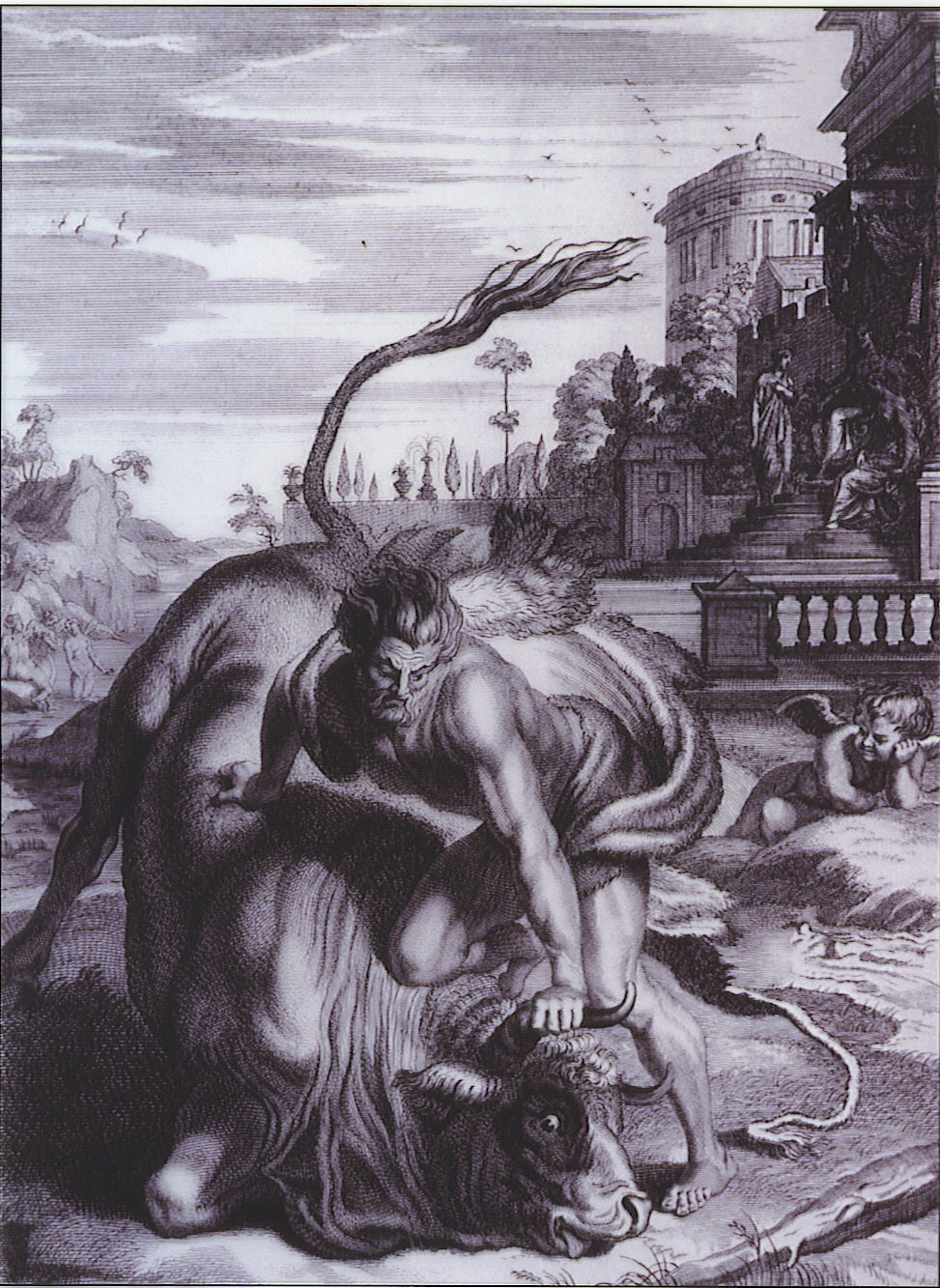
even know where the Apples are, and has to wrestle the
Old-Man-of-the-Sea, who keeps changing shapes while being held.
Certainly, this has something to do with achieving a meditative state of
mind, with stilling the flux, until the image emerges in the still
pool, as Tomberg readers will recognize. He then has to slay Antaeus, by
holding him aloft so that he does not touch the earth, and crushing
him. Again, this can be related to asceticism, which involves severing
the “natural” drive of desire from its magnetized source in the
passions, to make it serve something not purely of this world.
Journeying to Egypt, he is imprisoned by a king (again we see conspiracy
and political conflict), who desires to sacrifice Hercules himself for
the yearly offering. Indeed, this is done routinely in the Brave New
World. It is the liberal version of “Knockout Game”, in which some
endangered species of latent heretic is dragged out of his abode and
thrashed around for vicarious thrill and for the
pure pleasure of witch-hunting.
Have you tried this lately? It’s lots of fun. And you don’t even have
to have any real courage, because, after all, the people you are
attacking have no actual power to hit back. Plus, you can feel like the
Pharisees did when they tried to stone the woman they had committed
adultery with. But, really, it’s just a species of perverted and
ignorant dark magic, because the
faux Liberaux deep down just
think that every witch they burn will help ensure the pleasure of the
Multi-Cult Gods. Don’t burn too many: one or two a year will do. After
all, who will do the work around this insane asylum?
After this hold up, Hercules manages to break through. We don’t hear
of too many accidental killings this time around. Hercules is just
thinking about those apples, and apparently, even his enemies are
becoming less inclined to use open violence against him. When he arrives
at the Hesperides, he finds that he himself cannot pick the Apples. In
an interesting twist, which is of worthy note, he tricks Atlas first
into doing it for him (while he holds up the world on his back) &
then lies to Atlas that he needs to retrieve his cloak to make things
easier for holding the globe, will Atlas hold it up momentarily?
The Lesson here is that, apparently, the hero is no longer bound by a
conventional code of honor. Like Odysseus, the cunning one of many
stratagems, Hercules is allowed (apparently) to use help (this was
disqualified, as you remember, in the case of the Augean Stables and the
Hydra), and to use it dishonestly. Apparently, the Apples are a prize
which does not require perfect virtue or honor to retrieve.
As a Christian, I would like to re-interpret this passage, if it were
permissible, but honesty forbids it. Here we reach into the mystery of
Good & Evil, where the law or ban of the true sovereign reaches a
point that places that entity beyond what is commonly conceived as right
and wrong. To attain some perspective, and try to square the Circle, we
will note that even the decent, salt-of-the-earth common man lives in
some degree of tension and
hypocrisy, when you scratch him deep enough. After all, we all shop at Wal-Mart.
In this instance, I will say that Hercules returned at a later date,
building the pillars of Hercules, belatedly, thus liberating Atlas much
as he freed Prometheus. But he still lied. Indeed, it was a lie extorted
in bad faith by Atlas, as the apples would do Hercules little good,
were he to stand there forever hoisting the world orb. Mouravieff deals
with some of this in
Gnosis. The lie can never be to the Self,
although Life forces many lies upon us, in many contexts, in which (at
the least) we allow people to see what we perceive them to be
mis-perceiving, without correcting them, because to “always tell the
truth” in a bald manner at all times would ensure that we spent our
lives much like Don Quixote spent his. I might also add, that the
spiritual laws of Fairie Land, where the Apples grow, are not like unto
the laws of Middle Earth, where the common code of the Hobbit must tend
to prevail. Cunning is always a quality heavily valued in the Fairy
Tale; we have to learn, as humans, that we are not always speaking to
another person, but to an archetype, especially in a quest.
And what of “let your Yes be Yes, and your No, No”? As a
Christian, I say that I am not yet the Son of God, and furthermore, will
never be so in the same way that Christ succeeded in being so, as He
never knew sin. The religion of the apostles is slightly different in
modulation and form from the religion practiced by Christ Himself. This
“gap” is not a proof that one is not understanding the Logos, but
rather, a testimony to the innately flawed and tragic situation man has
cognized, and seeks to transcend. Christ, after the Resurrection, was
not the same Christ Who was laid in the tomb. If we see the Church after
Christ’s Advent, the promise is made to reconcile even those who are in
Purgatory, those who are
idiotes or imperfect, those who dimly
cling to the shreds of Christ’s garment, can find salvation in the
precincts of the outer Temple. This was the truth which Luther really
could not quite come to terms with, and which rejection, incidentally,
still marks his spiritual children in the modern world. For them, a
single imperfection invalidates the entire corpus. This ensures that one
will gravitate towards Alfred Jarry’s dictum:
Until we’ve destroyed everything, we’ve done nothing. The Perfect becomes the Enemy of the Good.
The Christian path recognizes the Evil and the hypocrisy, but (as
noted), the goal is not withdrawal from matter, but rather a shining
through and sublimation of that matter, however, imperfectly, which
transforms even Evil into Good. This is a delicate position, as it can
come perilously close to “Do Evil that Good may come” or the doctrine of
Progressivism that any broken eggs are worth the omelette. What I am
trying to say here is something capable of distortion. It is rather that
within us, it sometimes happens, when the hero is pushed to the
white-hot extremities of contradiction during his quest, he will
sometimes find himself acting (unconsciously perhaps, or consciously,
bearing the guilt truly) with elements of his being that are not
perfectly devoted to God. To give a concrete example, suppose I am
awakened in the middle of the night by the noise of strangers entering
my home. Now, as a good Christian, my first thought should be to ensure
the safety, not only of my family, but even of those who have knocked in
the door, if possible. Indeed, a pure and true Christian could square
the circle, with the help of angels, by reading their thoughts, speaking
words of wisdom, or even laying down his life to save both family and
foe. However, what would most likely happen (because I know myself,
especially at two o’clock in the morning) would be that a weapon would
be procured and used. My greatest fear (being imperfect) would not be to
fail to be a perfect Christian, since that is a given, but to allow
harm to come to my family through personal cowardice
or weakness or hesitation. In such a situation, it is likely that violence would occur.
This is the mystery of the temple of Rimmon. It is analogous to the
Earps deciding to clean up Tombstone themselves, rather than allow
Sheriff Beehan to arrest them for disorderly conduct in the middle of a
flagrant murdering spree perpetrated by those who own the Sheriff. In
fact, almost every human being has experienced a situation, on some
scale, of the same kind, in which to “do right” is actually to commit an
even graver sin. What is wrong with modern Liberalism is not their
recognition (they do this too) that sometimes you have to go against
your kin in order to be Just to the stranger and the alien, but rather,
the fact that they literally worship these strangers and outcasts as God
Himself. And the fact that they do not allow such niceness of
conscience or subtlety of distinction to be used by anyone else but
those who also, like them, worship at the altar of Revolution and
Degeneracy.
In this case, Hercules knows he has to seize the apples, and they are
his provided he is willing to answer for the consequences – he can
return later and redeem his pledge. Hasn’t he committed worse sins than
this, and been forgiven? What is worse than slaughtering your wife and
children in a fit of madness, or a woman who loves you as she brings
your prized object? We see that Hercules is simply “unequal” to ordinary
standards of right and wrong. This is completely different (as far as I
can tell) from the Nietzschean idea that one must go beyond them
entirely. In a word, Hercules is a gentleman, but with a bit of a rogue
left in him. Indeed, anyone who seeks individual salvation will find
that they become a gentleman, with a bit of something else streaked
through, which remains (even in the redeemed state, in Heaven) as
something like the silver lining of a storm cloud.
Like Cromwell, if you are willing to stand tall before God and answer for the blood on your gauntlets, then “you may proceed”.
Take what you want, and pay God for it.
But, had Cromwell subdued himself more thoroughly, and acted more in
accordance with his caste, had he seen himself caught in the currents
and dragged by Fate as a slave to the rising order of Revolution, would
he have acted so?
With the ancients, we affirm that no man consciously would will Evil
(at least before he was thoroughly corrupted, as this Life is a second
chance, and perhaps not even then). Which is why it is the duty of every
man of Order to subdue himself, that when he creates, he may create
according to the whole Eye of Light, perceiving the Logos not through a
glass darkly, but almost face-to-face.


 As I have argued, Hercules has decisively “come into his own”: he has achieved the unstated goal of the classical polis, which was to become an Aristotelian unequal.
He is not yet equal to gods, but he no longer lives under mortal law,
because he has suffered its stroke, and lived (which is the only way to
transcend it). He has passed through the difficult time of his hero
saga. In any heroic legend, there are moments, particularly early on,
when the hero is set upon by all seemingly legitimate forces. In doing
so, these forces either illegitimate themselves, or show themselves to
have been (in fact) illegitimate from the beginning anyway: they “fall
away” before the great individuality. Traditionalists should never
forget that King Arthur,
As I have argued, Hercules has decisively “come into his own”: he has achieved the unstated goal of the classical polis, which was to become an Aristotelian unequal.
He is not yet equal to gods, but he no longer lives under mortal law,
because he has suffered its stroke, and lived (which is the only way to
transcend it). He has passed through the difficult time of his hero
saga. In any heroic legend, there are moments, particularly early on,
when the hero is set upon by all seemingly legitimate forces. In doing
so, these forces either illegitimate themselves, or show themselves to
have been (in fact) illegitimate from the beginning anyway: they “fall
away” before the great individuality. Traditionalists should never
forget that King Arthur, 