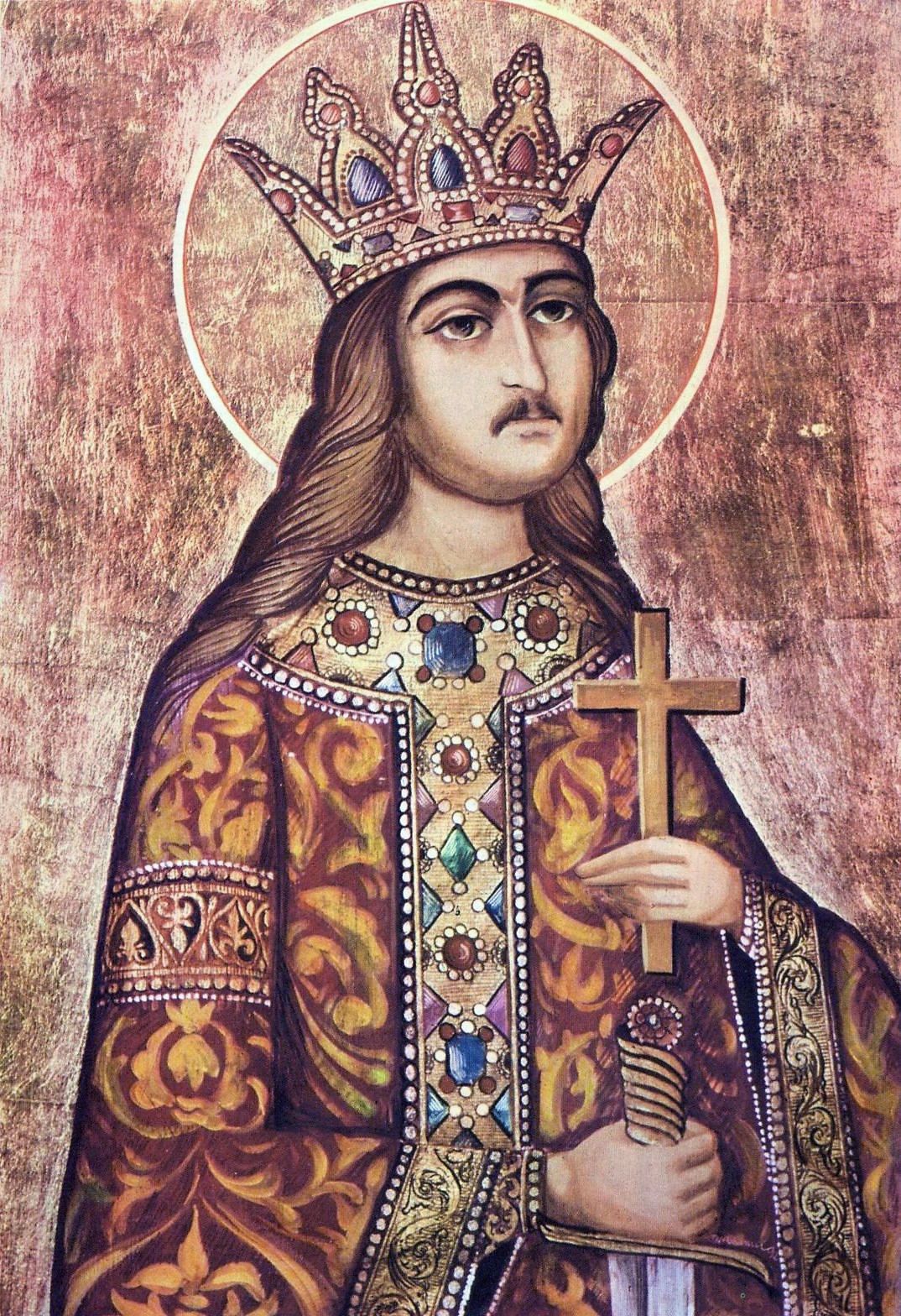
 "According to Tradition doctrine, the certain angel, the celestial being is appointed to look after each nation of the Earth. This angel is the given nation’s history sense, being out of the time and the space, but being constantly present in all nation’s historical peripetias. The mysticism of a nation is based on this. Nation’s angel isn’t anything vague or sentimental, indistinctly dim. This is an intellectual, lighting being, “God’s thought”, as Gerder said. Its structure one can see in nation’s historical achievements, in social and religious institutes, which characterize the nation, in the national culture. All gist of the national history is just the text of narration about quality and form of that lighting national angel. In traditional society the national angel used to have the personified expression, in “divine” kings, great heroes, pastors and saints. But being the over-human reality, this angel itself does not depend on the human bearer. Therfore after the monarchical dynasties fall it can be incarnated in a collective form, for instance, an order, a class, or even a party."

Dedicated to the red and the white rose, to the eyes and the flame, to a more perfect unity... You can reach me @ cathasach71854@gmail.com
Showing posts with label Tradition. Show all posts
Showing posts with label Tradition. Show all posts
Tuesday, September 4, 2012
Shields of the Earth, Arise.
"According to Tradition doctrine, the certain angel, the celestial being is appointed to look after each nation of the Earth. This angel is the given nation’s history sense, being out of the time and the space, but being constantly present in all nation’s historical peripetias. The mysticism of a nation is based on this. Nation’s angel isn’t anything vague or sentimental, indistinctly dim. This is an intellectual, lighting being, “God’s thought”, as Gerder said. Its structure one can see in nation’s historical achievements, in social and religious institutes, which characterize the nation, in the national culture. All gist of the national history is just the text of narration about quality and form of that lighting national angel. In traditional society the national angel used to have the personified expression, in “divine” kings, great heroes, pastors and saints. But being the over-human reality, this angel itself does not depend on the human bearer. Therfore after the monarchical dynasties fall it can be incarnated in a collective form, for instance, an order, a class, or even a party."


Friday, August 24, 2012
Everything Repeats Itself
 It's kind of depressing that man never learns. As Burke teaches, he only learns collectively (which is to say, as a species, but not a group - if that distinction makes any sense to anyone).
The debate between Past & Future has been going on for more than just three hundred years...
In our "modern" Era, man is still so resolutely unsure of himself, who he is, what is "Good", what is less desirable, what is Evil and Damnation, that practically all we hear from our intellectual elite is re-hashed Fontanelle: We are smarter than the ancients, our scholarship is more elaborate, we follow reason and possess empirical science, we are going to download our consciousness onto computers and surf the Noosphere, etc. etc.
It's almost as if our uncertainty is overcompensated by belligerent hatred of the Past, a denial of all its worth, and certitude on "one thing and one thing only" - that all is Good and Light and Best and Better today.
The Past isn't irrelevant, or over - it isn't even Past (W. Faulkner). I agree (of course) that mere antiquarianism looks a little ridiculous, and that a man who can't be of his own time can't be of any Time (Goethe). However, only someone who is connected to the Past (at a deeper level than drawing on Voltaire for their spiritual inspiration, or Fontanelle) can hope to show the unity of Time through marrying the Past, Present, and Future in Eternity. This love of the past can be individual (the individual's pre-existence) and have no intellectual roots in the past that are obvious - it can even be existential. However, the one thing it cannot be is openly, ideologically committed to hating the Past. Which is exactly what our "Leaders" are committed to.
Saturday, November 5, 2011
The Sunday Article Round-Up
Sundays, or Saturday evenings, I'll be trying to post articles I am currently working on, or at least interested in trying to halfway complete sometime soon. Here is the weekend offering.
Dugin-Olavo debate.
Dugin argues against "the West" and calls for allies within. Olavo calls him a fascist. I am left wondering if these are the only two alternatives, and somehow feel that Dugin is closer to the truth than his interlocutor.
Greed Ain't Good.
Since Vico & Mandeville, "greed is good". First Things writer takes umbrage at any system, moral or otherwise, which reaches such a counter-intuitive result.
The Market as God.
Sacrificing chickens may work as well as the "science" of economy. The language of the invisible hand sure sounds theological.
An alternative, paleo-con style.
Medaille tries to parse why we, the West, are disintegrating on all fronts, even in our vaunted "free markets". I especially like this short effort to refute the idea that politics and economics (or morals) can be ultimately and finally separated.
Dugin-Olavo debate.
Dugin argues against "the West" and calls for allies within. Olavo calls him a fascist. I am left wondering if these are the only two alternatives, and somehow feel that Dugin is closer to the truth than his interlocutor.
Greed Ain't Good.
Since Vico & Mandeville, "greed is good". First Things writer takes umbrage at any system, moral or otherwise, which reaches such a counter-intuitive result.
The Market as God.
Sacrificing chickens may work as well as the "science" of economy. The language of the invisible hand sure sounds theological.
An alternative, paleo-con style.
Medaille tries to parse why we, the West, are disintegrating on all fronts, even in our vaunted "free markets". I especially like this short effort to refute the idea that politics and economics (or morals) can be ultimately and finally separated.
Sunday, September 11, 2011
Martha Nussbaum & Criticism
Martha Nussbaum is a perfect example of the new elite that operates today in the high echelons of polite & civilized (not to mention educated) society. After scanning her Wiki entry, I wanted to ask, what was the big deal about being denied Classics tenure at Harvard? She wasn't even a Classicist? Maybe there is something I am missing here, I thought her specialty was Philosophy. A list of her credentials are here.
The popular reactions to her work tell me a lot about her:
Roger Kimball dissects her fairly well.
Moral evasion is typical of the Left. They are good at it - the Right is obtuse, but the Left is corrupt. Camilla Pagila revised her opinion of her, apparently (and Paglia is a "feminist", and yet a very reputable scholar).
The popular reactions to her work tell me a lot about her:
Fragility made Nussbaum famous throughout the humanities. It garnered wide praise in academic reviews,[24][25] and even drew acclaim in the popular media.[26] Camille Paglia credited Fragility with matching "the highest academic standards" of the twentieth century,[27] and The Times Higher Education called it "a supremely scholarly work."[28] Nussbaum's fame extended her influence beyond print and into television programs like PBS's Bill Moyers.[29]Her work is based on a rejection of Plato, and an affirmation of the traitor, Aristotle, so this, too, demonstrates what we can expect. Aristotle only affirmed tragedy as a category, and addressed the issue of "human flourishing" as a response, exactly what Nussbaum wants to do. Tragedy as an epic, as a religion, as metaphysic, is alien to her. Thus, one bases one's entire corpus on an understanding of something fundamental that is flawed - exactly man's problem to begin with.
Roger Kimball dissects her fairly well.
It's hilarious she should use this example. Is this a poorly-veiled attempt to co-opt Aeschylus' play? This next quote is downright elitist (something the Left professedly hates)- who's being "elitist" now? The point is not that she may or may not be right - the point about the following elitism is that it is something she claims to be opposed to it on the face of it.
Professor Nussbaum finds this a thorny problem. Who, after all, is harmed in the transaction? Professor Nussbaum wonders “whether necrophilia ought, in fact, to be illegal.” She acknowledges that there is “something unpleasant” about a person who rapes a corpse, but it is “unclear” to her whether such conduct should be “criminal.” Possibly, since a corpse is generally the property of its family, there should be “some criminal penalties” where “property violations” are involved, but otherwise not.
Professor Nussbaum doubts “whether the disgust of the ‘average’ man would ever be a reliable test for what might be legally regulable.”So I guess the average person is below the Law.
From public nudity to poverty, the global AIDS crisis, and homosexual marriage, Professor Nussbaum has embraced the entire menu of politically correct causes. Poverty, she says, is “one of the most stigmatized life-conditions, in all societies.” Therefore it must be removed. And not just poverty: we must also supply items that are “part of the social definition of a decent living-standard,” e.g., “a personal computer.” AIDS is “a major cause of stigmatized lives.” Something must be done!This is the nub. Actual, finalized equality.
One saw this at work a decade ago when she was called upon to give expert testimony in Evans v. Romer, which challenged a state constitutional amendment in Colorado that prohibited any official body from adopting a law or policy that grants homosexuals “minority status, quota preferences, protected status or claim of discrimination.” As the philosopher John Finnis showed in an article for Academic Questions, Professor Nussbaum, by deliberately misrepresenting the meaning of Greek words and the work of other scholars, engaged in “wholesale abuse of her scholarly authority and attainments.” Among other things, she went back to a nineteenth-century edition of the standard Greek-English lexicon because it did not include a morally opprobrious definition of a contested Greek term. She took the trouble to white-out the name of a contributor to the later edition of the lexicon that the lawyers, unaware of her subterfuge, had supplied in the footnotes of a court document. Challenged about this, she claimed that she was simply correcting a clerical error because the earlier edition was “more reliable on authors of the classical period” than later editions. I asked a former Regius Professor of Greek about that and it took him about five minutes to stop laughing. It’s clear that Professor Nussbaum doesn’t believe it either, since it has been shown that her own work regularly relies on later editions.If this means what I think it means, it shows her true colors.
Moral evasion is typical of the Left. They are good at it - the Right is obtuse, but the Left is corrupt. Camilla Pagila revised her opinion of her, apparently (and Paglia is a "feminist", and yet a very reputable scholar).
Nussbaum's exposé is long overdue. Of course, if she had real courage or disinterested motivation, she would have written it seven or eight years ago -- just as she would have publicly allied with me in the campaign for academic reform instead of doing the opposite (as when she denounced the editor of Arion, Herbert Golder, for publishing my essay). Nussbaum isn't squeamish about borrowing my ideas without acknowledgment, however, as in her proposal in her most recent book to put world religions at the center of 21st century multicultural education. (Cooking dinner one night, I laughed out loud when David Gergen, interviewing Nussbaum on PBS's "Newshour With Jim Lehrer," gushily singled out that idea in her book, as she smiled winsomely and flashed some more leg.)In a perfectly Leftist society, only people like Robert Bork suffer the moral "shame" (the liberals would say "opprobrium" - so much more dainty) they deserve to suffer, while opportunists like Nussbaum (if she is what she appears to be) simply move to greener pasture before the chickens come home to roost - not a hard thing to do, when you are in the glitzy set and have maximum academic (including honorary) credentials. This is exactly the kind of behaviour which they DEPLORE in any other context - someone apparently above the social Law, who can always move on to new opportunities, new horizons, new cutting-edges, while even her comrades in Revolution and Progress can see her for what she has become.
How prevalent is this in America today?My guess is very.
"The move from a structuralist account in which capital is understood to structure social relations in relatively homologous ways to a view of hegemony in which power relations are subject to repetition, convergence, and rearticulation brought the questions of temporality into the thinking of structure, and marked a shift from a form of Althusserian theory that takes structural tonalities as theoretical objects to one in which the insights into the contingent possibility of structure inaugurate a renewed conception of hegemony as bound up with the contingent sites and strategies of therearticulation of power."Can you decipher this? Can anyone be sure what it means?
I think what she is trying (very badly) to say is that late stage capitalism operates in a more sophisticated and subversive manner than even the Left had anticipated - however, it's unclear as to why this would be not just a concern contra capitalism, but contra the Left. Don't they use PC for just this purpose? Or perhaps she's being deliberately vague. If so, good job.
But it is horrendous English.
Thursday, January 20, 2011
The Idea of the West
Someone else has usually said "it" so much more clearly...this is why I am "traditionalist":
That said, creative genius will have to go beyond this, but not in a "titanic" or grasping manner, in which the past is "overcome". Rather, the past will have to be brought to completion, not evolutionarily (merely) but alchemically and through regeneration.
To the profound comprehension of this law of the intellectual generation of ideas, are due the marvels of Catholic civilisation. To that wonderful civilisation is due all that we admire and all that we see. Its theologians, even considered humanly, put to the blush modern and ancient philosophers; her doctors excite wonder by the immensity of their science; its historians by their generalising and comprehensive views, cast those of antiquity into the shade. St Augustine’s “City of God” is, even today, the most profound book of history which genius, illuminated by the rays of Catholicity, has presented to the astonished eyes of men. The acts of her Councils, leaving aside the divine inspiration, are the most finished monuments of human prudence. The Canonical, excel in wisdom the Roman, and the feudal, laws. Who is before St Thomas in science, St Augustine in genius, Bossuet in majesty, St Paul in power? Who is greater as a poet than Dante? Who is equal to Shakespeare? Who surpasses Calderon? Who, like Raphael, infused life and inspiration into the canvas?
Place people in sight of the pyramids of Egypt, and they will tell you, “Here has passed a grand and barbarous civilisation.” Place them in sight of the Grecian statues and temples, and they will tell you, “Here has passed a graceful, ephemeral, and brilliant civilisation.” Place them in sight of a Roman monument, and they will tell you, “Here has passed a great people.” Place them in sight of a cathedral, and on beholding such majesty united to such beauty, such grandeur to such taste, such grace to such delicacy, such severe unity to such rich variety, such measure to such boldness, such heaviness in the stones, with such suavity in their outlines, and such wonderful harmony between silence and light, shade and colour, they will tell you,
Here has passed the greatest people of history, and the most astounding of human civilisations: that people must have taken grandeur from the Egyptian, brilliancy from the Greek, strength from the Roman, and, beyond the strength, the brilliancy, and grandeur, something more valuable than grandeur, strength, and brilliancy—immortality and perfection.
That said, creative genius will have to go beyond this, but not in a "titanic" or grasping manner, in which the past is "overcome". Rather, the past will have to be brought to completion, not evolutionarily (merely) but alchemically and through regeneration.
Friday, July 30, 2010
Traditio?
 It's always useful to ponder, what if? Here is one of the oldest churches in England. Tradition can be viewed, not merely as calcified accretion (with a life/death all of its own) but as the product of human choice - That which endures is that which we choose and re-choose, and choose again. That which is sustained, and sustains over time, nourishing with a life blood that connects us to the past and the future. There is no "Tradition" which needs to die, is outmoded, etc. etc. Tradition exists because the sacred dead exist. God is a God, not of the dead, but of the living. This is more true than the "postmoderns" realize. Tradition exists because our life is not our own, and also because it is our own. There is no war between Fate and Love, Tradition and Life, etc., etc. Here, all is One.
(Photo from Blog, Cotswold Peeps)
Thursday, July 15, 2010
Tradition and Non-Tradition
What we want is both liturgy and inner-ness, worship in Spirit & in Truth. The liturgy is the exoteric gesture and ritual which both protects, channels, and helps explain the inner truth of the esoteric spirituality to our children. We can tell them to "love and know Jesus" all we like; without the physical movement and space, we risk them catching our Spirit without entirely understanding what is happening. Which can lead to problems. For one thing, people often misinterpret spiritual events. They also often misunderstand them in the same language : "God" becomes "ground of being", "Jesus" becomes "my personal Saviour only", etc., etc. Without inner power, the ritual or form can become dry and empty and without power. The salt loses flavor. Yet because the form is preserved, there is always a possibility of restoration. This is not true with the "Spirit", which makes things dangerous. More powerful, it is also more deadly if channeled wrongfully. Without preciseness in liturgy or creed (and the two go together), we risk losing our children to everything from New Age to Emo-ism. We want civilization & individualism. We want the classic heritage along with spirituality. The two are properly interpretive and mutually supportive.
Subscribe to:
Comments (Atom)