Showing posts with label Tomberg. Show all posts

Friday, December 26, 2014

The Emperor

The Emperor

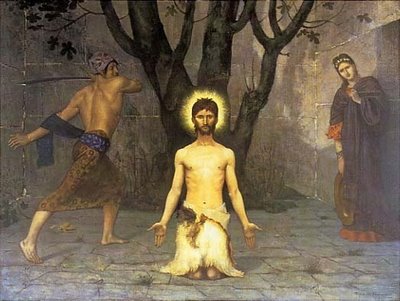
johnbaptist
“The ones who truly love their traditions don’t take them too seriously. They march to get their heads shot off with a joke on their lips. And the reason is that they know they’re going to die for something intangible, something sprung from their fancy, half humor, half humbug. Or perhaps it’s a little more subtle. Perhaps hidden away in their fancy is that pride of the blueblood, who refuses to look foolish by fighting for an idea, and so he cloaks it with bugle calls that tug at the heart, with empty mottoes and useless gold trim, and allows himself the supreme delight of giving his life for an utter masquerade. That’s something the Left has never understood, and that’s why its contempt is so heavy with hate. When it spits on the flag, or tries to piss out the eternal flame, when it hoots at the old farts loping by in their berets, or yells “Women’s Lib!” outside the church, at an old-fashioned wedding (to cite just some basic examples), it does so in such a grim, serious manner — like such “pompous assholes,” as the Left would put it, if only it could judge. The true Right is never so grim. That’s why the Left hates its guts, the way a hangman must hate the victim who laughs and jokes on his way to the gallows. The Left is a conflagration. It devours and consumes in deadly dull earnest. (Even its revels, appearances notwithstanding, are as grisly an affair as one of those puppet parades out of Peking or Nuremberg.)The Right is different. It’s a flickering flame, a will-o’-the-wisp in the petrified forest, flitting through the darkness…”
The Camp of the Saints,  Jean Raspail (1925–) a French author, and explorer.
The Number of the Emperor is Four; this is the sign of Earth’s four elements, and also the procession of the movement of Being out of the perfect triangle-circle of One-Two-Three, into the world of material creation, the union of spirit and matter. The Emperor has authority because he has achieved existence, he knows something, & he is capable of acting (1-2-3): he can therefore assume the post of emperor because he is “earth of earth”, “the most human of humans”, King David – a shepherd, a hero, a champion, a warrior, an outlaw, a king, a sinner, a saint. He is the manifestation of the Divine in the form of he who bears the sceptre, and is (therefore) the wielder of the sword not in vain.

The rise of the emperor to the post appointed for him by God occurs in the topsy-turvy world: for this reason, the emperor is “out on the green grass”, under the skies. His authority originated in the fact that the power of his being is such that he can hold court in the wilderness, and indeed (most likely) this may be where he plants the seeds that lead to his rule. As Rosenstock-Huessy argues in Out of Revolution, real political authority is worth nothing unless it is so powerful that it first begins “under the stars” or the clear blue skies. We reject the “whiff of Hegelianism” that wafts from Huessy’s work; however, he is correct to say that political authority changes with the revolution of the stars, and that even the secular revolutions (which aped legitimate procession of government) adhere to this change that which falls from the skies first (particularly when government is corrupt and asleep at the wheel). Auctoritas comes from the one who is self-restrained and crucified: that is, the emperor does not need the outer symbols to rule – they come to him like gravity draws smaller objects: he is comfortable at first, not with worldy power, but with naked Being. Like the sage on the mountaintop, the emperor sits by the river banks, or in the woody dells, or out in a cow pasture. He dwells outside the “city”, when the city is falling apart and degenerate. He is at home within his own skin, and is free from worldly A influences which dominate the “kingdom of this world”. He is King Alfred living in the swamps, awaiting his chance to reconquer England from the Vikings.

This is the opposite of the career politician, the demagogue, or the opportunist. His power comes from power over self, not over other people. He holds sway over others, and carries or embodies real authority over them, and as a result, he exercises legitimate power. Tomberg makes the strong case that compulsion is superfluous for those with real authority: “where there is authority, there is present the breath of sacred magic filled by the rays of light of gnosis emanated from the profound fire of mysticism, there compulsion is superfluous”. Viewed this way, Leftism or revolutionary thought is basically like a mental disease, which is healed by true action on the body politic through the esoteric organs. This is consistent with the doctrine of the Gnostic Church as the “heart” of the organized Petrine and Pauline Churches.

“The Emperor has renounced movement by means of his legs (they are crossed) and action by means of his arms (one hitches the belt, the other holds the sceptre).” The “instinctive and impulsive” nature of the Emperor is restrained, by self-restraint acting under Divine influence. It is this, and this alone, which allows him to hold the post of guardian of the office of Empire. When King Alfred made peace with the Danes, but had Guthrum baptized, he secured the Anglo-Saxon kingdom of England and the Danelaw as a united realm, bringing peace to the land. He could have hid vengeance in his heart, but instead, he converted his enemy, quite literally, to a friend. It is this type of action which the Holy Roman Emperor aimed at, being king of kings and lord of lords, the means by which the petty rivalries of monarchs (which would later destroy Europe in repeated conflagrations) were brought to heel before the sacred body of the King. Tomberg remarks that the Middle Ages contain a wealth of political theory (which is unique, even from classical Greece and Rome) on the post of the Emperor: under this list, we include Dante (who sided with the White Guelphs in the Ghibelline controversy) and John of Paris.

“The emperor has renounced personal opinion to receive revelation of Truth, personal action in order to become a vehicle of sacred magic, the way of personal development in order to be guided by the Master of the Way, and his own personal mission in order to be charged with a mission from above.” This makes him the “source of Law and Order”.

I think I have quoted Bonaventura before: That which is not confined by the Great, but is contained by even the smallest, it is that which is Divine. God (the Self beyond Self) becomes King in respect of those who freely worship Him, and He is crucified in relation to those who choose to fight or struggle with that freedom against the Font of Freedom. In both cases, a withdrawal is accomplished in order to establish a realm of freedom. Hitler and Napoleon, both, attempted to occupy the post of the shadow of the Emperor, but they took up the sword to do it. That is, they placed their trust in worldly machinations: power and the grapeshot or Panzers that were seen to produce such.

There is an Emperor of Europe, of Christendom. The post is occupied. It in our day is occult, in shadow, but God does not allow a vacuum in Nature: the man who has a vacuum of Ego and Pride will be courted by the Spirit for the post of Emperor, and there is undoubtedly an occulted Emperor today, in 2014. The complete synthesis of mysticism-gnosis-magic which is effected in the Emperor is also, Tomberg states, the definition of initiation, where eternity and the present moment meet together.

Mysticism becomes true without falsehood (Gnosis), and most certain (magic), and then absolutely certain in the light of pure thought as both subjective and objective experience (Hermetic philosophy): the Emperor is the hermetic synthesis of the emanations of God’s light upon the world, though he may be unappreciated, unknown, hidden, or occulted.

“Presumption? It would be a monstrous presumption if it were a matter of human invention instead of revelation from above.”

“Ask” (mysticism or touch), “seek” (gnosis or hearing), “knock” (magic or sight/vision) – Luke 11:9. These become comprehension. This is initiation. The goal of initiation is depth, or “niveau”. For the post of emperor, the aim is the realization of patriarchy, the “father-man”, the most human of all men, the heir of David. It is the four wounds spoken of which mark the Emperor, and provide him with the concrete experience to fulfill his destiny, to be anonymous, or (rather) synonymous with the post of Emperor itself : hence it is said, King Arthur only sleeps, as does the “King under the Mountain” (the Holy Roman Emperor). If the king sleeps, he shall return.

Indeed he is already here.

This bears reflection upon in the present day, for those who want to rebuild the monarchies. It was the Empire which gave birth to kings, the Holy Empire, and not the kings who built up the Empire. Rather than seeking to restore a particular pedigree or bloodline, thus exposing these men and the movement to an undoubted reaction which will be most violent, more thought should be put into finding the occulted Emperor, and also, collating and honing the methods and practices which will produce divine candidates of this quality. There is a lot of synthesis to be done in esoteric studies, and it can only be done rightly by those who have experienced it. The Emperor will require men of depth around him to respond to his authority, & also to embody emperorship in their little field of influence. Has anyone given thought to joining the Gnosis seminar? Mouravieff gives a practical method for recovering the initiation of Christendom.

One ought to try to recognize Emperor within one’s self, by seeking that which is truly Just. As Cologero has outlined, justice is the synthesis of moderation (the man of the senses), courage (the man of the emotions) and wisdom (the man of the intellect). You can see the same symbolism of numeric progression: what does Courage have to do with Gnosis? This is surprising, as one would expect Intellect to correlate with Gnosis, and Courage with Magic. When such a deliberate contradiction to our “everyday” wisdom or literalness is generated, there is an opportunity to look more deeply. The man of Gnosis needs courage as the primary virtue because it goes so strongly against the “naive realism” which dominates worldly thinking. The man of Magic requires intellect, because he has already mastered courage (or courage has mastered him) and he requires mastery of the science and art, since Magic is potentially quite dangerous. Fast (senses), Watch (master passions), and Pray (effect the use of Magic under the name of God alone).

Tuesday, May 27, 2014

The High Priestess


The High Priestess


When God manifested in the created plane, the Two inescapably arose. First of all, as secondary to God, and secondly as articulations within itself, to create the pyramid and hierarchy of all Being. There is nothing wrong with Two: as Cologero notes, the animus within the woman is necessary for her healthy development. The Two is very good in itself, but not by itself. This is noted earlier on as it is not good for man to be alone. This would also apply to the feminine part within man’s own interior.
Watch a political debate, read a cutting edge expose of the Gospels, pick up a history book, or (worse) sample a modern textbook. For that matter, pick an acquaintance’s brain. What you will inevitably almost always discover is someone for whom the Two is not merely a good, but is actually God, subsisting alone. Not only have they made a false god out of what is created, but (for them) the One and indeed any other competing Twos simply don’t exist. Thus, those who think the Catholic Church was part of a vast cosmic conspiracy involving the Demi-Urge suppressing channellers from the stars simply never get around to asking themselves the simple question, If God is a fake God (Yahweh is the Demi-urge) then how do I know the One True Light God is not just in on the fix? What if the deception is even more elaborate than I first believed? No for them what is an important psychological insight gets distorted into a cosmology, an ideology, and at last, a madness. They cannot square the circle. This phenomena is common today.

Psychologically and humanly speaking, people like modern liberals, civil rights activists, free thinkers and others may certainly possess a modicum of truth. Yet, what lie does not contain modicums of truth? It is not hard to be partly right. But this is not what is claimed: it is claimed that this is the truth, the whole truth, nothing but the truth, and (most importantly) the only truth which could possibly matter. And it must be taken as presented, which is to say, in isolation from the One. It is, at root, a narrative created by the demonic power of the egocentric mind, which attempts to enslave others to its dominating will. This is the opposite of the what the Priestess was created to be: instead of the alma mater, we have the devouring wrath of the psychotic Lilith, who hates Eve, and attempts to destroy Adam (this is how salvation comes from the woman, for Eve will oppose Lilith).

We see at work here the very power of distortion and twisting which they claim to see in the One. To quote Phillip Dick, “Those who fight the Empire, become the Empire“. Or to quote Jesus, “resist not evil, but overcome evil with Good”. Anyone who uses the Ring of Sauron against Sauron is doomed to either become like him, or to be turned into a slave. God Himself does not overcome evil with evil, but rather overturns Hell from the inside out. Good triumphs because it remains unchanged when Evil touches it, and is capable of changing Evil into its opposite. Evil cannot make this claim, and therefore, has no true power. Evil can only uncover what is already Evil, and test what is Good.

This is not to say one cannot be a warrior and a man of the One. There are beautiful stories about how to reconcile the two, & many men have done it extremely well, so well they merit great titles and honors, and perhaps even more than man can say. Giorgio has pointed out that the warrior (however) is female in relation to the brahmin or priest. That is, the warrior has to overcome the flesh to arrive at the one, he has to fight himself. He has to struggle against the tendency to carve out a separate kingdom away from the Law of the One. This is the first temptation faced by man, to divide himself into Two and to make a kingdom of his own, separate from the aboriginality of the Self Beyond the Selves.

How can this be? How can the virile, manly warrior be female? When the universe is taken hierarchically, we can say that that which is above something is male in relation to it, and that which is below something is female in relation to it. Things below revolve around, cling to, and require for their health and sanity the relation to that which stems from above. When something is detached, it careens off into the outer darkness, and although it may retain its own hierarchy for a time, there is a process of decay that sets in immediately. The horizontal cannot sustain itself by itself. It requires a link to the vertical. Thus, everything is male/female, and yet we can properly speak of certain things as “male” or “female” in configuration to each other.

Neither is privileged. Without the female, the male does not make itself known. If there is a privilege, it consists of duties. To quote the Baron, loving,proud obedience and humble command are the duties of respective stations. Since all of Being involves climbing the ladder or the Tree, there is no Black Iron Prison of compartments or boxes, but rather a kind of dance. If you are living in a Black Iron Prison, it is because your soul (to that extent) is tainted and evil, and God manifests to you as the oppressor. The eye, being not single, cannot see the Light. The psychological insight (however) of this state is correct: you are seeing that the God you made in your own image is actually a Demi-Urge. Angels appear as demons, men of good breeding and sound sense are tyrants, Western civilization is the greatest evil on earth, etc. The only way out is “deeper in”, that is to say, to pull the beam out of your own Eye.

The lesson of the second Card is that Two cannot exist alone. Which (put this way) is irrefutable. QED. Or, put another way, Two can only exist together as One.

Tomberg gives an example of what happens when the Two wants to be alone:
“Passing on to mysticism which has not given birth to gnosis, magic and Hermetic philosophy – such a mysticism must, sooner or later, necessarily degenerate into ‘spiritual enjoyment’ or ‘intoxication’. The mystic who wants only the experience of mystical states without understanding them, without drawing practical conclusions from them for life, and without wanting to be useful to others, who forgets everyone and everything in order to enjoy the mystical experience, can only be compared to a spiritual drunkard.”
He mentions that those who develop the spiritual sense develop a “touch” which allows him to apply and understand what he has experienced. This is analogous to the virginal pool, which more deeply reflects (until it engenders or creates) what is shining on it from above : the Sun gives birth over the void, or the waters. One begins to examine the thoughts that enters one’s mind, to make them pass “tests” (smell, touch, hearing) before true gnosis (or sight) is finally engendered, much as a baby learns to see in three dimensions and to arrange shapes in proper contours to the forms emanating them. This is the meaning of “become as little children”, who are female/passive at first as regards that which is already fully grown and solar.

The Gnostic challenge to the Church is an opportunity to recover what was Once: an exoteric Church which is sustained by a Life, to reunify the split between Gnosis and Faith that spiraled out of control in the early development of the West. Neither the New Age or Gnostics on the one hand, nor the purely exoteric believer on the other can long subsist in division. Such a division engenders monsters, more confusion, and less and less life. We can apply this pattern to the post-colonial schools of thought in literature, to the revolutionary and reactionary schools of thoughts in politics, and to the endless culture debates in sociology and geopolitics.
“On the part of the human being it is the act of daring to aspire to the supreme Reality, and this act is real and effective only when the soul is serene and the body completely relaxed – without smoke and crackling fire.”
We remember the One, because gnosis and magic and alchemy “do not dazzle God.” In the eyes of God, their practitioners are “dear sheep to him: in his consideration of them he desires that they shall never go astray and that they shall have life increasingly and unceasingly”.

The yoke is easy, the burden is light. There are more dangers ahead, but to learn the lesson of the One is to pass into abundant Life.

Saturday, April 26, 2014

Le Bateleur, or Thus Endeth the Lesson


I will assume, for this, a basic familiarity with the text, as well as perhaps some of the items and discussions on the mailing list. Rather, we will look at several prisms or aphorisms or anecdotes from this chapter, to help elucidate in precise detail what quarry Tomberg is hunting.
First of all, like his master, Tomberg affirms that the “most dangerous spiritual malady” is “self-complacency”. This is a huge claim, and we will see later how it is justified in detail. Tomberg was well aware of the dangers of megalomania and insanity, & apparently thought worse of this first sin (question: can we rank the seven deadly sins?). Elsewhere, in a similar spirit, he remarks that “vice is oppressive or disgusting and virtue is boring” : it is concentration that matters. By this he certainly does not reject the “moral tradition of the virtues”, but rather is commenting on the legalism or moralism that is always too busy relating moral principles in concrete hierarchies of rules to be bothered with attaining the whole purpose of the Law. He (also) elsewhere relates that the Law appears to us as (Phillip Rieff would say) an interdict, & that this fact is important (has an esoteric meaning) because what it means is that God is not an egregore, or reflection of the human mind that responds to corruption and sin. God is Who He is, & that is Good News. The Law is Good News. So much for Luther. So the first virtue is “poverty of spirit” (the Beatitudes) and alack of self-complacency. Angels can fly because they take themselves lightly. Other sins (like hypocrisy or pride) are lesser: of course all sins have an element of the first Arcana of Sin, so this is not a justification of sinning, that grace may abound.

2, He mentions the perpetual service of Sacre Couer de Montmarte as a picture of the inner reality of a lack of self-complacency, which is the one thing needful. This silence, by an ancient law, engenders the influx of holy forces. As all numbers are multiples of One, so all spiritual Arcana flow from poverty of spirit. “You will receive power from on High”: “in Paris one works, one amuses one’s self, one sleeps, one dies”…all the while, the center of the city holds in the form of a sacrament in silence. This is an important metaphor, given how much time Tomberg spent in France. Evidently, he viewed the Church there as essentially creating the jovial atmosphere of Paris.

3. The world is not a mosaic. Diversity can only bring us together once a real, true, beautiful, & good Unity has previously unified Man. If the world is not One, it is not knowable. So there is a place for beginning with Dogma or exoteric practice, where a framework is established in anticipation of the scaffolding being pulled down one day when the living temple is completed. There is no room here for starting (as Revolutionaries and binary thinkers do) with the Dyad as the Monad. First things first.

4. He draws an enormous amount of attention in the first chapter to the Emerald Tablet. This tablet teaches us that the phenomenal world is not nothing, because it is moved (like sand) in the wind: nevertheless, it must be affirmed that the Wind is not like the patterns in the sand in a literal way. Wind and sand are not equivalent. Tomberg will affirm in this and future chapters that the uniqueness of Christianity lay in its desire and power and calling to sublimate both inner and outer way (Sand and Wind) into one picture in which nothing was lost of either the one or the other. The old Greek question of the One-and-The-Many was resolved in perichoresis, Trinity, & Incarnation. “As philosophers, Christians, and scientists, we embrace the Emerald Tablet”. The line of succession is Enoch/Hermes Trismegistus, Orpheus, Pythagoras, Philolaus (Divi Platonis nostri praeceptor), Plato, the NeoPythagoreans (Apollonius), the NeoPlatonists (Plotinus), continued down (for example) through Ficino (since Ficino is the one citing the line of succession).

5. The method of analogy is the only means of apprehending or beginning to apprehend Truth as the intuition develops; although it is quite possible to err with this method, it nevertheless is the door to truth: “it is qualified to lead to the discovery of essential Truths”. We reason that the Sun sets with glorious colors (it bleeds), Night falls, but we wait for the Dayspring, which must return, pace Hume. Even Science heightens probability in order to sharpen analogies to yield the most to intuitions (the Double Helix code, for instance), notes J. Maynard Keynes. Tomberg is making a vast and overarching case here. Nature teaches us that the acorn does not “resemble” the tree (to the naked eye), unless one is paying attention, that is, intuiting the process as it unfolds in play. All tree like things have seeds, and all seed like things contain trees.

6. He affirms the basic table of correspondences which obtain and hold between metals and planets, common to all ancient and traditional Cultures, with minor variants and errors, but notes that the correspondences with the Tarot are far from agreed upon. Tomberg is no idiot: he is clearing the ground of objections by showing he has taken them into consideration. This is the act of a scholar and a man of good breeding. It is also a clue to his purpose: he will provide the Tarot with the symbols and arcana which it lacks via the stars, due to confusion.

7. He connects this intuition towards play with classical European ideas as well, such as Schiller’s Speiltrieb (the urge to play)and Jung’s “individuation” (synthesis of the conscious and unconscious elements in the personality), in which the perfect vision of the beautiful Good transforms duty into a delight. Nonetheless, there is Play and there is play. Be careful when you play, otherwise, you will become a charlatan. Alas, says Tomberg, too many are both charlatan and genius, so let Le Batteleur be a perpetual Guardian of the Threshold to always return to! He quotes an anonymous author:
To perceive and to know, to try and to be able to, are all different things. There are mirages above, as there are mirages below; you only know that which is verified by the agreement of all forms of experience in its totality – experience of the sense, moral experience, psychic experience, the collective experience of other seekers for the truth, and finally the experience of those whose knowing merits the title of wisdom and whose striving has been crowned by the title of saint. Academia and the Church stipulate methodical and moral conditions for one who desires to progress. Carry them out strictly, before and after each flight into the region beyond the domain of work and effort. If you do this, you will be a sage and a mage. If you do not do this – you will only be a charlatan.
The Arcanum of Geniality of Intelligence, analogous but not identical to the play of a little child, is the First and Final Good, the Monad and the One, identical to the Archetypal (space) and Mythical (time) of the Godhead, which is the arena in which souls are exercised in a vast gymnasium designed to produce “greater than angels”. That is our begging beginning, and our triumphant End-ividuation.

Friday, March 7, 2014

The Metalogikon


The Medieval period represents, for Western man, a kind of germinal gestation of the Spirit in the form of an actualized Christian civilization, one which was fully in accord with Tradition, as far as it was able to go. We know this because, for the neo-pagans, it is too “Christian” & for the neo-Christians, it is too “pagan”. Something with this many enemies has to have more going for it than meets the eye, & when one begins to dig in its archives, or leave through its holy books, or experience its ghosts in an old castle, you get a cold breath of fresh air that refreshes the heart.
I wrote in an earlier post:
Cologero’s translations have provided this gem, from de Giorgio:
“We could also call it “intuition” although no psychological quality is given to this term: the psyche in fact is below the spirit, the intellect, the heart—these three terms denoting, under three aspects, the same type of integrative activity of the divine. The spirit expresses the direct integration whose absolute type is the divine breath, the intellect expresses the cognitive permeation, the heart expresses radiant receptivity: by means of the first, one is elevated, with the second, absorbed, in the third, one is welcomed and realizes himself. Representing here a vertical axis, the spirit is the peak, the intellect the base, the heart the center that gathers the two extreme points and extends them, prolonging them horizontally, hence the Cross as radiant symbol of universality and unifying centrality.”
The intellect, the heart, and the spirit are One...
John of Salisbury was a minor church official in England, & yet he ably defended the classical ideal (expressed in Seneca and Cicero) of the philosopher: the lover of wisdom has to live as if these things (the Tao) were actually true, subordinating earthly desires and concerns to a higher goal. To this end, one studied grammar as the foundation, proceeded to logic-dialectic to pursue the ends of what was begun, and summarized this rhetorically in the “living flame” of a common chase after the Logos. Errors in grammar (mixing categories of speech) are analogous to conflating Spirit & matter, or of admixing them (eg., “race” = the spirit). Errors in logic are analogous to perverse twisting of the Logos inside one’s self (eg., it’s some one else’s fault). Errors in rhetoric are analogous to not being able to judge the spirits, following will’o'the’wisps (eg., Equality as God).  Therefore, the educated man pursues a formal calling (for which he is more harshly held to account) in learning to tell what is true from what is false, & what is good from what is better or Best. The uneducated man has to look to his betters for guidance (as indeed does the educated man, as sainthood or herodom actualizes liberal studies in real freedom).

Where is anyone of John’s stature today? If he exists, he is certainly not holding an official post: that is the difference between then & now.

Because of the chiasm formed by earth and heaven, in which the material world becomes the divine drama or staging ground for salvation, and in which whatever you bind will be bound, whatever loosed, loosed, the Hermetic method is to continue the medieval project of christening earth and humanizing heaven: that is, earth must be baptized, & heaven taken by storm. Rather than effacing human nature, personality, and the Logos as it sustains the “shields of the earth”, it overcomes General Law by drawing the entire human person up into the Divine order, simultaneously actualizing and drawing down the celestial powers, as was the original intent of God.

One only has to compare Eastern Orthodox icons to the Book of Kells to appreciate the difference in Western spirituality, which very early on committed itself to a playful acknowledgement and sublimation of the natural order. It was no accident that Pelagius hailed from Ireland, or that the Irish monks “saved Western classical civilization”. Whereas the East has been more heavily influenced by the idea of breaking out of the charmed, magic circle of the Fall, the West has been more willing to run the risk of damnation by insisting on a full recognition of the Logos in the material Creation. This does not mean that Eastern Orthodoxy is opposed to the Western Church, far from it. It is simply to point out that they are, in the end, returning to the same place, from a different point, like radii back to the center of the circle. The French hermetic tradition which inspired Tomberg openly admits and acknowledges the importance of co-inherence of the two worlds, which are One. Charles Williams (who drew attention to the term) was influenced by some of the same circles as Tomberg was.

So it is not merely a matter of all Westerners re-converting to the Eastern Church (although perhaps this is how God shall choose to re-unify?), but rather of rediscovering that one’s lines have “fallen in pleasant places & that I have a goodly heritage” (Psalms). In re-reading works such as John Cardinal Newman’s The Idea of the University, or John of Salisbury’s Metalogicon, or perhaps Boethius’ Consolations, we can see the Western, classical yearning for the order of the City, for Tradition, for the true & original religion, which pre-existed the Christ, but was re-energized by the appearance of its crown prince.
I have pointed out that Grammar corresponds to Spirit, Logic to Logos, and rhetoric to the archetype or Father. This is how liberal learning can again be brought into a right relationship not merely with right Reason, but with the embodied and personal Good, which is a super-Person:
If we were relating this to a knowledge of castes and Order (including internal order) we would say that the Spirit correlates to Fact, the Heart to Logic, and the Intellect to Rhetoric (for true self-consciousness is consciousness of the Master inside, allowing domination of both Self and Destiny). The Spirit initiates, or factualizes the supernatural; the Heart has its inner logic that we must learn to listen to; the Intellect realizes and epitomizes the power of the Invisible made Visible, the fruit of what has gone before.
In this way (surprisingly) the Spirit “chiasms” (or inverts by crossing a boundary in a creative way, the opposite of revolution, which is not fecundate) with “Fact” (which we tend to identify somewhat strangely with pure matter, the Son who is “matter incarnate” is seen as the heart of the worlds with a logic that transcends analytical power alone, and the Father is not the brutal demi-God who oppresses, but rather the Archetype or “Ground”, the “infinite possibility” Himself, out of which all proceeds.
Tomberg has pointed out that pantheism, emanationism, demi-urgism, and creation ex nihilo all correspond to various aspects or levels of Being, all true, which can be properly coordinated in the One.
This is why the medievals did not mind reading the Timaeus, which frankly teaches that there is a demi-Urge, or perusing the Stoics (whose spirituality they did not share as much in common with as the theurgic tradition of Plotinus), which emphasizes the unity of the Logos in the natural world (pantheism), or in picking up Iamblichus or Plotinus (whose systems of theurgy were incorporated into the Roman mass). They held all this together with the Grammar of Dogma, which demanded that the mystery of the Spirit as it actualizes in matter is the foundation point for slowly climbing Parnassus and reaching the heights which in earlier ages may have been scaled more swiftly or dramatically by avatars and heroes who shared a small portion of the charisma of Christ.

Now that Christ has come, the real work begins! Rather than rely on being born as a “son of God” dedicate to Apollo (like Pythagoras), or being conceived by the interaction between Olympian celestials and mortals (like Hercules), we have been fully restored. But being fully restored, the work has only just begun, as it is now our calling in this darkest and brightest of all Ages to achieve on the inside, project on the outside, and re-echo the divine nuptials that have been consummated between Heaven and Earth. This is the chivalric destiny the Middle Ages glimpsed and began to achieve, & this is what each must set themselves again to do.

To that end, it is encouraging that, even in John of Salisbury’s “bright age of Faith”, he complains that false philosophers and fake Christians abounded, that learning was already turning dim, that madness was loose upon the earth in the form of institutional folly, and that corruption too often triumphed over virtue (he and Thomas Beckett were allies). Maybe the Age we live in, as Cologero has said, has its own unique advantages, and that much can be done in candlelight, away from the hustle and bustle of a world that (even at its best) was ambiguous about accepting the Lordship of the King.

Saturday, December 31, 2011

Watchers Above, Below

Source
One of the biggest problems with modern political entities is the question of cybernetics, or “the helmsmen” : who watches the Watchers? Who guards the guardians? This problem is not very effectively answered today; if there was a famine in the year 1200, you knew where the nobleman who was feasting on venison lived, what his name was, & whether or not he had contributed to the problem. Likewise, the king oversaw them in their turn, & perhaps an emperor looked over the king.

Modern man doesn’t have an answer to “who the guardians” are, in either the terrestial life, or the life-to-come. Only the “Free Market” regulates such matters.

Esotericism (however) has a very precise, and relatively homogeneous answer to this problem, which goes even beyond political solutions. The “Guardian of the Threshold” is an entity personal to each human being, and consists of the sum total “bad” or negative acts of that being – this “doppelganger” constrains, judges, and (perhaps) terrifies that being, in this life & the next. Tomasso Palamidessi articulated the strongest doctrines concerning this entity, but this idea is by no means peculiar to merely him. Papus mentions the movement through the Zodiac houses which every being undertakes as part of its journey, and one of these entities or houses is “the guardian”. Likewise, Max Heindel speaks of the way the thought/mental, vital, and spiritual bodies interact in a way that is suggestive of the idea that we are surrounded by our own cosmic creations:

“Repulsion is the centrifugal force and if that is aroused by the thought there will be a struggle between the spiritual force ()the will of the man) within the though-form, and the desire body. This is the battle between conscience and desire, the higher and the lower nature. The spiritual desire0stuff needed to manipulate the brain and muscles. The force of repulsion will endeavor to scatter the appropriated material and oust the thought. If the spiritual energy is strong it may force its way through to brain center and hold its clothing of desire-stuff while manipulating the vital force, thus compelling action, and will then leave upon the memory a vivid impression of the struggle and the victory. If the spiritual energy is exhausted before action has resulted, it will be overcome by the force of Repulsion , and will be stored in the memory, as are all other thought forms when they have expended their energy.”
(page 26, Rosicrucian Cosmo-Conception)

These facts or truths may be behind the old medieval belief that demons were attempting to pluck man off the ladder, or carry his soul to hell when he died. Heindel goes on to speak of “ripe Fate” which not even the Lords of Destiny will enable man to “shirk”.

Franz Bardon also makes mention in his magical system of mental “larva” which are generated by frustrated or misused desire.

Valentine Tomberg speaks of the “Guardian” in some detail in Chapter XVIII of Meditations on the Tarot, particularly in relation to conscience.

“The guardian of the threshold spoken of in the Hermetic tradition is the great judge, charged with preserving the equilibrium of that which is above and that which is below. The traditional iconography of the Church represents him with a sword and balance. The sword is his vivifying and healing action, giving courage and humility to the soul which hungers and thirsts for the depths, and the balance is his action of presenting the precise account of what must be paid in order to have the right to go further.”

Thus, we see that behind the old medieval traditions of visions, temptations, sin, the devil, etc. lurked a very prescient sense of the true reality of man’s situation, which is always perilous, always blessed. The modern world derides “shame cultures” as inherently backwards and perverse, yet it has nothing better to put in its place, nor has it managed to do away with “shame”, if for no other reason than that it can pass all the progressive legislation it wishes to, it cannot abolish the reality of the Guardian of the Threshold. This Guardian waits for every man, and for those who cannot don the armor of St. George whereby to triumph over the old serpent, a heavy price will be paid.

Such a spiritual truth is surely behind the old Scripture verse : “It is appointed unto man once to die, and after that, the judgement”. Even re-incarnation or the Lords of Destiny will not save a man from paying the full and terrible price for those deeds, for “re-birth” is not an erasure of karma, but rather a further ripening of it, a passing to an new & developmental state.
There is, in the Christian religion, one possible way out of karma, but it is not a release from its burden, but rather a servant-like assumption of it in a state of pleromic Love, the highest state of Being identical to the Lord Himself. This is known as “forgiveness” and “the new birth”, and rather than being a blank check for modern people to silence their inner “guardians” of conscience, it represents a higher path which allows a victory where perhaps none is possible. This can occur at the whim of the Lord, and therefore, is not ultimately subject to earthly protocol or guarantees, either in its favor (extra ecclesiam non est salus) or (as the case today is) against it as a presumption upon grace in the form of graceless and shameless culture.

Wednesday, December 28, 2011

Evola and Magic

Here at Argus & Phoenix, we do not shy away from a hard discussion, even of occult ideas or doctrines. On the contrary, we enjoy it. Taking Tomberg's principles of grace enunciated in Meditations on the Tarot as a starting point, we can therefore then begin to deal with the ideas in a work such as this. The danger of the Evolan path is that of nature magic, which is the temptation to TAKE rather than to receive. It should be noted that Grace represents a higher Magic than this, which is not to reduce Grace to magic, yet Grace has a higher magic that is higher than that exemplified by Evola, who did not understand Grace. Submission to "the Lord" (then) is not what it looks like to the "dark magician" - it is (in fact) born out of Love for what is always higher, and a desire to see that that higher is always worshipped. It does not deny that there is a middle path of the Higher self which can effectively initiate forms of magic as described by Evola. It simply says they are not ultimate, as Evola thought.

Saturday, December 24, 2011

Popes, Councils, and Local Churches May Err

Gornahoor guest post.

Extra Ecclesiam non est salus – without (outside) the Church there is no salvation. This was the motto of the Christian Church during the Medieval Era, and (supposedly) that which is objectionable in the Church today – the neo-pagans argue that the Church assimilated and reduced what it could not destroy. This argument is actually true, but not in the sense which the neo-pagans intend it to be. The Church did indeed enter a phase of development which represented a diminution, but it was not because it had combated paganism, but because it had decayed the patrimony which those same pagans had entrusted to it.

Specifically, the Church rejected the tripartite definition of man which had been handed to it by those who converted into the Church because they saw something worthy of merit which completed their aspiration. The Fourth Council of 869 AD (note that Constantine had long ago “done his dastardly deed”) repudiated a sophisticated, metaphysical view of man’s nature in favor of something more exoteric and easy to understand.

Though the old and new Testament teach that a man or woman has one rational and intellectual soul, and all the fathers and doctors of the church, who are spokesmen of God, express the same opinion, some have descended to such a depth of irreligion, through paying attention to the speculations of evil people, that they shamelessly teach as a dogma that a human being has two souls, and keep trying to prove their heresy by irrational means using a wisdom that has been made foolishness.

Therefore this holy and universal synod is hastening to uproot this wicked theory now growing like some loathsome form of weed. Carrying in its hand the winnowing fork of truth, with the intention of consigning all the chaff to inextinguishable fire, and making clean the threshing floor of Christ, in ringing tones it declares anathema the inventors and perpetrators of such impiety and all those holding similar views; it also declares and promulgates that nobody at all should hold or preserve in any way the written teaching of the authors of this impiety. If however anyone presumes to act in a way contrary to this holy and great synod, let him be anathema and an outcast from the faith and way of life of Christians.

Source

The esotericism of the Church which had survived Justinian’s codification was declared out of bounds. The time of this council was well after the “Roman” phase of the Church had ended, after the chaos of the Dark Age invasions by Lombards, Franks, etc. The Roman Catholic Church (RCC) was essentially struggling to maintain what it could, both of the Greek connections & the ancient Roman ones. John Romanides has some helpful articles detailing the unintended consequences of Charlemagne’s adoption of Rome. Although he is incorrect to exaggerate the damage done from a proto-Greek perspective, he is certainly right to perceive that the chaos of the Western invasions did immense damage to all Roman institutions. Conditions in the West were so bad that Church fasts were lifted in order that populations might eat meat in order not to starve. For the West, it was the Roman Church, or nothing – Chaos. It is unfair, then, to assume that perfect freedom of choice was exercised when the Church “misplaced” or misunderstood its patrimony. Esoteric meaning can be lost in the best of times (just look around you); how, then, can we assume a deliberate error? Instead, one ought to look for what is best.

The case of Iceland proves the point; one man’s respected voice won a reprieve for paganism there, but only a private toleration – this man was actually a pagan priest. Additionally, the main proselytizing was done on the basis of “trial by battle”, a conflict in which (apparently) the archangel Michael came out over the berserkers, rune curses, and armies and storms of the pagan Gods. And what was the price? Not to eat horsemeat, nor to expose the infants at birth to the elements!

Note, also, that the conversion was done by royal decree & blessed by a heathen seer who had converted :

Shortly after Olaf Tryggvason became King of Norway he decreed that the old faith should be discarded and replaced with Christianity. His decree extended also to the islands of Shetland, Orkney, and Faroe.

When news of Norway’s conversion reached Iceland, it was received by many with great anger. “It is monstrous,” they said, “to forsake our ancient beliefs.”

But Njal, a respected leader known for his ability to foresee the future, replied, “I support the new faith. I believe that Christianity is a better religion than our old one. Those who accept it will be happy.”

The rune magic which was supposedly lost was already very weak, just as Druidism had already been proscribed through battle and law by the Roman Empire. See, for instance, the account of the battle at the Isle of Anglesey. Christianity actually preserved many remnants of paganism and gave them (arguably) a new life. This is not to minimize the bigotry of (for instance) Norman priests in England after the Conquest, but is merely to recognize that the policy of the Church towards paganism is not a simple matter of clear-cut answers. Surely, if paganism had been potent at that point, St. Boniface and others would not have been able to hew down sacred groves for firewood? When King Edwin converted based on the famous sermon with its analogy of a sparrow flying through the hall, from one door to the other, the instance proved that paganism had already lost the metaphysical knowledge of its own rituals.

Steiner and others offer a different account of what was occuring at the time, which has an attraction neo-paganism lacks – it is esoteric. It purports to be the revealing of the inner-ness; neo-paganism (on the other hand) seems to (often) an appeal to a neo-liberal conception of ultimate “freedom of religion”, rather than a cosmic account of history.

Perhaps the most brilliant and influential proponent of this Arabian culture were the Caliph Haroun al Rashid and his associates, in the Eighth Century AD. This culture was, as indicated above, brilliant in a way, but was also anti-evolutionary in that it failed to appreciate the Christ-Impulse and was infected with the Sorat/Ahriman influence from Jundi Sabur.Around this time the cosmic Intelligence began to “fall to earth”, out of the rule of Michael and in the “heads” of Men; the Pan-Intelligence becoming individualized, personal intelligence. This process was a preparation for what was to culminate after the dawn of the Consciousness Soul Epoch in the Fifteenth Century: that Men were to experience their thoughts as coming from out of themselves, as a personal intelligence in individual freedom. In 869 AD the fateful Eighth Ecumenical Council in Constantinople declared to be heretical the doctrine of “trichotomy”: that the Man is body, soul and spirit — thus effectively “outlawing the spirit” in Western Christendom, and plunging West-European mankind ever more deeply into material experience. While this Council was happening on earth, in the soul/spirit world Haroun al Rashid and his associates, who had recently died, conferred with the individuality of Aristotle and associates: Alexander and the “Aristotelians”, together with the “Platonists” and the Knights of Arthur’s Round Table. In this meeting Aristotle and his associates resolved to bring to earth a renewed and Christianized wisdom suitable for the epoch of individualized intelligence of the Consciousness Soul, but al Rashid and his party remained opposed to this Christianization. Subsequently, on earth, the Arabian impulse was carried forward by philosophers such as Avicenna and Averroës, who upheld a decadent and retrogressive quasi-Aristotelianism, which denied human-spiritual individuality surviving death. And the Platonists descended to earthly incarnation, up through the Twelfth Century, as teachers of the Christianized Nature-wisdom of the School of Chartres. (This wisdom later inspired Bruno Latini, and consequently his pupil Dante.) In the Thirteenth Century the Aristotelians incarnated into the Dominican Order, wherein, with the help of the Platonists then in the spirit-world, they upheld the doctrine of human-individual intelligence and immortality, in the subtle conceptual thinking of the Scholastic “Realists”, as against the Arabian philosophers. The greatest of the Scholastics was Aristotle himself, incarnated as Thomas Aquinas, the proponent of the reality of Pan-Intelligence in the form of concepts — the “universals” — and of the reality of human-individual experience of intelligence. — After the end of Medieval culture and the beginning of the Consciousness Soul Epoch, al Rashid himself incarnated as none other than Francis Bacon, the fountainhead of modern, Ahrimanic scientism. (Paradoxically, Bacon was inspired by a high Initiate, who also inspired Shakespeare, Jacob Boehme, and Jacob Balde. [Karmic Relationships, Vol. II] Again: evolution is not a simple, two-sided conflict between “good” and “evil” — in a way, a nominalistic-empirical science “had to” enter cultural development.) Ahriman intends to make the now-earthly human intelligence entirely, overly individualized and personal, so that it degenerates into mere cleverness, driven by lower instincts and divorced from universal reality. But while Baconian science gained ground on earth, in the spirit/soul world the Platonists and Aristotelians convened in a “school” under the leadership of Michael.

No matter what one thinks of Steiner (and keep in mind Evola’s definition of re-incarnation), this account is at least a “mystery” account of the secret history of the world, rather than a Romanticization of an era which we are at least as completely detached from, collectively, as we are from the world of traditional Catholicism. Certainly, the prohibition of the Holy Spirit at that council would explain the submersion of the esoteric stream in the West, so that it had to re-enter the Western world via Tomberg, Solovyev, and others much later on.

Without the restoration of the tripartite doctrine, the veredictum of history on the Church will risk becoming that of John Keat’s on the clergy of his day:

Axioms in philosophy are not axioms until they are proved upon our pulses: we read fine things but never feel them to the full until we have gone the same steps as the author. The Consecration was – not amusing – there were numbers of carriages, and his house crammed with Clergy – they sanctified the Chapel – and it being a wet day consecrated the burial ground through the vestry window. I begin to hate Parsons – they did not make me love them that day – when I saw them in their proper colours – A Parson is a Lamb in a drawing room and a lion in a Vestry. The notions of Society will not permit a Parson to give way to his temper in any shape – so he festers in himself – his features get a peculiar diabolical self sufficient iron stupid expression. He is continually acting. His mind is against every Man and every Mans mind is against him. He is an Hippocrite to the Believer and a Coward to the unbeliever – He must be either a Knave or an Ideot. And there is no Man so much to be pitied as an ideot parson. The Soldier who is cheated into an esprit du corps – by a red coat, a Band and Colours for the purpose of nothing – is not half so pitiable as the Parson who is lead absurdities – a poor necessary subaltern of the Church -

This sad state of Churchism as opposed to Christendom will come to pass, not because neo-paganism was correct in assuming the Church to be an alien usurper upon the Northern heritage, but rather, precisely because the Church failed to preserve a heritage given it by those very pagans who converted, and failed to have it restored by those pagans who picked up their mantle and immediately denounced the world their ancestors created. This is because they are dubious metaphysicians, and incline rather to a “poetic” view of history; even the poets knew better than that:

This is the very thing in which consists poetry; and if so it is not so fine a thing as philosophy-For the same reason that an eagle is not so fine a thing as a truth-Give me this credit-Do you not think I strive-to know myself? Give me this credit-and you will not think that on my own account I repeat Milton’s lines~
“How charming is divine Philosophy
Not harsh and crabbed as dull fools suppose
But musical as is Apollo’s lute”
Keats saw the errors of the Church, but used poetry to intuit the ancient doctrines of “the vale of soul-making” & the “house of many mansions” – it’s a pity he couldn’t have read Guenon on states of being. It would be easy to pillory the Church (and I agree with Keat’s analysis of many parsons), but it is the harder (and more productive) to abandon invective, and to pursue the “great work” of following the Spirit.
Tomberg puts it this way:
“Dear Unknown Friend, do not interpret what I am saying in the sense that I am opposed or even hostile to the above-mentioned societies, fraternities, and movements of a spiritual and initiatory nature, nor in the sense that I am accusing them of an anti-Christian attitude. Do not attribute me with a lack of respect for the mahatmas and gurus of India. It is a matter here only of the purely psychological tendency (that I have been able to observe something of everywhere) which prefers the ideal of the superman to the ideal of the Son of Man.”
Tomberg goes on to add (this is the sixth chapter of MotT, the Charioteer) that the tendency is everywhere resisted in these organizations, that tendency to the three temptations of mania, inflation, and megalomania. But he insists that it is most effectively combated within the doctrine of the Church, which teaches that “the Lord” safeguards the sanity & humility of the initiate.
Isn’t this what the West has always aspired to? The mutual recognition of truth under the umbrella of Truth? What is to prevent the practice of this, upon either side of the Roman wall?

Friday, March 11, 2011

Meditations on the Tarot

As one example of these insights, consider the distinction Tomberg makes between three forms of mystical experience: union with Nature (pantheism), union with the transcendental human Self (Asian spirituality), and union with God. The later is the goal of Christianity, and is inevitably dualistic because it involves the uniting in love of two distinct beings. Characteristic of this third type of mysticism is the "gift of tears", whereas the "advanced pupil of yoga or Vedanta will forever have dry eyes". Another key point is that for Tomberg "the spiritual world is essentially moral".

As Balthasar writes, after sketching the history of the Kabbalah and the Tarot and the various attempts to reconcile these with Catholicism, Tomberg is interested not in the "commonplace, magical will-to-power, which seeks by way of world forces to gain dominion in the realm of knowledge and in the sphere of destiny. Rather, it is something very different. One can only call it the 'magic of grace', the magic which issues forth from the very heart of the mysteries of the Catholic faith. Since this faith neither is nor aspires to be magical, the 'magic' amounts to the content of faith: that all cosmic 'principalities and powers' are subject to the sole rulership of Christ. The New Testament depicts this subjugation of the cosmic powers to Christ as a process, which - although achieved in principle - will continue until the end of the world. Thereby a dangerous possibility emerges: the temptation - through curiosity or the desire for power - prematurely to give oneself up to the cosmic powers instead of approaching them by way of the triumphant victory of Christ. The right approach is only possible through faith and, ultimately, through truly Christian wisdom.

commentary on Tomberg, from Second Spring Forum

Meditations on the Tarot

As one example of these insights, consider the distinction Tomberg makes between three forms of mystical experience: union with Nature (pantheism), union with the transcendental human Self (Asian spirituality), and union with God. The later is the goal of Christianity, and is inevitably dualistic because it involves the uniting in love of two distinct beings. Characteristic of this third type of mysticism is the "gift of tears", whereas the "advanced pupil of yoga or Vedanta will forever have dry eyes". Another key point is that for Tomberg "the spiritual world is essentially moral".

As Balthasar writes, after sketching the history of the Kabbalah and the Tarot and the various attempts to reconcile these with Catholicism, Tomberg is interested not in the "commonplace, magical will-to-power, which seeks by way of world forces to gain dominion in the realm of knowledge and in the sphere of destiny. Rather, it is something very different. One can only call it the 'magic of grace', the magic which issues forth from the very heart of the mysteries of the Catholic faith. Since this faith neither is nor aspires to be magical, the 'magic' amounts to the content of faith: that all cosmic 'principalities and powers' are subject to the sole rulership of Christ. The New Testament depicts this subjugation of the cosmic powers to Christ as a process, which - although achieved in principle - will continue until the end of the world. Thereby a dangerous possibility emerges: the temptation - through curiosity or the desire for power - prematurely to give oneself up to the cosmic powers instead of approaching them by way of the triumphant victory of Christ. The right approach is only possible through faith and, ultimately, through truly Christian wisdom.

commentary on Tomberg, from Second Spring Forum