Source
What is interesting (here) is that this Federalist approach would actually be branded as pacifistic, placating, appeasing, and (ultimately) cowardly and evil, by the modern day Abolitionists like Jaffa. What is at issue over the Civil War is not the instrinsic (let alone abstract) moral worth or desirability of slavery (particularly racial modes) but rather the guiding idea behind those who attacked it, which is Equality. We are much more inclined, rather, to consent and agree to those who argue against Equality as an ontology. Men, as we find them, are highly unequal, rather than identical. Equity (in fact) demands a recognition of this lack of identical nature (which we celebrate in perverse form as "diversity"), so that it is equally unjust to subjugate a free and virtuous man, as it is to liberate a vicious scoundrel who is by nature a slave.

Dedicated to the red and the white rose, to the eyes and the flame, to a more perfect unity... You can reach me @ cathasach71854@gmail.com
Sunday, February 26, 2012


Wednesday, February 22, 2012

Sunday, February 19, 2012
Quoted in Full (Shuon & Modern Men)
I am particularly taken by Stephen’s critical insight – following Don Colacho – above: “Intellectual resistance is more demanding than military resistance. As the Colombian aphorist Nicolás Gómez Dávila said, ‘To think against is more difficult than to act against.’”This is, I believe, profoundly true, as the necessary understanding – thoroughly assimilated, firmly held to and hard against the grain of modernity – is sufficiently difficult as to be largely inconceivable to the mass of contemporary individuals. What is needed is a ‘heroic act of the intellect’, a conversion – or, better, an un-inversion – of worldview, with all the concomitant consequences for the soul that flow from this. Man, having turned away from God, must turn back, and – having worked himself into an intellectual cul-de-sac – this re-turning will necessarily be, in critical aspect, intellectual in character.
Let me pass to a garland of quotations from Frithjof Schuon that exemplify the articulation of ‘intellectual resistance’ such as is needful:
“The ‘mystique’ of modern man is one of revolt. Between the spirit of revolt and the spirit of submission there is no communication: like oil and water they neither mix nor understand one another; they speak different languages or lead incompatible lives; there is between them a fundamental divergence of imagination and sensibility, to say the least of it. This spirit of revolt has nothing to do with the holy wrath that is by definition directed against error and vice, but is rather a case of pride posing as victim; it marks both a ‘hardening’ and a ‘freezing’ of the soul; it is a spiritually deadly petrification – for hatred is inseparable from it – and an agitation without issue which only intelligence and grace can conquer.”
– Frithjof Schuon, “Dimensions of Islam”, p.39
“Most ‘intellectuals’, to speak without euphemism, are not intelligent enough to understand writers like Saint Anselm or Saint Thomas Aquinas, that is to say to understand them in depth and to find there evidence of God. The darkening of our world – whether we mean the West properly so called or its ramifications in the East and elsewhere – appears patently in the fact that an extreme mental dexterity goes hand in hand with a no less excessive intellectual superficiality; it has become habitual to treat concepts as if they were playthings of the mind, committing one to nothing, in other words everything is touched on and nothing is assimilated; ideas no longer bite into the intelligence, which slides over concepts without taking time to really to grasp them. The modern mind moves ‘on the surface’, all the time playing with mental images, while not knowing their possibilities and role; whereas the traditional mind proceeds in depth, whence come doctrines, which may seem dogmatist, but are fully sufficient and effectual for those who know what a doctrine is. Twentieth century man has lost the sense of repose and contemplation; living on husks, he no longer knows what fruit is like.”
Frithjof Schuon, “Stations of Wisdom”, pp.x-xi
“Independently of doctrinal atheism and of cultural peculiarities, modern man moves in the world as if existence were nothing, or as if he had invented it; in his eyes it is a commonplace thing like the dust beneath his feet – more especially as he has no consciousness of the Principle at once transcendent and immanent – and he makes use of it with assurance and inadvertence in a life that has been de-consecrated into meaninglessness. Everything is conceived through the haze of a tissue of contingencies, relationships, prejudices; no phenomenon is any longer considered in itself, in its being, and grasped at its root; the contingent has usurped the rank of the absolute; man scarcely reasons any more except in terms of his imagination falsified by ideologies on the one hand and by his artificial surroundings on the other.…What we need is to become once again capable of grasping the value of existence and, amid the multitude of phenomena, the meaning of man; we must once again find the measure of the real!”
– Frithjof Schuon, “Light on the Ancient Worlds”, p.41
“Promethean minds believe themselves to be creatures of chance moving freely in a vacuum and capable of ‘self-creation’, all within the framework of an existence devoid of meaning; the world, so it seems, is absurd, but no notice is taken – and this is typical – of the absurdity of admitting the appearance within an absurd world of a being regarded as capable of remarking that absurdity. Modern man is fundamentally ignorant of what the most childish of catechisms reveals, doubtless in a language that is pictorial and sentimental, yet adequate for its purpose; namely, that we are inwardly connected with a Substance which is Being, Consciousness, and Life, and of which we are contingent and transitory modalities. He is consequently unaware of being involved in a titanic drama in terms of which this world, seemingly so solid, is as tenuous as a spider’s web.”
– Frithjof Schuon, “Logic and Transcendence”, pp.59-60
“It has been said that modern man has lost the sense of sin, the kind of attitude in question can best be described by saying that man no longer has a feeling of his own smallness or that he has become insensitive to all the violations brought about through the decadence of his nature, in short, that he has become insensitive to the point of being pleased with himself and of no longer having any awareness of the ambiguity attaching to his own condition. The empty shadow of this awareness he calls ‘anguish’ and he hates all those who, still possessing this awareness and accepting the positive responsibilities implied therein, escape this ‘anguish’ and thereby also escape ‘revolt’; these two complexes, anguish and revolt, he wishes to make universal, for it is in the nature of man not to wish to go to perdition alone.”
– Frithjof Schuon, “Treasures of Buddhism”, p.57-8
Saturday, February 18, 2012
Anglicanism is the Perfect Polity? Theoretic Theology
'Three main schools of traditional thought are to be distinguished.... The first school teaches that ... on these grounds... Most clearly opposed to that is the teaching... on these grounds... A doctrine between the two affirms that... The strongest Anglican tradition is to affirm that ...'
And then he would talk with his fullest emphasis on the theme that to say that a man could either believe this, or that, giving grounds for each, was totally different from saying that he could believe anything he liked, or that no one knew what he should believe.
He never tired of pointing out that to refuse extreme of belief need not be compromise but accuracy, and a more intellectually valuable state for those who operated it than to be drawn by either lodestone.
Source
Thursday, February 16, 2012
Multiculturalism vs. Real Diversity
Excellent post. Throne, Altar, & Liberty, by a Canadian. He highlights the basic important points anyone who deals with liberalism, progressivism, and multiculturalism needs to fathom, in order to escape their gravitational fields. These three items are all secular Christian heresies, and need to be seen as such. The "truth" inherent in them is formally limited and used by the parasitical thought-form out of which the "ism" was created. Thus, formally, they have no truth; at the same time, they rely on Christian "charity" (naivety, really) to grant them discourse "rights" and power due to their existential residual truth and supposed human worth. All of this is autistic and parasitic. Multiculturalism, like homosexuality, can only be defined by assuming its contrary and then contradicting itself to morph into a predetermined thought-form that is guided by self-deception and sometimes even hatred or rage.
Tuesday, February 14, 2012

Saturday, February 11, 2012
Modern American Democratic Propagandists
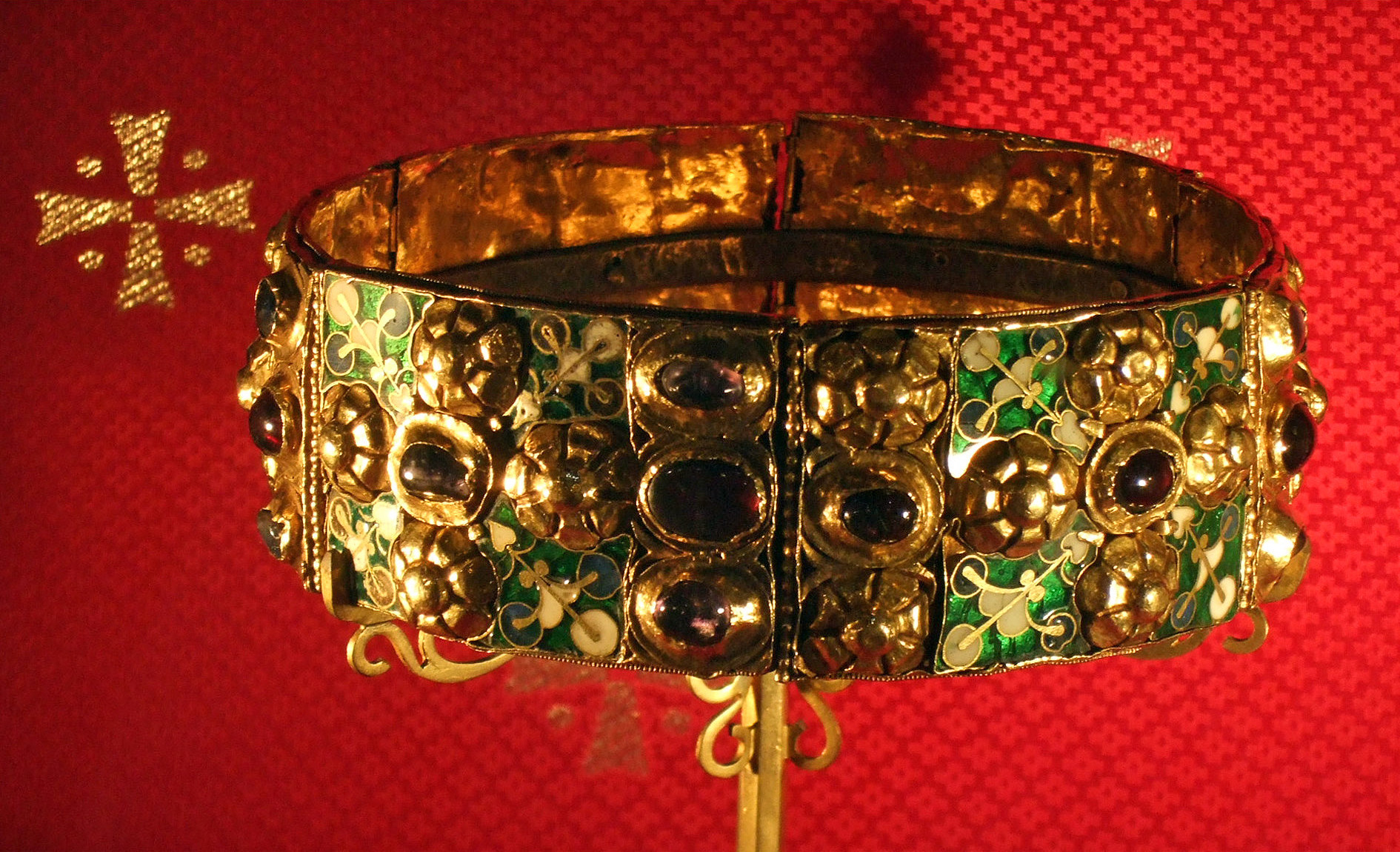
Our picture today is the Iron Crown of the Lombards, which is said to be made of the nails of Christ's cross (the inner band, that is).
American "thinkers" are finally catching up to de Tocqueville - I guess over 150 years is just enough time? Our "perverse yearning for equality" is starting to turn heads, even American ones, at what we've become - a gigantic dysfunctional corporation. Hate your work milieu? Want some time alone to yourself? Well, pretty soon, your work environment will grow to include all civic discourse (which, as Marx taught us, is nothing but economics writ large). Don't worry, "progressives" (name change after "liberal" became a dirty word, thanks to homeward bound roosting chickens) advocate the annihilation of all "intermediate institutions". After all, the reign of the atomized individual (with his sacramental rights to participate in modern dark Satanic rituals, such as after conception "contraception") is more important than anything else, especially benighted religious flim-flam.
Do you still think that Democracy means freedom? Many, maybe most, do. "Think" is the wrong word here. I think it's not so much a "point of view" (let alone a belief or a philosophy) as a reflexive "mindset". Now introducing Bernays & Lippman, two men of impeccable liberal-democratic credentials (and all benefits accruing thereunto) who most emphatically thought that You, the sovereign subject, were anything BUT free.
Here is the alternative, and there is really only one alternative (and not the "halfway house" of "Republicanism" either, although it is always conveniently forgotten that even Thomas Jefferson believed a natural aristoi):
"I reject republicanism. At the head of races, above the elite, there isHere is an account of the martyrdom of Charles II:
Monarchy. Not all monarchs have been good. Monarchy, however, has always been
good. The individual monarch must not be confused with the institution of
Monarchy, the conclusions drawn from this would be false. There can be bad
priests, but this does not mean that we can draw the conclusion that the Church
must be ended and God stoned to death. There are certainly weak or bad monarchs,
but we cannot renounce Monarchy. The race has a line of life. A monarch is great
and good, when he stays on this line ; he is petty and bad, to the extent that
he moves away from this racial line of life or he opposes it. There are many
lines by which a monarch can be tempted. He must set them all aside and follow
the line of the race. Here is the law of Monarchy.” - Codreanu
Now, "race" here must mean something more than pure genetics, after all
Codreanu was half-German, not full blooded Romanian. What Codreanu is defending
is the idea (and ideal) of self-government as expressed through familial ties,
personal loyalties, and cultural "lines of force". All of which find logical
expression in Kingship (one could go on to talk of the King of Kings, or the
Empire, but now we are concerned with the "shields of the earth").
Far from being an upright quest for justice, the trial of King Charles is seenIn other words, the King was made a scapegoat for usurpers who had a radical base to appease. Sound familiar? It should - this always happens in Democracies. Yet many Christians believe that we make an idol of the "king", a teaky-wood god which we crave for vanity and because of our desire to vicariously live out life as an "alpha-male". This suspicion is deep-rooted in Christianity, particularly in the West:
by many as perhaps the greatest act of deceit in British history. Author C.V.
Wedgwood wrote that, “Cromwell’s faction was determined to kill the King mainly
because this symbolic act of revolution would satisfy discontents that might
otherwise be directed toward the more fundamental and more farsighted
constitutional changes sought by Lilburne’s Levellers”.Nevertheless, just or
not, King Charles I was taken before what was left of Parliament to stand trial
for his actions.To say that such an act was unprecedented is a vast
understatement. The King was accused of making war against Parliament, not the
actual nation, and no effort was made to show how this “Rump” (which had been
purged by military force) was a true representation of the English people.
Realizing this, His Majesty protested that this left his accusers with no legal
right to judge him saying, “you never asked the question of the tenth man in the
kingdom, and in this way you manifestly wrong even the poorest ploughman, if you
demand not his free consent”.
SourceNo doubt, it is possible to overdo things and to worship the Encolpion instead of the relic inside it or the transcendent reality beyond it. It is also possible to forget (in a secular world) that man was made for worship, that he must worship, and that if he cannot have his king, a dark father figure will come in by the back door as the real Father is ejected out the front.
"According to St. Jerome, however (in Matt., c. xxiii), some of the faithful in his day attached a superstitious importance to these aids to piety; he censures certain classes of women who seem to have, in some degree, identified sanctity with an exaggerated veneration for sacred relics: "Hoc quod apud nos superstitiosae mulierculae in parvulis evangeliis et in crucis ligno et istiusmodi rebus, quae habent quidem zelum Dei, sed non secundum scientiam, factitant" (That which superstitious women amongst us, who have a certain zeal for God but not of right knowledge, do in regard to little copies of the Gospels, the wood of the cross, and things of that kind)...."
Forthcoming posts will deal more directly with these objections, and others (such as the idea that human nature is basically evil, and cannot be trusted with "absolute power").
For now, we simply note that America is descending into a "soft totalitarianism".
More arguments in favor of monarchy.
Here is Kaiser Wilhelm's opinion of Hitler. It must not be forgotten that the monarchies presided over the suicide of Europe, but that the republican elements (nationalism) and the new mass democracies were even more enthusiastically in support of it than they were (the monarchies were all "kindred"), and in fact, in many instances, pushed their thrones into war as a pawn.
Here is an excerpt from a 1938 interview of Kaiser Willhelm II Ken magazine. In
this interview Kaiser Willhelm II expresses a very harsh opinion of then German
leader, Adolf Hitler. Kaiser WIllhelm II was known to have a strong
disliking of Adolf Hitler and the National Socialist movement in general. However some modern historians try to convince us that he was a staunch National Socialist sympathizer. However as you can read his own words, you can see that nothing is farther from the truth. Here is what Kaiser Willhelm II had to say about Hitler and the National Socialist movement.
“There is a man alone, without family, without children, without God....He builds legions but he doesn’t build a nation. A nation is created by families, a religion, tradition: it is made up out of the hearts of mothers, the wisdom of fathers, the joy and the exuberance of children. [Of Germany under Hitler he says]....an
all-swallowing State, disdainful of human dignities and the ancient structure of
our race, sets itself up in place of everything else. And the man who, alone,
incorporates in himself this whole State, has neither a God to honour nor a
dynasty to conserve, nor a past to consult....
For a few months I was inclined to believe in National Socialism. I thought of it as a necessary fever. And I was gratified to see that there were, associated with it for a
time, some of the wisest and most outstanding Germans. But these, one by one, he
has got rid of or even killed....He has left nothing but a bunch of shirted
gangsters....
This man could bring home victories to our people each
year without bringing them...glory....But of our Germany, which was a nation of
poets and musicians and artists and soldiers, he has made a nation of hysterics
and hermits, engulfed in a mob and led by a thousand liars or fanatics....”
How ironic that the Catholic Church chose to move against monarchism within
its spiritual organization exactly as the outer world tired of liberalism
and bourgeoise!
Certainly Vatican II was also a Council of protest and contradiction, so to speak, a reaction of the liberal Church against the remnants of feudalism and monarchy inside the Church. Hence, the emphasis on collegiality in the government of the Church. Only by means of this Council did the Church officially accept the great conquests of the French Revolution and the liberation of the bourgeoisie: tolerance, liberty of religion and conscience, ecumenical openness, etc.However, the irony of History, she did so just when society was prepared to criticize the new forms of slavery produced by the liberal bourgeoisie.
Also ironic - continued arguments as to why American hegemony is a good thing take a monarchical turn: There Can Be Only One!
But why should this be? Unless, indeed, Monarchy is the actual pattern of real Nature? Sovereignty itself is derived from the unifying principle of monarchy.
Subscribe to:
Posts (Atom)