

Dedicated to the red and the white rose, to the eyes and the flame, to a more perfect unity... You can reach me @ cathasach71854@gmail.com
Wednesday, October 6, 2010


Monday, October 4, 2010
Meditations on Fascism


More on Fascism.
"I knew no more about Spanish politics and history than most of my fellow-countrymen, that is to say, not much. I had read (in translation) much (but not all) of Don Quixote, and seen reproductions of the great paintings of Velázquez and Goya. I knew that Philip II had married an English reigning Queen -- Mary -- and on her death claimed the throne of England, but had been defeated when in 1588 he sent the great Armada to invade England and enforce his claim. I knew that the Duke of Wellington had fought a long, hard campaign against Napoleonic armies in Portugal and Spain and that guerrilla (which was to become my military specialty in World War II) was a Spanish word. But I had no real understanding of the complicated situation that had produced the military revolt of July 1936. What I did know was that Franco had the full support of Hitler and Mussolini. In fact, that support had been decisive at the beginning of the war. The military coup had failed in Madrid and Barcelona, Spain's principal cities. Franco's best troops, the Foreign Legion and the Regulares, the Moorish mercenaries recruited to fight against their own people, were cooped up in Morocco, since the Spanish Navy had declared for the Republic. Planes and pilots from the Luftwaffe and the Italian Air Force, in the first military airlift in history, had flown some 8,000 troops across to Sevilla, Franco's base for the advance on Madrid"
This from one of the most educated Americans of his time...but then again, Americans have made a career from being oblivious to the oldest cultures of the world, particularly if they are antique European ones that are part of old Christendom's body. After all, what else do you need to know than that Franco "had the full support" of Hitler? This phrase reeks of American politics and political posturing. Franco, in fact, irritated Hitler so much that he once stated he would rather have his teeth pulled than another conference with Generalissimo. As for the Tercio, the Rif War was probably even more outside Knox's expertise...Knox conveniently forgets to mention the Soviet advisors operating upon the other side of the line...advisors who came with "materialle". To Knox, he knew what he needed to know. Which wasn't much.
Bernard Knox is, in fact, oblivious to the insensitivity of forming part of an International Army which volunteered to come & conquer Spain. Now, granted, he was fighting for a universalist ideal, but it seems strange for a liberal to overlook this fact when discussing (or romanticizing) about War and their own past participation in it. Imagine what that would look like today, in America, as an experiment....
Contrast this with the martyrial attitude and religious spirit that existed in the "Fascist" ranks of Spain. One place to examine what it means to be Fascist is the Spanish Civil War, given that the operating definition of that term seems to have been formed (among the intelligentsia) in that theatre. To be Fascist, ultimately, was to be opposed to the progress of the Republic and the international "world community". Who wouldn't want Abraham Lincoln Brigades to come and help save them from their own Nationalists?
If nothing else, I know that the Spanish Civil War was more complex than this. (And you can, as well. Read Jose Maria Gironella, if nothing else). Therefore (ergo, if the dataset is more complex than admitted) so is the term "Fascist". To Bernard Knox (GRHS!) there was no such thing as a "premature anti-Fascist", because, as we would do well to remember, Progress never sleeps nor slumbers. It is impossible to jump the gun here, and prudentials have no consideration. What do the Proverbs mean anyway? Wisdom? Knowledge? No. There is only Progress. And those who resist are "Fascists". Liberals have no other word for those they hate as "Fascists" because there simply isn't substitute for the word "evil". You don't say "bad" or "not-good". You can say, partly-evil, or mostly-evil, as in mostly-Fascist or semi-Fascist. But you cannot get rid of the term, because it is a primary signifier. What would you replace it with? And what gradations would you admit from its elementary vileness? Any government that is authoritarian + Right Wing = Fascist.
This is how the term "means" to me.
"I knew no more about Spanish politics and history than most of my fellow-countrymen, that is to say, not much. I had read (in translation) much (but not all) of Don Quixote, and seen reproductions of the great paintings of Velázquez and Goya. I knew that Philip II had married an English reigning Queen -- Mary -- and on her death claimed the throne of England, but had been defeated when in 1588 he sent the great Armada to invade England and enforce his claim. I knew that the Duke of Wellington had fought a long, hard campaign against Napoleonic armies in Portugal and Spain and that guerrilla (which was to become my military specialty in World War II) was a Spanish word. But I had no real understanding of the complicated situation that had produced the military revolt of July 1936. What I did know was that Franco had the full support of Hitler and Mussolini. In fact, that support had been decisive at the beginning of the war. The military coup had failed in Madrid and Barcelona, Spain's principal cities. Franco's best troops, the Foreign Legion and the Regulares, the Moorish mercenaries recruited to fight against their own people, were cooped up in Morocco, since the Spanish Navy had declared for the Republic. Planes and pilots from the Luftwaffe and the Italian Air Force, in the first military airlift in history, had flown some 8,000 troops across to Sevilla, Franco's base for the advance on Madrid"
This from one of the most educated Americans of his time...but then again, Americans have made a career from being oblivious to the oldest cultures of the world, particularly if they are antique European ones that are part of old Christendom's body. After all, what else do you need to know than that Franco "had the full support" of Hitler? This phrase reeks of American politics and political posturing. Franco, in fact, irritated Hitler so much that he once stated he would rather have his teeth pulled than another conference with Generalissimo. As for the Tercio, the Rif War was probably even more outside Knox's expertise...Knox conveniently forgets to mention the Soviet advisors operating upon the other side of the line...advisors who came with "materialle". To Knox, he knew what he needed to know. Which wasn't much.
Constrast this with the chivalric and martial spirit operating on the Nationalist side:
"
During the Spanish Civil War, Colonel José Moscardó Ituarte held the building against overwhelming Spanish Republican forces in the Siege of the Alcázar. The incident became a central piece of Spanish Nationalist lore, especially the story of Moscardó's son Luis. The Republicans took 16-year old Luis hostage, and demanded that the Alcázar be surrendered or they would kill him. Luis told his father, "Surrender or they will shoot me." His father replied, "Then commend your soul to God, shout 'Viva Cristo Rey' and die like a hero."[1] Moscardó refused to surrender. Contemporary reports indicated that the republicans then executed Moscardó's son. Other historians have reported that Luis was not in fact shot until a month later "in reprisal for an air raid".[2] The dramatic story also camouflages the fact that the fate of a number of male hostages, mainly from the Guardia Civil, taken into the Alcázar at the beginning of the siege is unclear. Some sources say the men "were never heard of again".[3]"Bernard Knox is, in fact, oblivious to the insensitivity of forming part of an International Army which volunteered to come & conquer Spain. Now, granted, he was fighting for a universalist ideal, but it seems strange for a liberal to overlook this fact when discussing (or romanticizing) about War and their own past participation in it. Imagine what that would look like today, in America, as an experiment....
Contrast this with the martyrial attitude and religious spirit that existed in the "Fascist" ranks of Spain. One place to examine what it means to be Fascist is the Spanish Civil War, given that the operating definition of that term seems to have been formed (among the intelligentsia) in that theatre. To be Fascist, ultimately, was to be opposed to the progress of the Republic and the international "world community". Who wouldn't want Abraham Lincoln Brigades to come and help save them from their own Nationalists?
If nothing else, I know that the Spanish Civil War was more complex than this. (And you can, as well. Read Jose Maria Gironella, if nothing else). Therefore (ergo, if the dataset is more complex than admitted) so is the term "Fascist". To Bernard Knox (GRHS!) there was no such thing as a "premature anti-Fascist", because, as we would do well to remember, Progress never sleeps nor slumbers. It is impossible to jump the gun here, and prudentials have no consideration. What do the Proverbs mean anyway? Wisdom? Knowledge? No. There is only Progress. And those who resist are "Fascists". Liberals have no other word for those they hate as "Fascists" because there simply isn't substitute for the word "evil". You don't say "bad" or "not-good". You can say, partly-evil, or mostly-evil, as in mostly-Fascist or semi-Fascist. But you cannot get rid of the term, because it is a primary signifier. What would you replace it with? And what gradations would you admit from its elementary vileness? Any government that is authoritarian + Right Wing = Fascist.
This is how the term "means" to me.
Sunday, October 3, 2010
drákôn pyrròs mégas
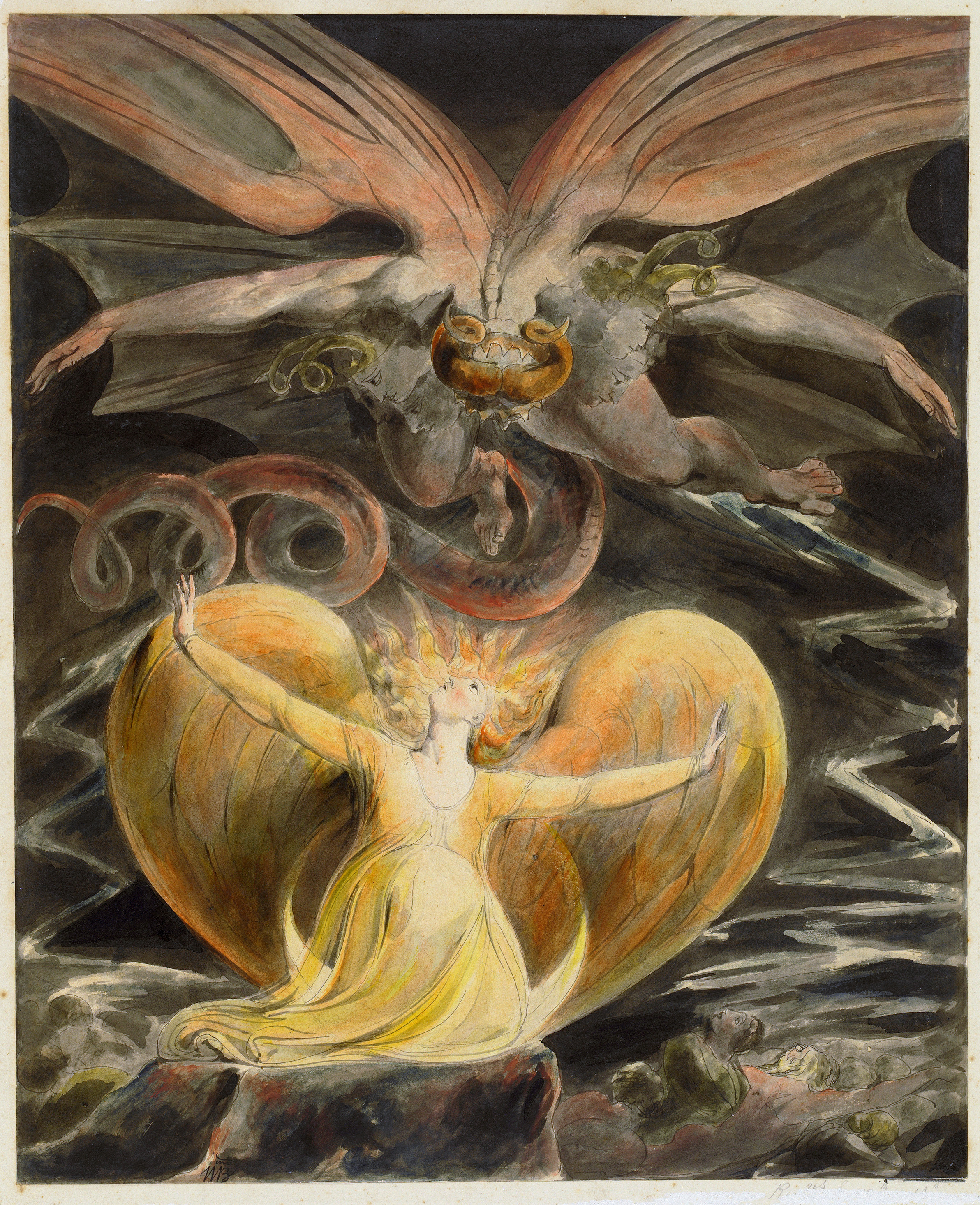
The Dragon can appear either as a serpent (when ruling by subtlety and disguise) or as the Dragon himself, when his power is rampant. Lately, he is underground. This is far more effective than openly showing his fangs.
Saturday, October 2, 2010
Wendell Berry

I've been meaning to do a review of Wendell Berry.
As I dig deeper into my Christian patrimony which I have inherited (and have yet to make utterly, entirely my own, though the heart which has once loved, never forgets), I keep coming up against certain contours that endure. In addition to a skepticism over Aquinas (due to his intellectualization of Christian faith) and all other systematic thinkers (including Calvin), I often find myself drawn towards Southern Agrarianism. No modern thinker embodies this tradition better than Berry.
I also have an affinity for Eastern Orthodoxy, which likely stems from their large measure of freedom from "white guilt", a leftover Puritan hangup that has been secularized until it largely means attacking one's political opponents and loving one's non-neighbors so that they don't come kill you and take all you have. Puritan theology emphasized sin so heavily that it was inevitable that this took a toll on the Western ego. In Orthodox theology, sin is emphasized, but not at the expense of free will or the good impulses of man. Although they join with us in praying that ALL elements of our nature would die and be resurrected (good & bad, in different forms and ways), they insist with Saint John Cassian that man's freewill and original nature is still "good". Man is fallen in his integration with himself and his assimilation with God, but this doesn't make him a "pile of dung" in every respect, except when held up against the immediate presence of God in an arrogant way. Orthodox Christians still have ethnic/national churches, and aren't ashamed of being "Serbian" or "sons of Japeth". In fact, they count it a means of grace, which indeed it is.
In our modern hyper-Protestant world of unitarian/universalist secularism (degraded DNA from rationalistic Puritans), both white nature and natural Nature (green Nature) are subjects of manipulation, contempt & control. Creation is not "good" until it has been landscaped and divided into suburbs, preferably integrated and multicultural ones. There is no such thing as a "happy union" of Luck, Nature & pious Man living on the land. Thus, there can be no "American" identity. Identity is what we make it, which is largely a matter of channeling or co-ordinating the ferment of the rainbowed Masses with the lever-pulling of politically correct bureaucrats. These Satanic operators of the "dark Satanic mills" (the machine of Science & Empire) make sure that both man and Nature are plasticized and rendered inert to the operations of CenterCom, which emanates from charismatic elites able to surf the rising Chaos. Thus, the "heartland" shrinks every year under the hammer and the anvil.
Wendell Berry is opposed to all of this, although he wouldn't put it in such a way (he says it even better):
"Despite its protests to the contrary, modern Christianity has become willy-nilly the religion of the state and the economic status quo. Because it has been so exclusively dedicated to incanting anemic souls into heaven, it has, by a kind of ignorance, been made the tool of much earthly villainy. It has, for the most part, stood silently by, while a predatory economy has ravaged the world, destroyed its natural beauty and health, divided and plundered its human communities and households. It has flown the flag and chanted the slogans of empire. It has assumed with the economists that "economic forces" automatically work for good, and has assumed with the industrialists and militarists that technology determines history. It has assumed with almost everybody that "progress" is good, that it is good to be modern and up with the times. It has admired Caesar and comforted him in his depredations and defaults. But in its de facto alliance with Caesar, Christianity connives directly in the murder of Creation. For, in these days, Caesar is no longer a mere destroyer of armies, cities, and nations. He is a contradictor of the fundamental miracle of life. A part of the normal practice of his power is his willingness to destroy the world. He prays, he says, and churches everywhere compliantly pray with him. But he is praying to a God whose works he is prepared at any moment to destroy. What could be more wicked than that, or more mad?"
What has Christ to do with the dark Satanic mills?

"Perfection/imperfection aren't complementary, either. Rather, imperfection is again a deprivation, a declension from the Absolute, as the celestial rays proceed from the vertical cosmic center to the periphery, which, as Schuon has written, "tends" toward a nothing that can never actually be realized. But the hardcore leftist feels a sort of frisson in riding the winds of the ray of creation all the way into the darkness of nihilism. The thrill of the fall, so to speak."
Schuon channeled via OneCosmos.
Incidentally, lately I've been contemplating the relationship between NeoPlatonism and Christianity. This is partly because Radical Orthodoxy has re-opened an old debate over Platonism, partly because theologians like Clark Pinnock (The Openness of God/I'm too good for classical Christianity) and others are busy running around complaining about the "static-ness" of Western Christianity (and advocating Loving God Through Eternal Change), and partly because Saint Paul himself endorses or rejects cultural forms/philosophies in Scripture. Being a Southron by birth, genetics, Fate & choice, NeoPlatonism is dangerous territory. We tend to think in terms of concrete materiality & personalities, and NeoPlatonism is a little, shall we say, over-refined?
One thing all the literature agrees upon is that Christianity irrevocably changed Platonism when it insisted upon creation ex nihilo. Things, however, often mingle and change each other in both directions. Hegel, for instance, managed to mingle classical mores with Christianity, and end up with neither.
However, even though Credenda Agenda itself went on the offensive against NeoPlatonism, and you can read a seriously informed response here. Now, whenever someone really gets up in arms against something, I get interested, and am generally either "all on board" or begin looking for holes.
Neo-Platonism, as far as I can tell, represented a Western version of an esoteric Eastern doctrine, and as such, is a counter balance to the discrete, material, juridical, and dialectical thought-forms that most "Western" thought tends to adopt without even knowing it. Westerners are always "hung up" over some distinction which they can't counter-balance. Over time, this leads to bad things. Liberals, for instance, are so obsessed with individuality, that they have effectively replicated themselves in weaker form over and over and ended up denying the very thing they wished to save. "We had to destroy the village in order to save it".
In this context, nothing says obsession, permanence, and thought-meme more than insisting ad nauseam that all of Western Christianity is obsessed with Plato and needs to adopt an "Eternal Change is Good, Just Love God" intellectual posture. Is anything more permanent than Eternal Change? Is anything more constraining to an individual than a world in which he/she is reduced to being a disembodied "atom", with no "intermediary" institutions (R. Nisbet) between himself and the infinitely progressive-State? Is anything more despotic than the feel-good sorcery-State that doesn't rule, but merely "moulds and controls", down to the last atom of society?
The answers to these questions are obvious when they are asked, at least obvious to those who believe some Life should exist forever outside the purview of the State. Europe, the home of Christianity's union with both classical culture & the Teutonic tribes, once was a bulwark or guardian against both disembodied Christianity (such as Peter Rollins seems to advocate) as well as infinite States. Time and time again, within "culture" and its own soul, the Church of Europe found the resources to reject the likes of Hobbes, Machiavelli, or the Cynics of Rome (St. Paul credit for this one).
NeoPlatonism may represent a means to an end which is worth keeping, perhaps a form which can assist/aid the thought of Western man in his effort to "feel (back) after God, if happily he might find Him". The nihilistic winter of mechanized global super-states will get rather cold. It seems a shame to throw out Father's old coat. Perhaps we might borrow a page from Sartor Resartus and re-tailor the thing.
We will need all the help we can get. If nothing else, Platonism is the hope that we are not doomed to immersement in matter, left without intimations of the Good or intimations of deprival.
From the great Don Colacho:
#1,968
"Individualism is not the antithesis of totalitarianism but a condition of it.
Totalitarianism and hierarchy, on the other hand, are terminal positions of contrary movements."
Escolios a un Texto Implícito: Selección, p. 321
Totalitarianism and hierarchy, on the other hand, are terminal positions of contrary movements."
Escolios a un Texto Implícito: Selección, p. 321
A Poem for the Moderns
"I am God. There is not God. And thus I compete with Him.
The life is this, that I also wish, and thus I come not hither.
I write because I like, I like what I write, and I find more fools to battle.
They that would rage, against me in spaces, together we'd meet in the middle.
I muck in the dirt, I find new worth, the old and the specter of time,
And under the dirt, is the greatest of worth - the death and the life of the father.
He fought and he won, then birthed him new sons, by putting his seed in the mother.
We are impressed, and lest we regress, so strive we forward together.
Our science's decree, also climatology, is the age of peace we've ushered,
No more children may come, but evolution has run, holding hands evolve we no longer.
Humanists all, for history's fault, is to have us strike at each other.
And when we address, problems in Congress, then make we war no longer.
The world today is a much better place, a much better place I tell you.
Then when we were then, in those myth-filled places when the old gods ruled over.
With His wicked decrees, His mind-bending fees, His lies and myths ruled together.
So walk we no more on old Eden's floor, until out of Silicon and Steel we rend her."
Joel Dietz
Friday, October 1, 2010
Soft Totalitarianism

For some time, I have thought this myself-
"Most of ‘apocalyptic’ literature, warning us of the dangers of totalitarianism, such as Huxley’s Brave New World, Orwell’s 1984, and Bradbury’s Fahrenheit 451, warn us of a fascist government (Orwell’s Animal Farm of course warns us of socialist totalitarianism). But whether the authors warn us of a communist or fascist dictatorship, they all perceive totalitarian societies as based on non-subtle (overt?), masculine force. They all have failed to envision a totalitarian society that was subtle, seductive, and feminine. The most successful totalitarian government in history has been the United States. Using feminine coercion rather than masculine, the U.S. has accomplished much more than Hitler, Stalin, Mussolini or any other 2-bit dictator ever hoped to accomplish.
In Fahrenheit 451, my favorite of the apocalyptic novels, Bradbury correctly notes that a totalitarian government must, if it is to maintain itself, kill history. There must be no historical consciousness; there must only be the reigning government, which has always been, and always will be, world without end. In Bradbury’s novel, the government kills history by burning all books from the past."
Just yesterday, I read in my nursing book that "results of progress may cause old ways of thinking to not apply anymore". The question here is not, what is ideology doing in a nursing book, but what kind of ideology has succeeded in making itself its own rationale? If Progress makes everything "not work anymore", then OBVIOUSLY we need more Progress. My boss the other day opined that America would not "go down the drain" but that we just needed more "creativity". I am sure everything will be fine.
Here is a liberal definition of fascism:
"Robert O. Paxton, a professor emeritus at Columbia University, defines fascism in his book The Anatomy of Fascism as: "A form of political behavior marked by obsessive preoccupation with community decline, humiliation or victimhood and by compensatory cults of unity, energy and purity, in which a mass-based party of committed nationalist militants, working in uneasy but effective collaboration with traditional elites, abandons democratic liberties and pursues with redemptive violence and without ethical or legal restraints goals of internal cleansing and external expansion."
But this definition fits La Raza quite as well as the smeared Tea Party. It also fits the NAACP.
Chris Hedges nails it. Liberal policies have CREATED a pre-fascist, as well as a proto-fascist, polity in America:
“It is time for us to stop talking about right and left,” McKinney told me. “The old political paradigm that serves the interests of the people who put us in this predicament will not be the paradigm that gets us out of this. I am a child of the South. Janet Napolitano tells me I need to be afraid of people who are labeled white supremacists but I was raised around white supremacists. I am not afraid of white supremacists. I am concerned about my own government. The Patriot Act did not come from the white supremacists, it came from the White House and Congress. Citizens United did not come from white supremacists, it came from the Supreme Court. Our problem is a problem of governance. I am willing to reach across traditional barriers that have been skillfully constructed by people who benefit from the way the system is organized.”
This is perfectly correct. And in fact, the relationship between Liberalism and Communism is far more complicated than this (given that National Socialism and International Socialism can be related as well):
"Moreover, this social mismatch has been entirely rectified. What the bohemians of Greenwich Village believed in 1923, everyone in America (and the world) believes now. The beliefs of an ordinary Calvin Coolidge voter would strike the ordinary John McCain voter as outlandish, ridiculous, insane, and often downright evil. America has no surviving intellectual tradition besides progressivism - which is no more than a synonym for communism. (My own grandparents, lifelong CPUSA members, used "progressive" as a codeword all their lives.) Communism is as American as apple pie, and America today is a completely communist country. As Garet Garett put it 70 years ago, the revolution was."
As Moldbug notes, the relationship between Liberalism & Communism is, well, "complicated".
It is not only complicated by Empire and Imperial politics, as well as such things as the results of the Civil War, it is complicated by religion & class divisions, as well as the money market situations (in which some Americans have a very vested interest, and are getting richer than anyone in history).
What seems fairly clear is that "Fascism" is a definition that everyone agrees is "bad", but almost no one agrees upon. This of course doesn't mean that general contours aren't there, or that some counters/markers can be identified with some safety. However, once a definition is agreed upon, MANY different polities or groups can fit the label. American business, for instance, is largely operative at the behest or at the service of government. Wall Street and Beltway have a CLOSE relationship. Is this not "corporate fascism"?
Another complicating factor is American transcendence over ethnic/cultural norms. When a race with a homogeneous culture constitutes a base, it can potentially "go" fascist (as Serbia did with Milosevic, who was "socialist"), but it is also a potential barrier or bar to Imperial/Global Fascism on the scale displayed in the post Berlin Wall era. Putin-era Russia, therefore, is both proto-fascist on an internal level, but is a barrier to global fascism in the external sphere. And proto-fascist formal polities can often prevent a "pre-fascist" mentality from blossoming among the "volk", a situation which we can only envy in America, where liberal over-kill and looting of the state for the benefit of the elites and a "new people" have effectively created a "learned fascism" among heartland peoples. Franco, for instance, managed to have the forms of fascism, without the power thereof, and in so doing kept Spain from radicalism of the Right or Left.
It's complicated. Basically, what we have in America is a situation of control flowing from the bureaucratic elites downward, channeled into the ferment of the progressive masses. These masses are directed by forms of political correctness into the proper channels, and the religion of democracy guides the rituals and forms in the upper crust, while providing the "bread and circus" faith from below in the masses. The engines of Science & Empire function to keep the brew fermenting, but more and more raw material (read "colored people") are being thrown into the crush. They, too, will be assimilated, and the product thereof may be a mixed race/culture with all of the worst characteristics of the donors. Like decaying DNA, our polity seems to suffer a degrading with each generation, both intellectually and morally. And in our case, the original blueprints are up for questioning as well. Were the Founding Fathers really wise to create a "proposition" nation? If so, have we done well in the battle to keep it?
Our current America is a giant corporation, with the CEO as president. The dollar is stock. And the shareholders are squabbling ferociously. Arguably, this is a pre-fascistic situation, with proto-fascistic forms already in place to guide us. To what & where?
Anyone for "Red Tory" tea?
Conservatives worth their salt should concentrate on creating the alternative base (whatever it costs, whatever it entails) that will preserve the country in the coming Winter.
Subscribe to:
Posts (Atom)